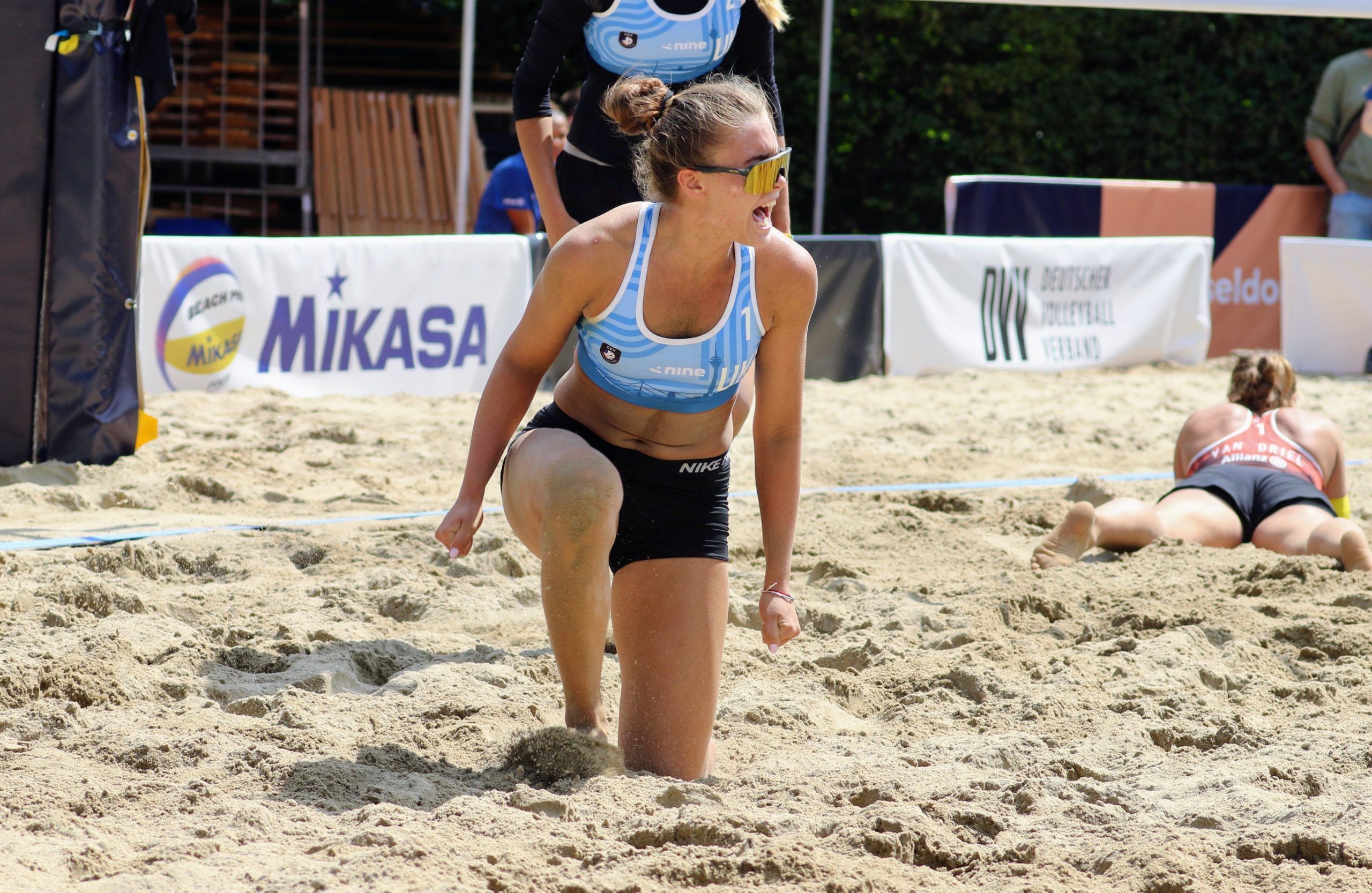
Yeva Serdiuk learned to play volleyball in Ukraine, sunny summer days spent on the Black Sea beaches around Odesa. She forged friendships in Ukraine, as often as not with people whose paths she crossed because of the sport she played. She grew up and grew into herself in Ukraine, as a sport that once frustrated her provided purpose and possibilities.
So, instead of joining her family elsewhere in Europe or pursuing studies only recently begun in the United States, she returned home after Russia’s illegal full-scale invasion on Feb. 24. 2022. And even as Russia terrorizes and kills a sovereign country’s civilian population on a nightly and increasingly daily basis, she remains in Ukraine. She endures sleepless nights amid explosions in Kyiv, where she now lives and trains, and marathon travel to tournaments. She experiences the instinctual fight-or-flight response to the sound of drones above a practice facility or a train in the middle of nowhere. She seeks shelter when sirens sound. Then she goes back to the task at hand, whatever it may be.
For nearly five years, longer in parts of the country, that has come with life in Ukraine. Sometimes foregrounded, other times backgrounded, the existential crisis is always present. But time didn’t stop on that February night in 2022. Even as tragedy abounds, life endures in all its complexity. People walk dogs and go to cafes. They get married, pay bills, earn promotions and celebrate milestones. Athletes grow and pursue their goals.
During those five years, Serdiuk and longtime partner Daria Romaniuk won the 2022 FIVB U19 World Championships. They won back-to-back Beach Pro Tour Futures events in 2024. They added another Futures title and gold in the U22 European Championships in 2025.
This year, despite a tight travel budget, they outperformed their seed in almost every event they entered. The results included a ninth-place finish after a knockout win against the Vergé-Dépré sisters in the European Championships and a berth in the Hamburg Elite 16 main draw, where they pushed Thamela and Victoria and Muller and Tillmann to three sets. Alongside Anhelina Khmil and Valentina Davidova, they helped first Ukraine and then Kyiv’s Sunrise Beach Sports win the CEV Nations Cup and European Cup, respectively.
“She’s just a girl on fire,” Khmil said of Serdiuk. “She’s really passionate about what she does, and right now she’s really passionate about beach volleyball. She’s a really strong girl. It’s so easy to talk to her, so easy to be friends with her. I mean, I’d love to be half the human she is.”
Serdiuk had played only a handful of international youth events at time of the full-scale invasion, scarcely a month after her 18th birthday. Now almost 23 years old and ascending toward the top 25 in the world, the 2027 FIVB World Championships and 2028 Olympics feel within her reach. It’s why she came home. Even amid what can feel like a waking nightmare, Ukraine is where she first dreamed. And in the sand, those dreams endure, undimmed and unbowed.
“I think when I’m playing I’m a different person,” Serdiuk said. “I can express all my emotions—screaming and cheering for my partner. I really feel free when I am on the court. I think it’s my happy place. I can forget about all my problems and everything that is going on in the country. I am just enjoying what I’m doing right now.
“When I’m on the court, I’m just happy.”
A Volleyball Life Shaped in Ukraine
Serdiuk didn’t choose beach volleyball as much as it chose her, in the form of a coach who visited her elementary school one day and informed one of the taller girls in the class that she was now a volleyball player. The new recruit was a bit apprehensive. Still, running around on the beach all day, with a free lunch thrown in for good measure, sounded fine.
But as anyone who watches her play today will surely recognize, Serdiuk has a hardheaded streak. At first, she couldn’t get the hang of serving. No matter what she tried, the ball wouldn’t go over the net. Frustrated, she just stopped going to the practices. Volleyball, she decided, wasn’t for her. Then the coach started calling her mom. She was doing fine, the coach said. Would she come back? With some cajoling, the newcomer agreed.
“And after what seemed like three years, my first serve went over the net,” Serdiuk joked. “And then I was going to volleyball every day between school.”
At 16, playing with a partner three years her senior, she won a bronze medal in the 2020 U20 European Championships in Brno, Czech Republic (perhaps as remarkably, they also reached the semifinals of the U22 European Championships a few weeks later). A lot of tournaments have come and gone since then. A lot of life has come and gone. But she vividly remembers how proud her dad sounded when she spoke with him after Brno—her parents had cheered themselves hoarse watching the online stream from Ukraine.
Until that point, volleyball wasn’t much more than a hobby. Playing was fun. Winning was even more fun. But it couldn’t really take her anywhere in life, could it? Suddenly, it could, literally and figuratively. Her success in European junior events attracted interest from across the Atlantic Ocean. She jumped at the first offer she received, from the State College of Florida, not knowing much about the American system or the difference between junior colleges and NCAA Division I. As a freshman, she helped SCF win the AVCA national title for two-year colleges and earned All-America honors.
She was grateful for the opportunity in the United States, but the training environment and competition at the junior college level weren’t entirely what she envisioned. As the first anniversary of the invasion came and went, she knew she wanted to return to Ukraine.
“I knew I already had my partner here, and that if we continue to play together, something good can happen,” Serdiuk said of Romaniuk. “We’ve played together since we were 9 years old, it’s a long time. Our club in Kyiv, all the Ukrainian national team is practicing here, so I knew that I’m going to be in good hands. I have a place to live. I have my partner. So I know that everything is going to OK.”
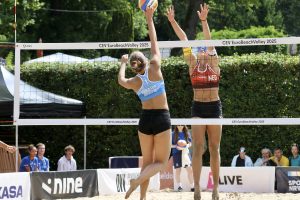
Serdiuk vs. Netherlands in the 2025 European Championships (photo by Graham Hays)
Returning to a Home Forever Changed
She was in Florida when the full-scale invasion started at home. She remembers hearing the news begin to circulate. Surely, she reasoned, it would be a limited action. At most, a few weeks of bluster and provocation. She called her mom in Chornomorsk, her hometown just south of Odesa, and was briefly reassured to hear that all was quiet in that part of the country. Within a few hours, the missiles started landing.
“I didn’t go to my classes in the first days because I didn’t know what to do, how to react,” Serdiuk said. “It’s really almost harder to be abroad while everything happened here.”
Serdiuk’s older sister and brother-in-law already lived in Italy by then. Her dad joined them shortly before the full-scale invasion, and her mom followed within days of the first missiles hitting Odesa. Serdiuk initially joined them after leaving Florida, but from almost the moment she arrived and in the face of their collective protests, she didn’t intend to stay. She wanted to see her friends and return to training in an environment she knew. She wanted to go home. That’s where her life was.
The return trip itself was a shock to the system. Commercial flights in and out of Ukraine had long since ceased. Traveling by bus or train, most often via Poland or Moldova, was the only option. Instead of a relatively quick direct flight from somewhere like Milan or Rome to Kyiv, it took her nearly 24 hours to cross the border and complete the journey.
Once jarring, that has become insidiously normal. And it’s getting worse, as Russia targets civilians with more and more depravity. In late October, a Russian attack killed 14 people waiting on a train platform in Dnipro. According to The Counteroffensive, Russia has damaged 550 locomotives since 2022, including 335 just this year. Not long ago, Serdiuk traveled by train to the Polish border, on her way to visit her family abroad. As her train passed through the endless forests outside Kyiv, passengers suddenly had to evacuate when two drones approached. She wasn’t sure if she felt any safer out in the open, exposed. She was sure she was done with trains.
At home in Kyiv, as Khmil shared in a viral social media post this fall, practices, too, can come to an abrupt halt amid a scramble to take shelter. Now, as winter approaches, practices have moved indoors. Serdiuk feels better with a roof over her head, the noise of any explosions and air defense at least muffled, even if reality is little safer.
“It’s still a weird feeling when you watch a missile explode somewhere near, and then we go straight back to practice,” Serdiuk said. “It’s hard to explain to someone who hasn’t experienced it. You have to go through it. But of course, I don’t wish for anyone to go through it.”
Sleep comes uneasily when it comes at all, as if her mind is preparing to wake up even on those vanishingly few nights that aren’t interrupted by sirens—and explosions. A night or two after returning from her most recent tournament in Turkey, a series of loud noises roused her from her sleep. For a few moments, some part of her mind that was still in a resort city on the Turkish coast told her someone must be setting off fireworks. It was a wave of ballistic missiles. She was back in Ukraine.
“Everything is fine,” she recalled of her inner monologue. “I will just go hide.”
At one point over the summer, she thought about going to Odesa for a weekend to take in a local volleyball tournament and connect with old friends. She knew she had a place to stay, the family apartment empty since her mom left soon after the invasion. In the end, she decided instead to visit her family in Italy. That weekend, a Russian drone hit the apartment building in Odesa, damaging several floors. She sent Khmil a photo of hole in the building. All they could do was cry. And, soon enough, go back to practice.
That is the bifurcation of life in Ukraine. One reality where the war’s imprint is inescapable and omnipresent. And another, equally strong, where people seek out normalcy—what they will not let anyone take from them. For Serdiuk, her happy place.
“When she’s at practice or when she is playing, she kind of gets herself in this little bubble of normal life,” Khmil said of how Serdiuk has explained it to her. “It’s when we all get to do what we love and not think about what’s going on in real life for like an hour or two hours. That’s kind of when our brain rests and we distract ourselves from what’s actually going on.”
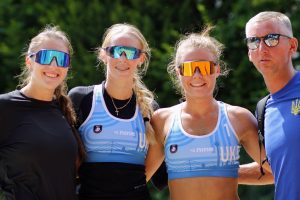
From left: Lazarenko, Romaniuk, Serdiuk and their coach at the 2025 European Championships (photo by Graham Hays)
A Competitive Will Undaunted
After a strong finish to 2025, which saw Serdiuk and Romaniuk qualify for their first Elite main draw and then break pool in Hamburg, this year began inauspiciously.
The pair signed up for a March Challenge in India, but as was the case for many players in the event, visa problems prevented Romaniuk from traveling. Serdiuk instead played with Sofiia Kurnikova, another Ukrainian whose own partner, Tetiana Lazarenko, had visa issues. But first, she had to get there. For once, that seemed like the least of her worries. Training in the Canary Islands, she planned to fly directly to India. No border bus crossing needed.
Only, just as she prepared to leave, the United States and Israel launched their war in Iran that snarled air traffic throughout the region—including her inbound flight through Abu Dhabi and, eventually, her return flights to Europe.
Still, seeded 17th, she and Kurnikova reached the quarterfinals playing together for the first time. They fought to the end in a three-setter against Sara Hughes and Ally Batenhorst after defeating the same Americans in pool play.
There are, seemingly, no easy road trips when you’re Ukrainian.
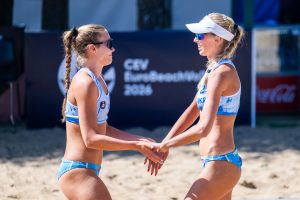
Serdiuk and Romaniuk in the 2026 European Championships (photo by CEV Volleyball, cev.eu)
But it’s the partnership with Romaniuk that has produced one of the best young teams on the European scene. Outside of the Beach Pro Tour’s sibling pairs, the Ukrainians are as much a constant as the sport offers. Also from Chornomorsk, Romaniuk is eight months younger than Serdiuk. They have played together, with only a few interruptions, from just about the time that Serdiuk finally started getting her serves over the net.
Long-limbed, agile and quick off her feet, Romaniuk is a talented blocker in her own right. In a one-off pairing with Lazarenko in the 2025 FIVB World Championships, she reached the round of 16 and bowed out only in a three-setter against Thamela and Victoria.
Serdiuk strikes an intense figure on the court. It may be her happy place, but a competitive fury often seems to lurk just beneath the surface. That she led the field in digs per match in this year’s Hamburg Elite is an objective measure of her talent. That you feared for the spherical integrity of any ball that defied her is a more subjective assessment of why she’s so good. Against that intensity, Romaniuk’s calm balances the equation.
“She knows me very well,” Serdiuk said. “She knows that I’m very emotional, and even if I look angry, I’m not angry.”
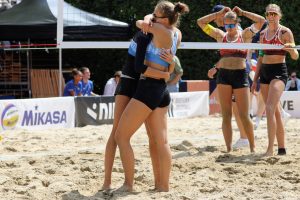
Serdiuk and Romaniuk celebrate their first career European Championships win during the 2025 tournament in Dusseldorf (photo by Graham Hays)
Like talented young players the world over, they face the challenge of moving from success at the age-group level to competing against the best in the world on a regular basis. The first step is proving your best is good enough. Serdiuk and Romaniuk went a long way toward doing that over the past 12-to-18 months, highlighted by their resiliency in Hamburg in a daunting pool that also featured Melissa Humana-Paredes and Brandie Wilkerson, Thamela and Victoria and Muller and Tillman. They didn’t break pool in that instance, but they belonged.
The next step is taking their best, when they revel in the underdog role, and making that the baseline standard for every match, every week. That begins in Brazil in a matter of days. With money for a rare trip out of Europe, they are seeded No. 11 in the 16-team qualifying draw for the Itapema Elite—needing only one win to make the main draw in the newly-expanded format for Beach Pro Tour events in 2027.
“I think our mindset and psychology changed,” Serdiuk said of their growth. “If you compare last year and this year, from the psychological part, our team was much more stable. We had good communication, good support for each other. When our mindset is we have nothing to lose, we’re going to play well. But if we feel we must win something, it can be challenging for us.”
Playing with nothing to lose is a difficult mindset for anyone to maintain. It’s even harder when you live with everything to lose.
A Life Undimmed
In 2020, when Khmil played in the U20 European Championships in Izmir, Turkey, and 2021, when Serdiuk played in the U22 version of the tournament in Izmir, travel meant getting on a plane, flying a couple of hours and settling into a hotel without even missing a meal. Turkey, after all, is just across the Black Sea from Ukraine—Istanbul and Odesa are closer as the crow flies than are Chicago and Toronto across the Great Lakes.
In the more recent European Cup in Alanya, a similar trip began with a bus ride from Kyiv to Warsaw that can stretch toward 15 hours. In this instance, they arrived about 10 hours before their flight. That’s how it goes. They have to build the buffer into the schedule to accommodate the lengthy delays that abound at the Poland-Ukraine border. When they finally boarded the flight, an engine problem forced them to collect their things and trudge back into the terminal to wait for a replacement aircraft. Weary and sore from sleeping in bus seats and on airport floors, the Ukrainians arrived after a 24-hour trek.
It’s one small measure of how their world has changed.
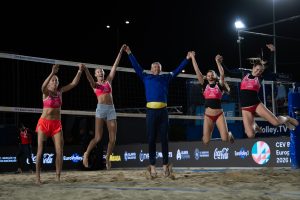
The Ukrainian champions at the CEV European Cup (photo by CEV Volleyball, cev.eu)
But once on the sand in Alanya, where Khmil and Serdiuk played together in the final, the new world merged with the old. They had played together earlier in the year for the “golden set” in the final of the CEV Nations Cup in Budapest, Hungary, a tiebreaker format that forces countries to select one player from each of the two pairs competing. Facing Italy’s Valentina Gottardi and Claudia Scampoli on that occasion, Serdiuk helped stake Ukraine to a lead it never relinquished with some audacious overs-on-one and fake-set overs. She was at it again in Alanya, leaving her partner, as Khmil self-deprecatingly put it, with little more to do than set the ball a few times and clap en route to a title in the competition between European clubs.
It’s difficult to think of a more expressive shot than going over on one. It requires the athleticism to cover the court and be where an opponent doesn’t expect you to be, the creativity to break from routine and an audacious streak. Hyper-competitive and high-stakes elite professional sports don’t lend themselves to doing things for fun. Going over on one feels like an athlete at the peak of her powers playing the game with a wink.
In Serdiuk’s case, a defiant wink. No one will take this from her.
“Volleyball is the place where I don’t have to think about my problems,” Serdiuk said. “When I come to the court, I feel free.”
She refuses to give up that freedom. She refuses to give up those moments when the world feels something close to normal again. She refuses to give up who she is.
In a world in which Russia would kill her because of who she is, she will not stop living as herself.
“Being Ukrainian, it’s fighting, always fighting to the end,” Serdiuk said. “Always fighting to the end, no matter what is what is happening.”
Opportunity to Get Involved: Latvian world champions Tina Graudina and Anastasija Samoilova organized to host Khmil and Davidova in an exhibition match on Nov. 27 to raise money to support for Ukrainian athletes injured in the war. The match at the Delfi Beach Center near Riga is open to all who register and donate, but fans worldwide are also welcome to donate via the center’s website.
I’ll try to update here with more information on where fans can stream the match.
Keep Reading …
For EJ Cudmore, Unlikely Elite Debut Is Only the Beginning of the Story
Fresh Off Beach Pro Tour Gold, Markéta Svozilová Has Reason to Smile
Tina Graudina Finds Joy in the Journey
Klinger Sisters Take on the Business of Beach Volleyball Dreams
Valentina Gottardi One of the Main Characters