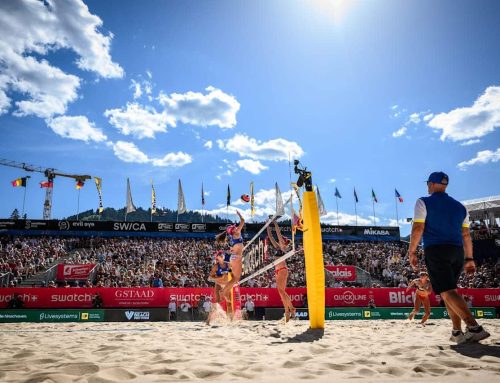
OSTRAVA, Czech Republic — Veronika Kleiblová doesn’t recall precisely where she sat during her first visits to Ostrava, one of beach volleyball’s most recognizable events, where a sport synonymous with Rio de Janeiro and Southern California sand unfolds beneath beautifully severe industrial architecture left over from Ostrava’s once abundant coal and steel.
She was just a fan. She traveled the roughly two hours from Brno, her home and the Czech Republic’s second city, to cheer on club mate Markéta Svozilová and boyfriend Jiri Sedlak. Probably, she decides, she found a seat wherever the loudest Czech fans were. Never mind that it takes a particularly acute sense of Czech-ness to identify which of the four stands that is whenever a home team takes the court. The roar seems to come from everywhere. All that mattered to her was she was there. Yes, it rained, spring sometimes reluctant to give way to summer. But for anyone who loves beach volleyball, and most of all for a Czech who lives and breathes the sport, simply being one among thousands was enough.
This year, she had the best seat in the house for one of the unforgettable scenes in the 2026 tournament. A wild-card entry seeded No. 31 out of the 32 teams in the women’s main draw and qualifying fields, Kleiblová, 20, and Valerie Dvorniková, 23, rallied from a first-set blowout setback to eliminate German mainstays Louisa Lippmann and Linda Bock. Sprinting from the service line on match point, Kleiblová dropped to the sand when the ball never came back over the net. There she sat for several seconds, her body visibly shuddering with giddy tears.
No longer one among many, she and Dvorniková were the ones.
“I heard everybody cheering for us, and I really didn’t have any breath,” Kleiblová said, “So I just enjoyed the moment.”
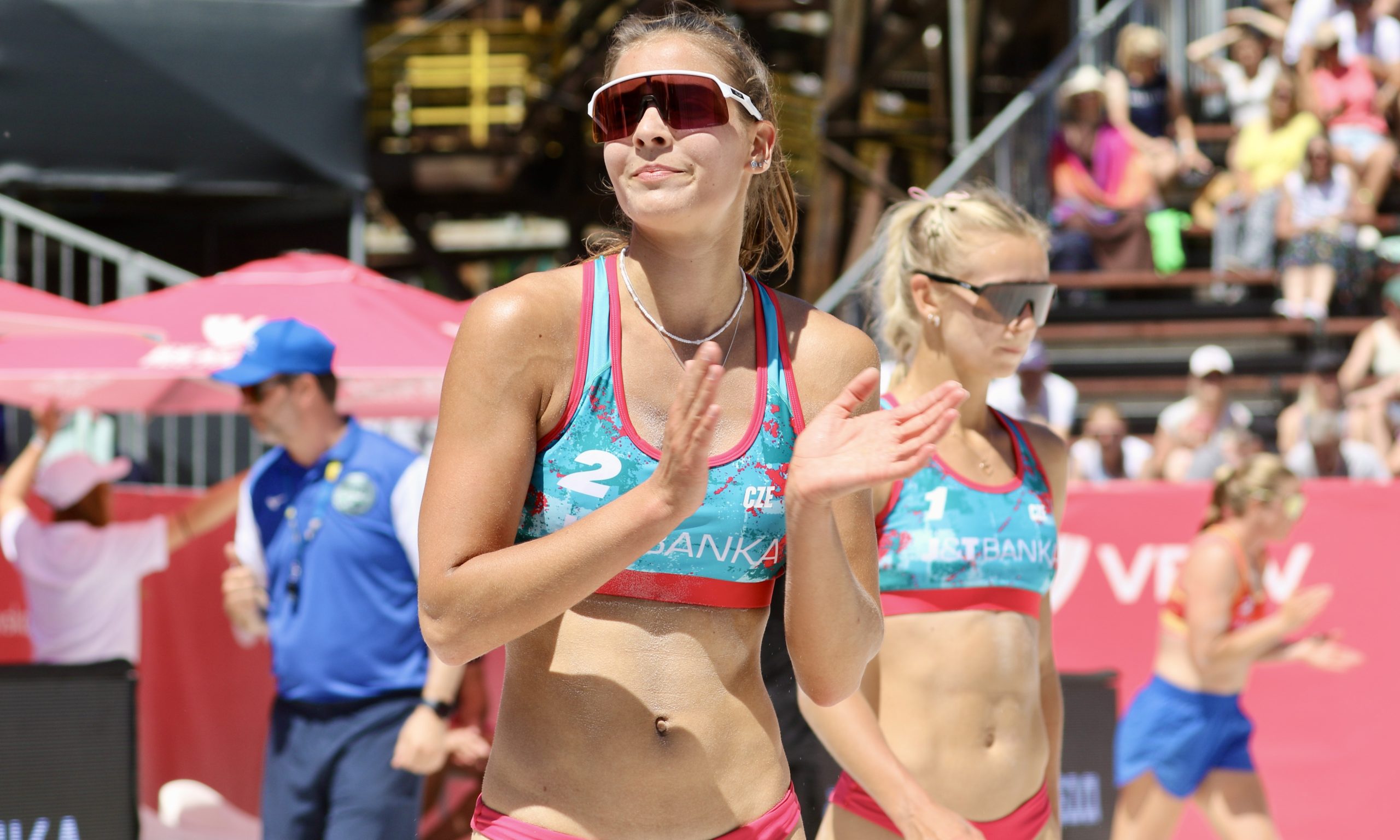
Kleiblová, left, and Dvorniková during the 2026 Ostrava Elite 16 (photo by Graham Hays)
Someone who hadn’t made it out of qualifying in her only two previous BPT Elite events had another thought, too.
We’re going to play another three matches—at least.
It turned out to be another four matches. Despite landing in the deep end of pool play and facing Americans Taryn Brasher and Kristen Cruz and eventual Dutch finalists Katja Stam and Raisa Schoon in their first two main draw matches, the unlikely Czech party crashers made it out of the initial phase. Expected to be gone before the food trucks fired up lunch on Wednesday, Kleiblová and Dvorniková made it to Friday evening before they finally bowed out against Switzerland’s Joana Mader and Leona Kernen in the lucky losers round.
They made themselves part of the story, even if it was only as a footnote by the time Melissa Humana-Paredes and Brandie Wilkerson celebrated their first Ostrava gold, David Åhman and Jonatan Hellvig their equally historic third in a row and Sedlak and the irrepressible Ondrej Perusic a satisfying silver. Kleiblová and Dvorniková had their moment. No wonder Kleiblová wanted to savor hers for as long as possible as she sat in the sand. It marked a waypoint, the moment when the road ahead and behind come into equal focus. When you understand you are exactly where you are supposed to be.
“I thought that the Elite tournaments are too difficult for us, but I would say that we saw that we really can play those tournaments and try to fight the best teams,” Kleiblová said. “That motivates me. It shows me I’m really on the right journey, and I want to continue. Everything about this sport is really hard, so it gave me motivation to continue and fight and train every day and do all these things. Because I believe it makes sense for me.”
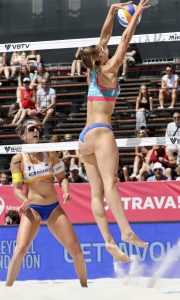
Kleiblova gets a block against Stam and Schoon (photo by Graham Hays).
The Making of a Moment
The Czech Republic may appear an unlikely hotbed for beach volleyball, given the scarcity of coastline if nothing else, but like the Ostrava event itself, Kleiblová is the product of the country’s rich volleyball history. Indoors, the Czech men are former world and European champions (the country is also co-hosting the 2026 Women’s European Volleyball Championships). Kleiblová’s father and grandfather played the game. She grew up with and around it, attending her dad’s tournaments and wanting to follow in his footsteps.
With former Czech Olympians Markéta Sluková and Bara Hermannová, along with Kristýna Kolocová, influencing a generation now populating the Beach Pro Tour, beach volleyball allowed her to honor those instincts while following her own path.
Watch Kleiblová play, and you might see at least a little of a raw Valentina Gottardi—the athleticism with which she launches herself through the air, relentless motor and joy and frustration that make a poker face impossible. Also like her Italian counterpart, Kleiblova soon gravitated exclusively to the sand because it was hers to shape for better or worse.
“I think I’m really ambitious—and I just didn’t like the fact that I have to sit on a bench and watch others play,” Kleiblová admitted with a laugh.
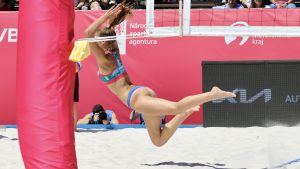
Kleiblová saving a point in Ostrava with a Gottardi-esque leap (photo by Graham Hays)
After making her first sustained appearance on the Beach Pro Tour in 2025 with Brno native Miroslava Dunarova, the veteran who has gone on to success as physical coach for Marie-Sara Stochlova, Kleiblová was in the market for a new partner looking ahead to 2026. She and Dvorniková had known each other for years in Brno, playing out of the same club. But the latter settling into a defender’s role opened up new possibilities for them together.
Still very much an ascending talent in her own right after turning 23 in March, Dvorniková nonetheless brought the experience of more than 30 Beach Pro Tour events—including a Futures gold medal with Michaela Brinkova in Brno last year in which she held her nerve after dropping a 27-29 first set against the second-seeded French in the gold medal match.
“I would say that the atmosphere we create on the court is a really good thing,” Kleiblová said. “My last partner had the same fire as me, and that was not always working well for us. Valerie is the calming presence and balance that I need on the court, and I think that’s been the biggest positive helping us improve.”

The Czech team have played just four BPT events together (photo by Graham Hays).
Reality Is Hard
Kleiblová was born two years after Carol Salgado played her first international event. That the Czech youngster is already playing Elite events—indeed, she played her first at 19 years old—is evidence of both prodigious talent and a meteoric ascent. Old souls around the world might chuckle softly at the idea of someone so precocious suffering for her art. But if anything in a beach volleyball is as grueling as staying afloat physically, financially and mentally as the years go by, it might be getting your foot in the door in the first place.
Czech athletes have made their presence felt in NCAA beach volleyball, from Svozilová and Julie Honzovičová at FAU to Karin Žolnerčiková at Texas and Stetson. It is easy to see why it’s an attractive option. Even in a country like the Czech Republic with a relatively stable developmental system and pockets of training expertise like in Brno, transitioning to a professional career comes with few of the perks available stateside in an NCAA athletic department. Months remoed from being a teenager, Kleiblová effectively runs her own business, with little in the way of staff beyond her dad. To that end, Aleš Kleibl recently founded an association, Beach Elite Brno, to help his daughter and others like her in Brno navigate the rules, regulations and financial necessities of being a professional athlete.
“I’m 20 years old, and i really don’t know how to do this—you don’t learn that in school,” Kleiblová said. “I really don’t know how to do it, so you need to find a lawyer, someone to manage finances. And I also hadn’t traveled much. So I need to learn how to find affordable options for tickets, accommodations, food and everything. We are in the beginning of our journey, so it’s really hard for us to find sponsors. It’s a lot of money. I’m exhausted by it, and when I have a full head with all these things, it also is visible in my matches.”

The Czechs outlasted Ferch and Van Gunst 19-21, 21-17, 19-17 (photo by Graham Hays)
Kleiblová and Dvorniková played their first event together this past December in the Elite 16 event in Itapema, Brazil, trying to take advantage of a relatively lighter field after the World Championships in Australia. Seeded No. 15 in qualifying, they lost to Americans Kelley Kolinske and Madison Shields in 31 minutes. So much for flying halfway around the world for your debut.
They tried again in March at the year’s first Elite 16 in Joao Pessoa, Brazil. Initially on the reserve list, they spent days making tentative travel plans and texting as many players as they could from the teams ahead of them, trying to figure out who might drop out. Eventually, with a couple of weeks to spare, they got their opening and booked their flights. The reward, in a bit of foreshadowing, was a spot opposite a local favorite. They lost a three-set qualifier against Brazilians Carolina Horta and Elize Maia (who nearly brought more years on this earth to the encounter than her young Czech opponents combined).
“I learned that this journey is a process,” Kleiblová said. “Everything about it is unpredictable, but we try it. And if it does not go well, we stay there and train with the best teams. So we’re collecting experiences and learning from the best.”
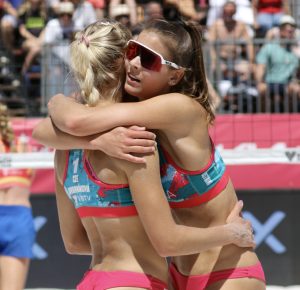
The fifth-ranked Czech team, Kleiblová and Dvorniková are trying to make their mark in a deep pool of federation talent (photo by Graham Hays).
Living the Dream in Ostrava
So, no, Kleiblová and Dvorniková didn’t just luck into their place on the court in Ostrava. Even the wild-card entry itself was uncertain until a few weeks before an event with the deepest field of the year to date. There was no shortage of Czech teams in the running for a third qualifying spot (and fourth spot overall). Their coach told them it might come their way as the tournament approached, but Kleiblová didn’t fully believe it until it was official.
It would be rewriting history to suggest Center Court was at full frenzy when qualifying began on the tournament’s first morning. There were cheers for the home team as it took the court, but the sound echoed and bounced off seats that would fill later in the week. Still, for Kleiblová, hearing her name announced during player introductions nearly brought tears. She had dreamed of playing on that court, never imagining it would happen so soon.
They promptly lost the first set 21-13, the second-most lopsided opening set in any of the day’s eight women’s qualifiers.
Looking back, Kleiblová suggested that she hadn’t been worried as the score ticked in the wrong direction. She was used to it. Indeed, remarkably, the Czech team ultimately lost the first set in each of its first seven matches together, spanning Ostrava and the pair of Elite events in Brazil. Squandering a five-point lead late in the second set, on the other hand, represented unwelcome new territory. This wasn’t ever part of the dream.
“From 17-12 to 17-17, I think there is a possibility that I get nervous,” she recalled with another laugh. “That was crazy. I made a lot of mistakes, and I just knew I needed to get one side out and then we’re going play. I did it, and it calmed me down.”
At 17-17, Bock went after her with a serve, but Kleiblová handled it without issue and rolled a shot over Lippmann’s imposing arms into the corner for the point. They won the second set 22-20 and the tiebreaker 15-13. They were into the main draw.

All the Moments to Come
Whether amid second set drama against the Germans, subsequent straight set losses against two of the top handful of teams in the world or the pool-saving three-set marathon win against Piper Ferch and Teegan Van Gunst, what made the Czech team’s run in Ostrava all the more compelling was just how much fun they seemed to be having with it.
They lived in the moment.
Dvorniková in her more understated manner and Kleiblová roaring her approval, they didn’t try to act like they had been there before. They only tried to play like they belonged there.
“I’m really working on my performance and how I act on the court,” Kleiblová said. “I think the fire is really, I’d say, dangerous because sometimes the emotions are so strong. I need to learn how to work with it. In Ostrava, we didn’t have anything to lose, and we really enjoyed the experience because the atmosphere and everything was amazing. But I would said that not every tournament is that easy for me, mentally, so I’m still learning.”
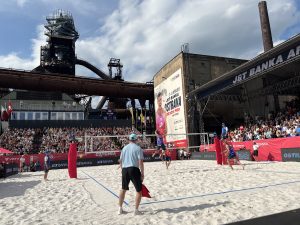
Kleiblová also watched Sedlak play for gold in the iconic venue (photo by Graham Hays).
It won’t always be like Ostrava. She could have a heck of a career without it ever being quite like those moments in a place she knows so well.
The next time out, Kleiblová and Dvorniková notched a quality win to open qualifying in Alanya, Turkiye. They even snapped their first-set jinx. But after dropping a taut 22-20 first set against Canadians Sophie Bukovec and Lea Monkhouse in the final round of qualifying, they were never able to regain control after the second set started with a string of miscues. Still, even trailing by a hefty margin late, there was Kleiblová racing toward the back line and flinging herself at the ball to try and prolong a point. And there was the same positivity between partners, reinforcing each other’s fleeting successes rather than shutting them out and shutting down communication. More experiences to file away.
In the meantime, Kleiblová will always have Ostrava. As the memory of an unforgettable moment. As the reward for a hard road taken. And as a blueprint for the road ahead.
Keep Reading …