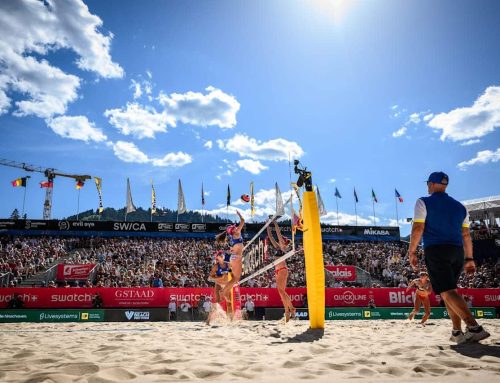
Some among the thousands of fans who packed center court during the 2013 CEV European Beach Volleyball Championship in Klagenfurt, Austria, went home with souvenirs. Maybe a sunburn, too. Dorina and Ronja Klinger left with a dream.
Mind you, they hadn’t gone looking for one. It was summer in Austria, a season as glorious as it can be brief in a country renowned for winter sports and Christmas markets. To Dorina, who had recently turned 16, and Ronja, then 13, it didn’t matter what sport was on display. They were competitive skiers. Their medium was snow. The important bit in Klagenfurt, then a frequent host for beach volleyball’s elite, was the excuse to gather together, soak up the sun and celebrate, well, anything.
“If there’s a huge event in Austria, a small country where there’s not so many huge events, you just have to go for the fun,” Dorina said.
It proved to be much more than that. Watching sisters Doris and Stefanie Schwaiger march to gold, just two years after Barbara Hansel and Sara Montagnolli became the first Austrian women to medal in the event, Ronja was entranced. Beach volleyball’s athleticism, atmosphere and community swept her off her feet with all the force of an avalanche.
“I decided this is my vision — ‘I’m going to go to the Olympics with my sister,’” Ronja recalled. “Which is completely crazy because I was literally a skier, so the furthest thing away from beach volleyball that you can get. It was a crazy moment for a 13 year old to realize this and then really chase this crazy dream.”
It’s a good dream. Born of the sort of inspiration that organizers always claim such events provide. Sure enough, then-CEV president André Meyer said at the time that he hoped the Schwaigers’ success in Klagenfurt would “motivate more and more young people in Austria to take up beach volleyball and possibly embark on a professional career.”
But a dream is the easy part. Plenty of people dream of standing on Olympic medal stands, of going over on one at the perfect moment or making an impossible dig to save a point and a match. Few imaginations dwell on evenings spent cold-calling businesses to secure sponsors or scouring travel sites for the cheapest flights, no matter how many stopovers, as you hopscotch your way around the world, only to get whitewashed in qualifying.
Entering the 2026 season, the Klingers are living their dream. Last November, they made the knockout rounds of the World Championships for the second consecutive time. They played for bronze in Ostrava. When the Beach Pro Tour stopped in Baden, Austria, they were the stars of the local advertising campaign and rock stars on site. It will be a bigger surprise if they aren’t part of the Olympic festivities in Los Angeles than if they are.
Maximizing sibling chemistry and complementary skills and personalities, they have become main-draw regulars. They made themselves elite. But to get the chance to battle Brandie Wilkerson or Tina Graudina at the net or try to sneak a ball past Kristen Nuss or Rebecca, they had to become entrepreneurs, brand managers, travel agents and marketing specialists. To play beach volleyball together, they had to build a business together. Because the story of sisters competing against the very best in the world isn’t just about having a dream. It’s about what you do when you wake up.

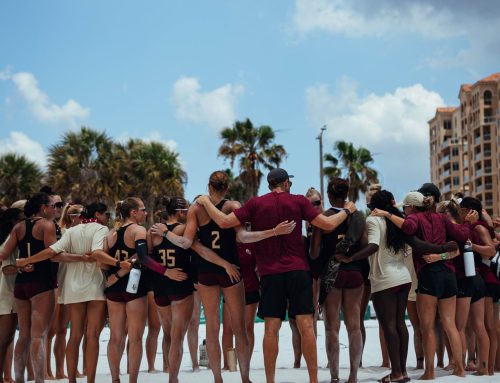
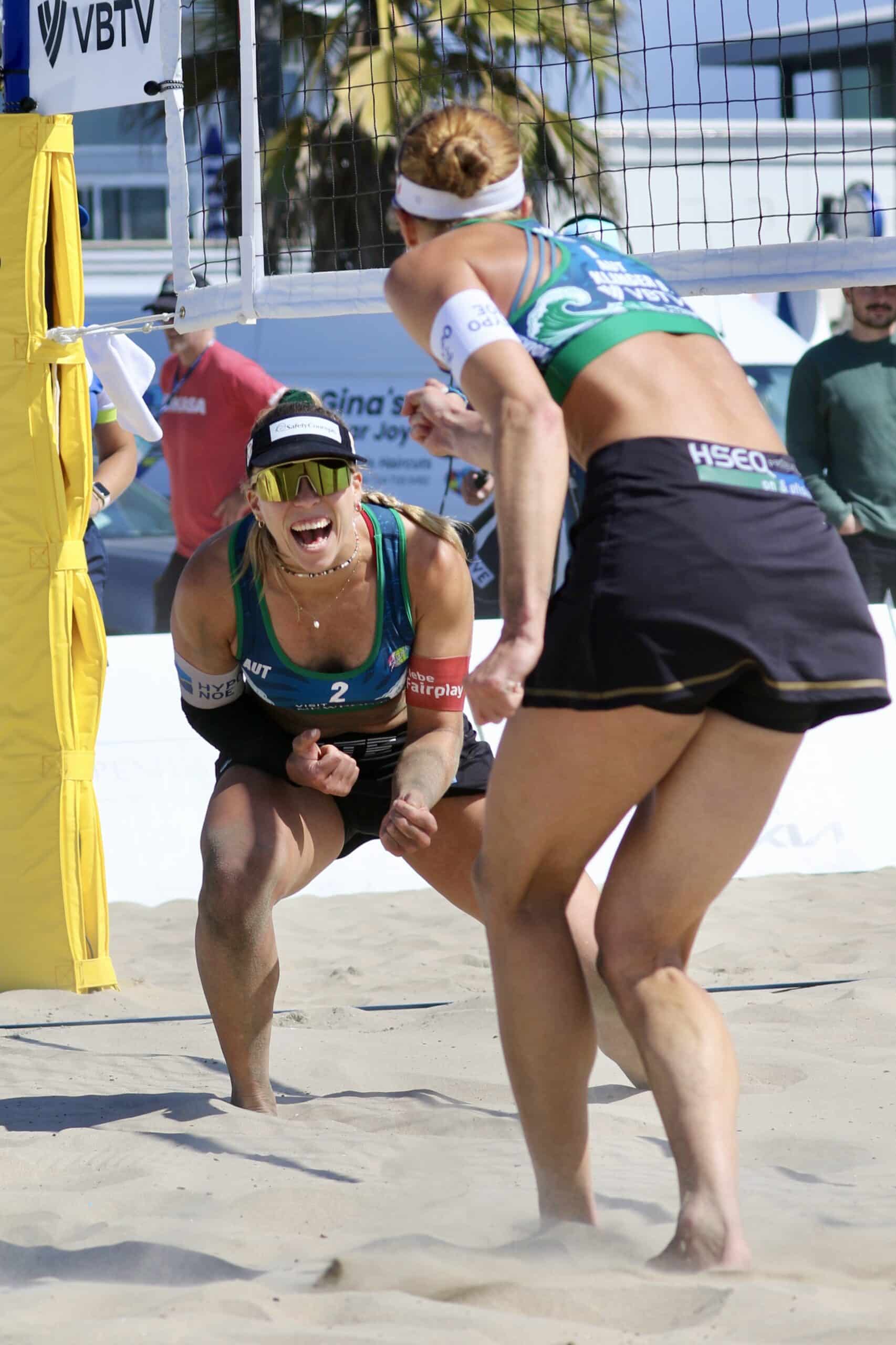
The Klingers in the Newport Beach Elite 16 (photo by Graham Hays).
A Sisterly Start-Up
When they attended the 2013 European Championships, Dorina had only been playing volleyball for a couple of years — and then scarcely more than recreationally. She was nonetheless more experienced than Ronja, who had barely touched a ball at that stage.
They grew up in and around the sports their parents competed in — skiing for their dad and track and field for their mom. Skiing, in particular, was literally the family business, as Gernot and Tanja Klinger operated a ski school in the Austrian Alps. Their daughters were part of an ultra-competitive youth skiing scene in a country where the sport is as much a part of the cultural fabric as beach volleyball in Brazil. But even with snow instead of sand, some of the traits that differentiate them today were already evident.
“For skiing, you have to be kind of a wild person,” Dorina said. “You cannot care about getting injured or being scared, and Roni was always a little more reckless in that way. I was the person who needed a couple of runs to get into it and then be really good technically. She was more the person who was like ‘I don’t care, I’m just going to go super fast.”
It could be a cutthroat and isolating environment, little sense of camaraderie among skiers looking out for their own interests. Given the age gap, Dorina and Ronja weren’t in direct competition on the slopes, the former training with their dad and the latter with their mother. But the sisters weren’t exactly a closeknit team, either. To teenage Dorina, Ronja was the annoying little sister always trying to tag along in social settings. Nodding along, all these years later, Ronja matter-of-factly accepts the characterization.
Volleyball and an ocean changed the dynamic. When she was about 15, Dorina joined a volleyball club after playing and enjoying the sport the previous year at school. Volleyball was everything skiing wasn’t, inclusive, low stakes and suited to someone taller than her peers. Volleyball, in turn, proved to be her ticket to studying abroad, something she had long wanted to pursue to expand her language and cultural horizons. Matched through a recruiting service, she assumed she would get big time and bright lights — like something out of football Saturdays in the SEC, had she known what the SEC was at the time. Instead, she arrived at Spring Hill College, a small private school in Mobile, Alabama, with an enrollment that doesn’t always stretch to four digits and NCAA Division II affiliation.
It wasn’t a bad experience. The school’s new beach volleyball program, in particular, was a welcome perk after indoor season. But it was a rather dramatic change of scenery. She found a surprising source of support in her little sister, not so annoying when thousands of miles away. Always sisters by genetics, they grew into friends by choice.
“For 16 years, you take it for granted that you have each other — you’re my annoying sister, whatever,” Ronja said. “And then she’s gone and it’s like ‘Oh gosh, I miss her.’ That was cool to realize.”
Dorina would transfer to Florida International after one year at Spring Hill, catching a break when a beach scholarship opened up at the last minute for the Division I program. Ronja joined her in Miami in 2019, a freshman in her older sister’s senior campaign.
They had played together occasionally before that. The earliest experiments were less than stellar — or as Ronja recalled thinking at the time, “This will not work. Ever. Like, literally never.” But as the younger sister gained more experience in the sport and smoothed some raw edges, they started to see their collective potential. The same compact, explosive athleticism, not to mention reckless abandon, that served Ronja well on the slopes worked as a defender and complemented Dorina’s agile but understated calm as a blocker.
“Compared to people our age who are going to age-level European Championships or World Championships, we were like 200 percent worse,” Ronja joked. “But we started having success because we were just fighting for each and every ball so much that the other teams got so desperate that they were losing it in their heads.”
They wondered how good they might be training more than a couple of times a week. The year they shared at FIU started to provide an answer. Playing primarily as the No. 2 pair behind Italians Margherita Bianchin and Federica Frasca, and as FIU crossed paths with everyone from 2025 World Champion Tina Graudina to three-time Beach Pro Tour Defensive Player of the Year Kristen Nuss, the Klingers went 14-8 together.
While Ronja ceding her remaining eligibility to return to Austria with Dorina after that year wasn’t an entirely foregone conclusion, it was always the most likely scenario. Dorina had her degree, and the two of them had the volleyball education they needed to take the next step in their careers. Not only could they play together, they learned, but they made each other better on the court. Perhaps as significantly, after childhood squabbles, they found far from home that they brought out the best in each other off the court — no small asset for two people about to embark on a career in which they would be tied at the hip.
“Probably this was kind of the groundwork and the starting point of us traveling together and being super comfortable with each other,” Ronja said. “Not just on the court, but also off the court because we were also living together in a different country. To have family with you on the road is a huge advantage. That’s what we feel right now, too, because I feel like there are a lot of teams that don’t get along as well. If you’re on the road for seven, eight months a year and you don’t get along that much — for me, it would be a reason to not do it. Why would I spend seven months with a person that I don’t like?”
Research and development completed, they were ready to take their product to market.
-
- Ronja Klinger
-
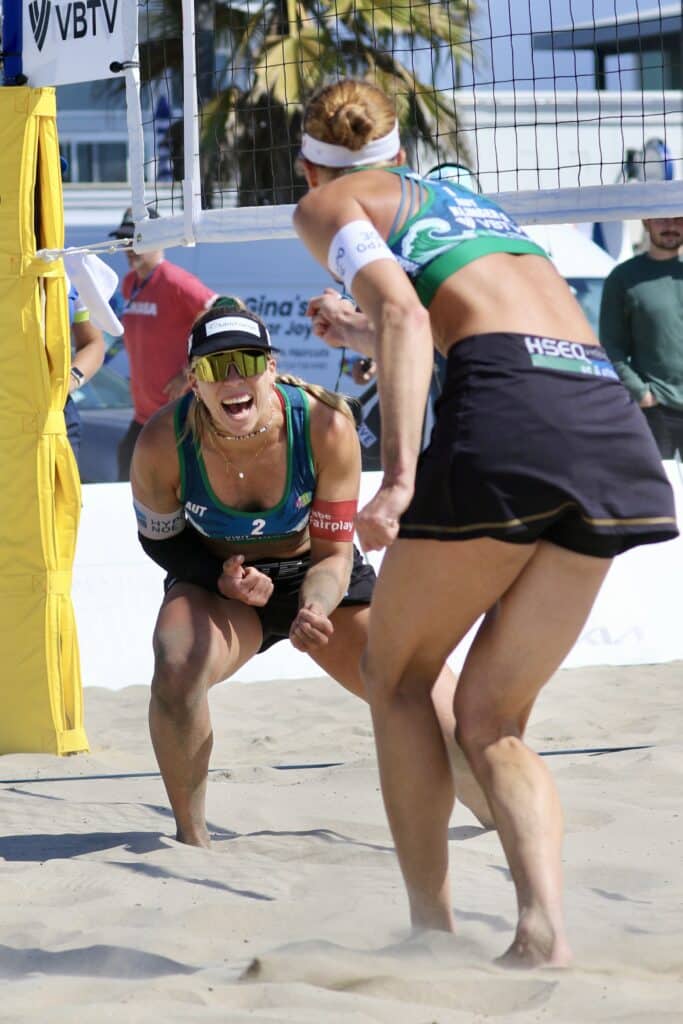
- All photos by Graham Hays
-

- Dorina Klinger
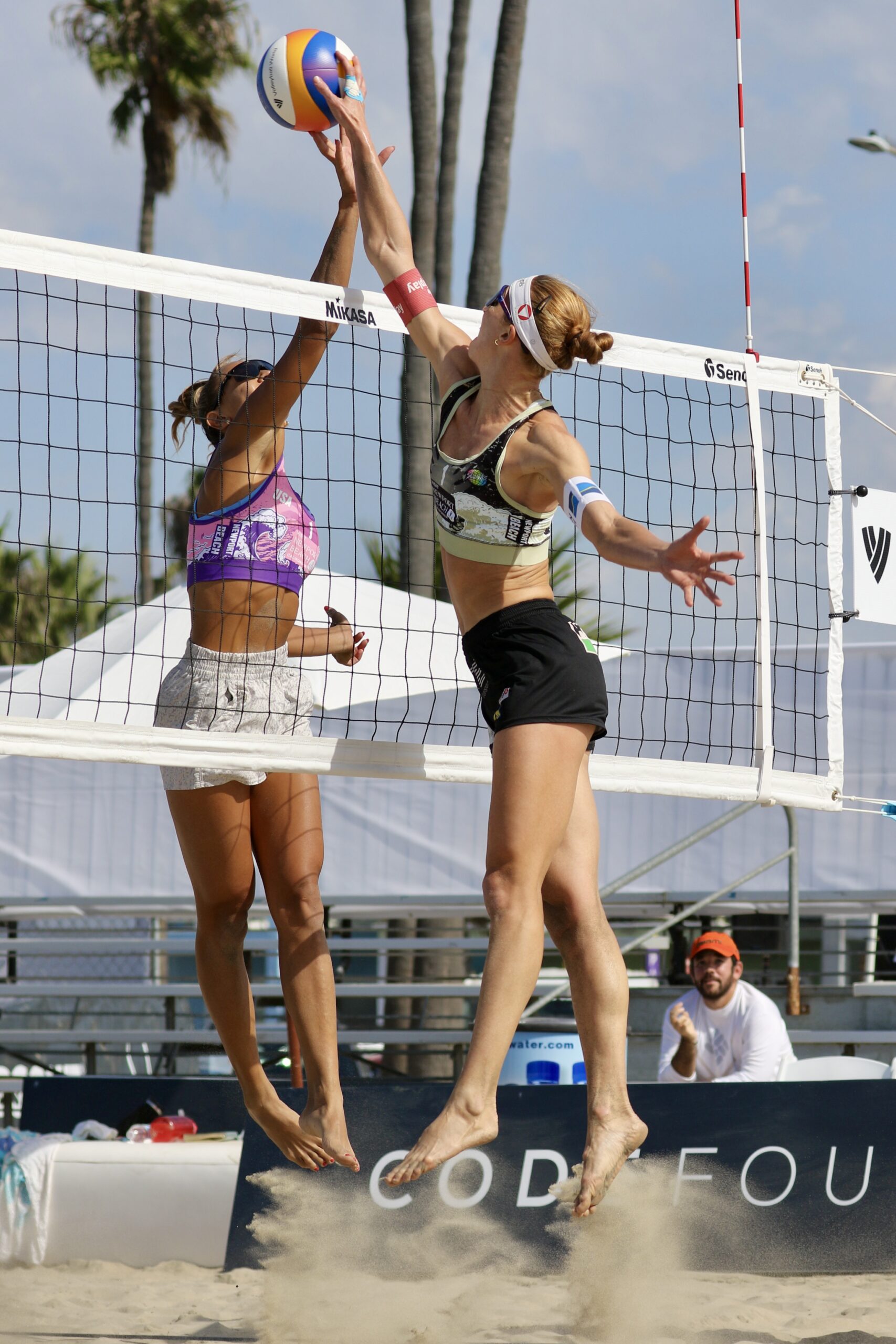
Klinger, Inc.’s IPO (Initial Professional Offering)
The Klingers met with modest on-court results in the summer of 2019, most of their handful of match victories coming in one-star events. But figuring out how to get out of qualifying was only a small part of the adjustment to life as full-time professionals.
The Austrian federation provides a head coach for the national team, but starting out, the sisters didn’t have access to the likes of a full-time physiotherapist or strength trainer. What help they wanted they had to find and pay for. Even playing a limited schedule at the outset, they also had to book their own travel everywhere from Ios, Greece, to Edmonton, Canada, then arrange training partners and practice times once there. FIU has a more modest athletic budget than Power 4 schools, but the self-sufficiency was still a shock to the system. In college, they just had to show up on time. Everything else was taken care of.
“It’s kind of funny because even though now I’m not a student anymore, and I am ‘only’ a professional beach volleyball player,” laughed Dorina, whose FIU degree is in marketing, “I feel like I have much more to do and I’m much busier.”
And there was the small matter of not going broke. Early on, the sisters were able to sign on to a program run by the Austrian military for athletes in Olympic-type sports that provides what amounts to a monetary stipend. It’s not a way to get rich, but it saved them from having to find work outside of volleyball while they got their feet under them on tour.
Beyond that, in a world in which even the winners in major tournaments can’t count on prize money alone to pay the bills, the newcomers had to get busy finding sponsors to keep them afloat. Dorina leaned on her degree. Ronja enrolled in sports marketing classes back in Austria. They went to event after event, conferences, seminars — anywhere sports officials, politicians and businesspeople might gather to listen to each other speak.
“If you get some connections there, maybe someone knows someone who knows someone,” Dorina said. “Like in the normal business world, where you just have to try to make many connections and then hope you catch a break.”
They spent lots of time on LinkedIn, sending messages by the dozens to executives and marketing staff in Austrian companies, hoping someone would take a chance on two sisters they had never heard of and who had little in the way of results to help make their case. A few puzzled responses sought more information as to who, precisely, they were. Most of their messages just went unanswered.
Asked if any early success on the sponsorship trail stood out, Ronja offered a rueful laugh and noted it was a lot easier to come up with one of the many stories of failure.
The nadir may have been a 2021 trip to Cancun, Mexico, where the Tour held successive events in a “bubble” environment during the COVID-19 pandemic. After spending thousands of Euros to make the trip, and with few promising leads on financial partnerships likely to help recoup the costs, the sisters lost back-to-back qualifying openers.
They totaled just 68 minutes on the court for their multi-week transatlantic travel.
At least there was plenty of time to practice, even if they were pretty sure their coach at that time barely tolerated their presence. With one gym shared by all competitors, they studied how stars like Laura Ludwig went about their work. All in all, it was an expensive lesson.
“You kind of have to lose until you learn how to not lose,” Ronja said.
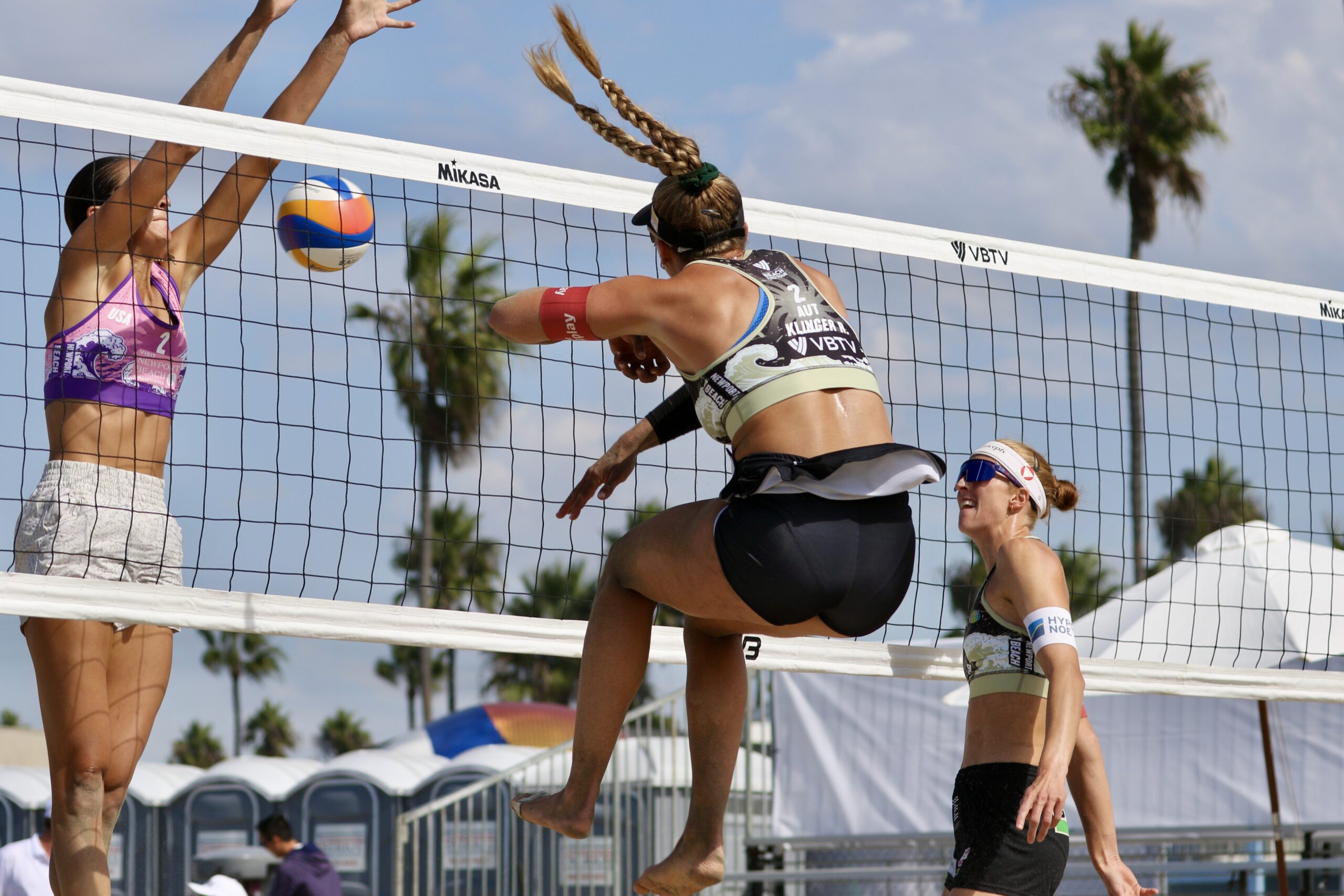


Successes were something to cherish, whether they came with a subsequent third-place finish at a Futures event in Bulgaria or an unexpected sponsorship victory.
That same year, with a wild-card entry to the European Championships in Vienna already in hand, they sent a message to the CEO of a major Austrian company. They didn’t really expect they would ever hear back. But they did, the executive telling them that he had two daughters who loved beach volleyball. Could the Klingers get them tickets for the tournament? Dorina and Ronja ultimately lost back-to-back three-setters in Vienna, but the connection with the CEO led to a productive multi-year sponsorship that was valuable not just over the life of the deal but in opening doors with other companies.
“For an outsider who thinks these are just athletes and they just have to train, the work we have to put into marketing and sponsorship is unimaginable,” Dorina said. “That’s what makes this sport very intense. It’s not just about being a great beach volleyball athlete. You have to be a great marketing boss for your company because you will not survive in this business without that part and without putting a lot of effort into that part.”
In the years that followed, as their on-court reputation gradually grew and the demands on their schedule increased apace, they hired someone to manage their business interests. It was about as successful as outsourcing the on-court product would have been. The experiment lasted scarcely a season.
“Brands told us like afterwards ‘What we really liked about you guys is that we could talk to you and we could get to know you,’” Dorina said. “And that it was so easy — if they wanted a video, they would just WhatsApp us and it didn’t have to be through another person. That was a big learning moment for us. If we do it ourselves, yes, it will take up a lot of our time, sure. But we will also have better connections to the people. They will probably support us through ups and downs because they actually know us, our team, our passion. That was a game changer, and ever since then we just do these things by ourselves.”
They divide the workload evenly. Living together, it’s easy enough to brainstorm an idea for an Instagram video or confirm which flight to book when your business partner is on the couch a few feet away. In the same way they complement each other on the court, they make sure everything is covered off the court. Perhaps harkening back to all those university assignments, Dorina doesn’t mind burying herself in the paperwork that grates on Ronja. The latter, in turn, always finds extra reserves of energy for networking events after a long day of training.
And just like all those years ago on the ski slopes, their authentic personalities emerge — all the more now that success gives them more leverage to negotiate rather than accepting anything on offer. Dorina is often hesitant to bring up numbers, easing into the details. Ronja, with all the reckless abandon of a downhiller, never hesitates to ask for exactly what she thinks is fair.
“At the end of the day, we both benefit,” Dorina said. “Because if it was only me, probably I would at some point sell ourselves under our value. But if it was only her, probably a lot of people would be like ‘No, sorry, then we’re not going to do that.’”
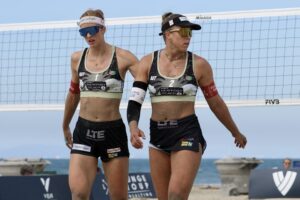
The Klingers enter 2026 ranked No. 13 in the world (photo by Graham Hays).
Growing the Business
Last preseason, after sketching out their preliminary budget for a year they hoped would end with a trip to Australia for the World Championships, the Klingers got an invitation to train in Brazil alongside reigning Olympic gold medalists Ana Patricia and Duda. It wasn’t a small expense to add into the mix. From a competitive standpoint, it was also a no-brainer. You don’t pass up a chance to work with legends.
Currently No. 13 in the FIVB World Rankings, they’ve reached a point where they have that flexibility. They won’t be flying business class anytime soon, but they can get to where they need to go and prioritize fewer connections over pure bargain hunting and sleeping in the airport. Similarly, they aren’t booking five-star resorts, but they can look for rentals with better amenities to aid in recovery instead of taking the cheapest place with a bed and a bathroom. They can hire a sports psychologist to help them unlock continued growth.
And when the federation hired a new coach, their input weighed heavily. The resulting collaboration with the talented and demanding Tiê Santana has been hugely instrumental in lifting their game to new heights, the trio together now for two World Championships.
They can even hope to finish the year with their financial ledger in the black.
The blueprint the sisters worked from over the past six years may not suit every team, as they are quick to point out. Every federation infrastructure is different, each team’s needs distinct. Every individual is unique, too. Not to mention, the Klingers have the rare partnership guaranteed to last for life.
But like all of their peers, they have to find a way to turn beach volleyball into a profession. What begins with a dream, and ends on the beaches of Copacabana or under the shadow of the Eiffel Tower, is for long stretches in the middle a job — in the gym, on the practice court, building a brand on social media and sitting across the desk from the people who will help get you to those courts around the globe. Whether or not they ever really love those parts, Dorina and Ronja have made themselves world-class in all of them.
“Sometimes it’s fun when you get to know really cool people — because usually with big companies, the marketing people or CEOs are really kind of inspiring people,” Ronja said. “To get to know the business side of things, it’s really cool. And to get invited to events and meet all these other amazing athletes, that’s awesome. But some of it is also just trash work — emails on emails on emails to beg for money. Of course, that’s not fun, and it takes up a lot of time where you’re thinking ‘OK, maybe I could use this time more for recovery or something else.’ But I feel like it’s a good balance.”
It might not feel like it, not in the same way as the three-set comeback spurred on by a cheering crowd on some sunny summer afternoon, but it’s the stuff dreams are made of.
A dream two Austrian sisters are in the business of living.
Keep Reading …
Tina Graudina Finds Joy in the Journey: A year that ended with Latvia crowned world champions began with Tina Graudina serving her country in the Latvian Mission to the United Nations — and discovering she has more to accomplish in the sand. Read more.