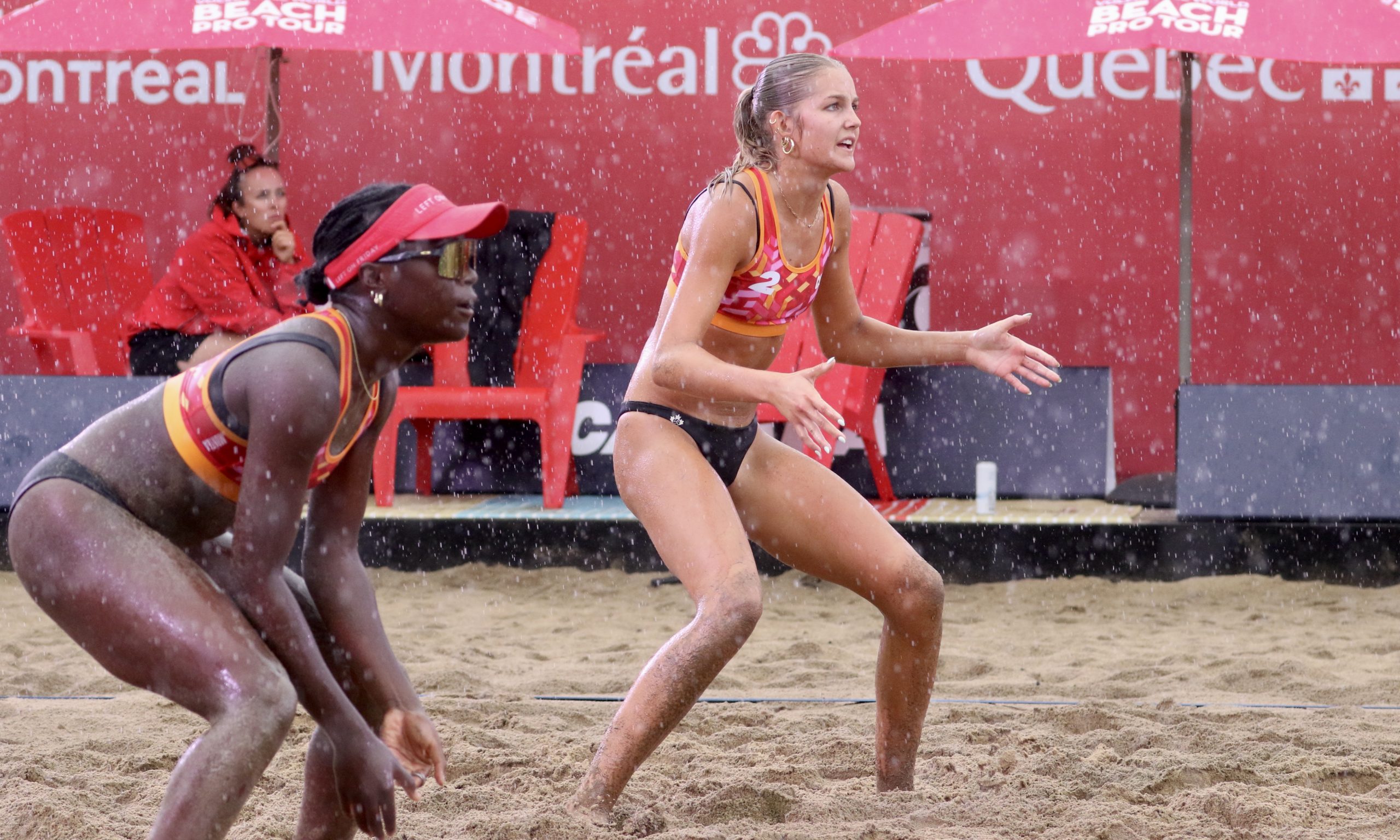
MONTREAL — This is a tale not of two cities but of two visits to the same city. And whether or not this particular August afternoon was the best and worst of times, it was memorable. Still in the first set of her first ever match at the Beach Pro Tour’s highest level, sharing the stage with Olympians, world champions and the sort of star power that would soon pack the Circuit Gilles Villeneuve’s hulking grandstand, Canadian teenager EJ Cudmore squinted through a downpour as she prepared to serve against a United States team.
These weren’t a few stray showers. With bright yellow, orange and red spreading across the radar, rain seemingly made up its mind to take in an afternoon of volleyball. It settled over the island in the St. Lawrence River that is home to Montreal’s F1 track and the volleyball tournament that borrows the venue. It refused to budge. Rather than curse her luck, Cudmore sought the silver lining in the ominously darker and duller clouds above.
“It’s raining,” she told herself of a match she started in sunglasses, “But at least I’m not really hot, and my feet aren’t burning.”
Take things as they come. You never know what life may bring.
When Cudmore and partner Ofure Odigie saw approximately 20 teams ahead of them on the initial reserve entry list for the Beach Pro Tour Elite 16 tournament in Montreal, they knew that making it into the 16-team qualifying bracket was unlikely, to put it mildly.
But what else was new? There was nothing likely about Cudmore being even that close to the draw three years after sitting in the stands as a relative newcomer to the sport.
An indoor specialist who dabbled in everything from pole vault to badminton, she never intended to start playing in the sand. When she did, midway through high school, she wasn’t entirely sure she enjoyed it. She didn’t plan to follow it across a border to university, earning 2026 Atlantic Sun Freshman of the Year honors for a Stetson team that reached the NCAA Championship. She didn’t imagine crossing oceans to events from the Czech Republic to the Philippines.
None of it was likely. It happened all the same.
Still on the outside of the draw looking in, she and Odigie went to Montreal a day before qualifying was to begin. Cudmore hitched a ride from the national team training center in Ontario with a fellow athlete. She had one change of shirt and nowhere to stay—worst-case scenario, she figured she could sleep in the airport before an early morning flight to Florida and start of a new school year. Then, at just about the last stroke of the last minute, Cudmore and Odigie got the last spot in the qualifiers. Three years after watching from the stands, she looked up from her chair in the sand and listened as the emcee introduced her.
So, when the clouds opened and the rain poured down, she didn’t flinch. It never crossed her mind that this wasn’t how a debut was supposed to go. She wasn’t living out a lifelong dream, every detail scripted in her mind ahead of time. She was living out a different lifelong journey. Namely, life. With all the improbable twists, unexpected turns and unlikely destinations it offers to those willing to see where it leads.
And in life, sometimes it rains.
“It doesn’t matter if it’s raining or windy or whatever, I know I can play through it,” Cudmore said. “Even when it’s raining, I feel like a lot of people get really distracted by it or think too much about it, but I’m like ‘No, this is my game, and I’m excited to play.’”
Odigie, left, and Cudmore prepare to take the court (photo by Graham Hays).
The First Road to Montreal
Three years earlier, Cudmore was just one among many fans when the tournament set up shop just a few hundred yards down the F1 track, a distance players now cover in golf carts that whisk them from the practice courts. This was 2023, and she had only been playing beach volleyball for about a year. She was in Montreal for a youth event bringing together athletes from Ontario and Quebec. They took a field trip to the Beach Pro Tour tournament.
She knew about fellow Canadians Melissa Humana-Paredes and Brandie Wilkerson, of course, and her other countrypeople. Most of the rest of the names were unfamiliar. She enjoyed watching one of the Brazilians launch skyball after skyball. She was impressed by the way the Japanese played defense, turning it into something of an artform. She liked how the line between competitor and crowd blurred when the players left the court, some of the world’s best athletes mingling with fans and soaking in the vibe.
As she recalled, “That was kind of the first ever time where I thought ‘This is really cool, and this could be something I could do in my life.’”
Growing up in Barrie, Ontario, Cudmore didn’t imagine volleyball in any form taking her anywhere beyond the local gym. She played indoor for fun, nothing more. Even in a place she describes as less than a volleyball hotbed, she wasn’t the big star. She doubted she was good enough to play in college on either side of the border. Still, when the opportunity came to apply for Team Ontario consideration, her mom encouraged her to at least fill out the forms. Athletes could express interest in beach volleyball by checking an additional box. Why not, she figured. Never mind that she had never played beach before.
She wasn’t surprised when she got the email telling her she hadn’t been selected for the indoor process. More surprising was their interest in her for beach volleyball, presumably mostly down to the scarcity of teenage blockers who were already 5-foot-10. As her dad drove her the hour and a half to the training facility, she read the sport’s rules. What did they mean open-hand tips weren’t allowed?
She was raw. But she was an athlete. And perhaps most importantly, when the provincial coaches asked if she was willing to make that same three-hour round trip multiple times a week, she didn’t hesitate to say yes.
“I was terrible,” Cudmore said matter-of-factly. “I didn’t win a single medal. I won maybe four matches the whole season.”
The coaches encouraged her to stick with it, for what reason she wasn’t sure. Go back to indoor for the winter they said, but come down a couple of times a week to keep learning the beach game at an indoor facility. If the following summer rolled around and nothing had clicked or she was miserable, they could reassess.
“It’s not that I didn’t like beach—because sometimes I did,” Cudmore said. “I just didn’t really know if I liked it or not, and I wanted to give it a fair chance. One of my big things, and it comes from my parents, is once you commit to something, you stick to it. And if you don’t want to do it after you’ve done your best, that’s 100 percent fine. But if you say you’re going to do something, you have to follow through so you won’t live with regrets.”
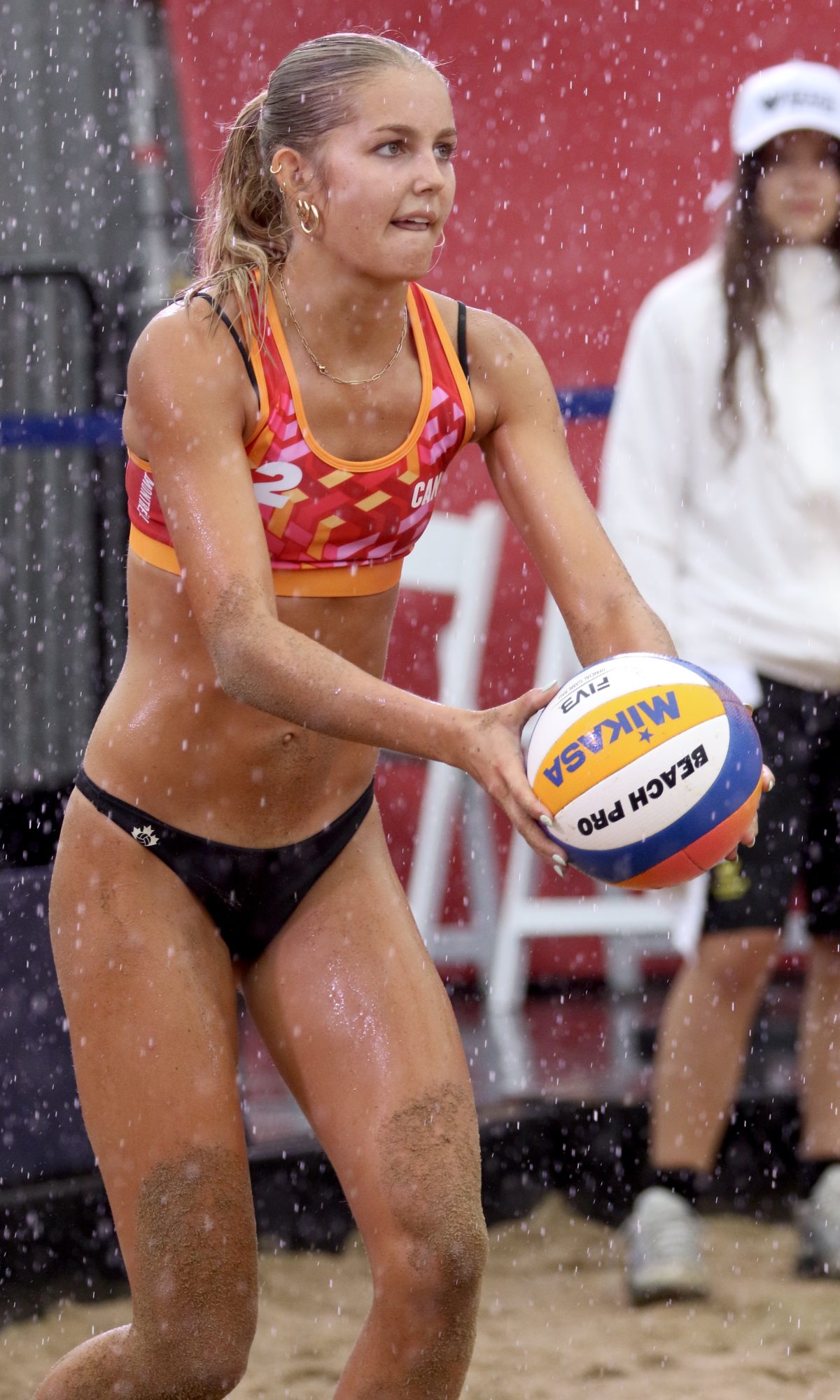
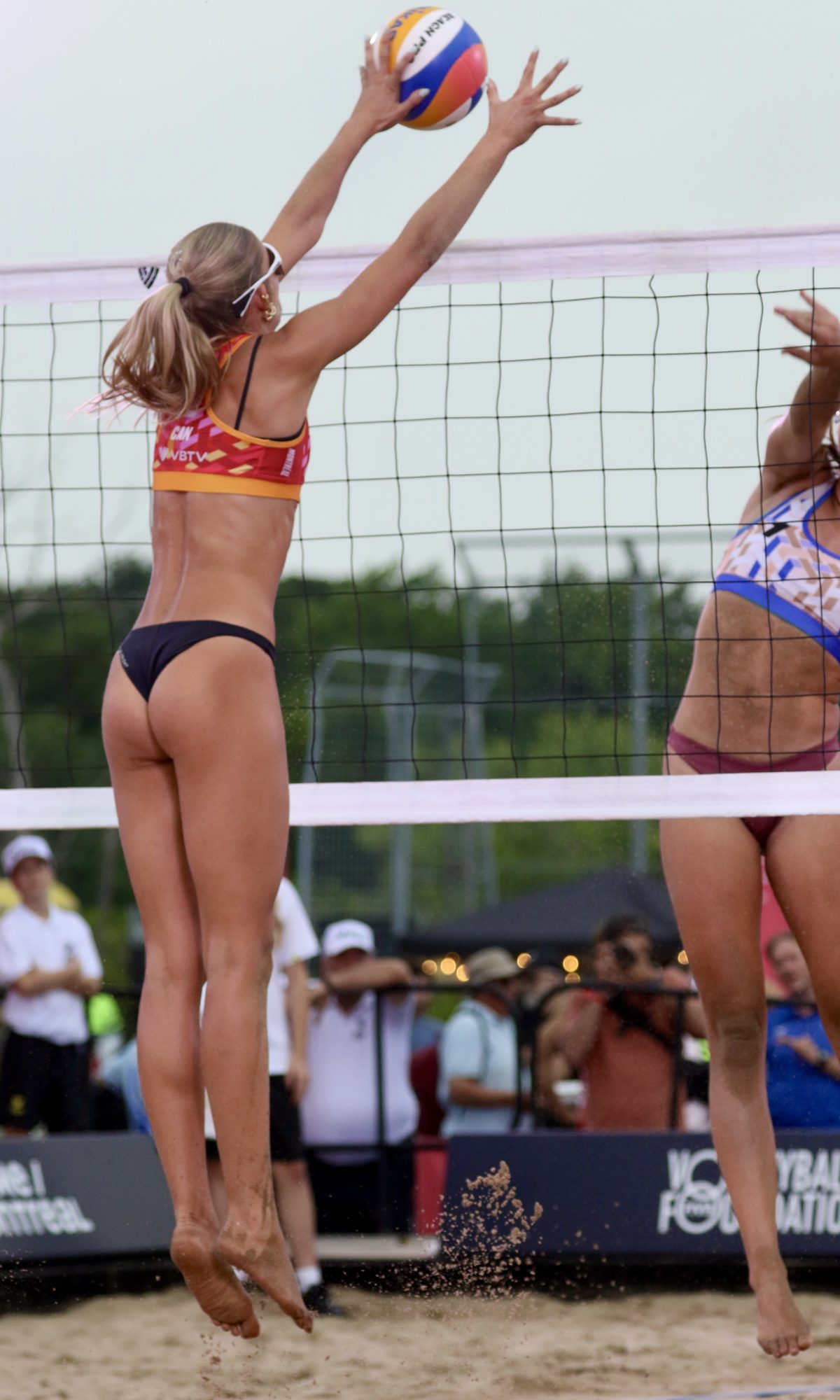
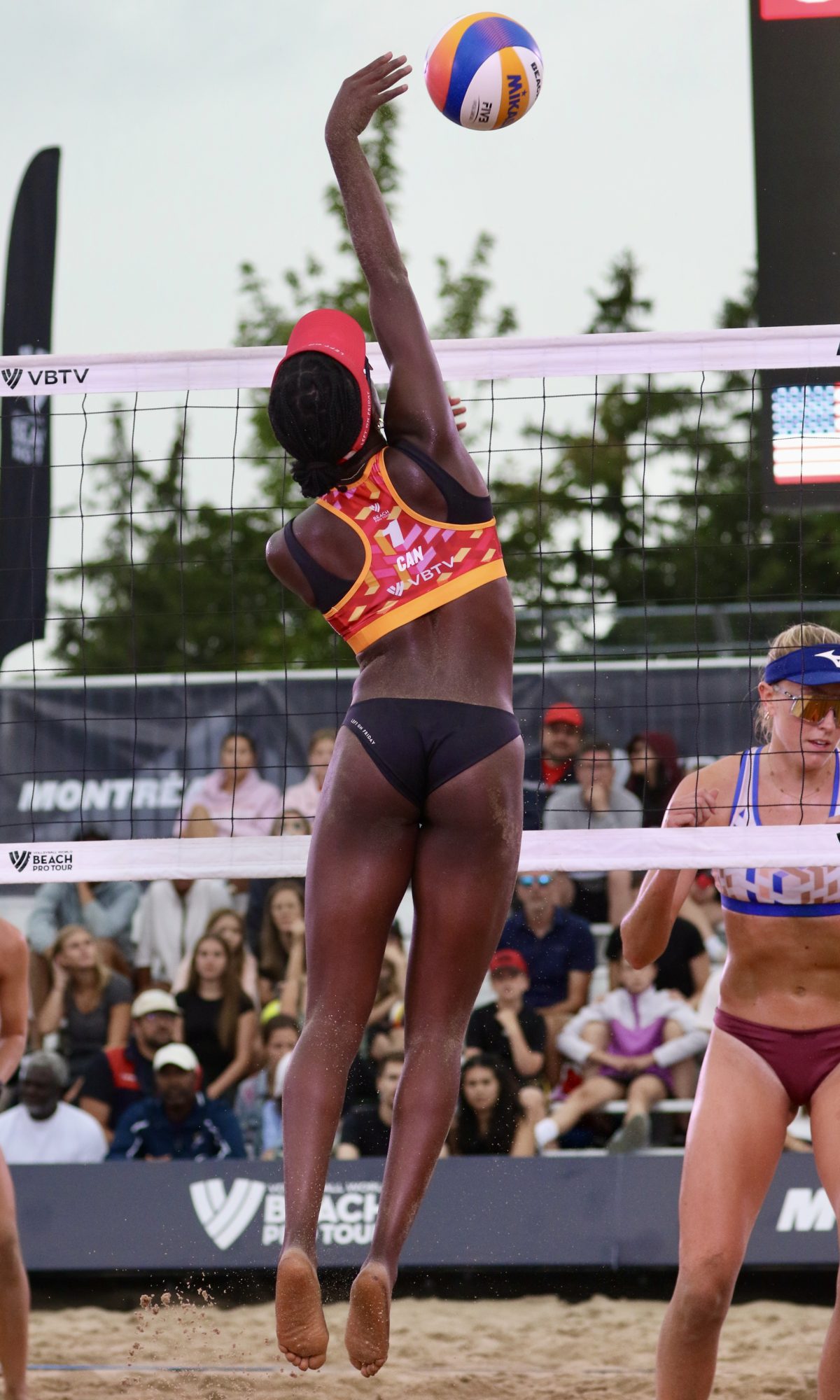
Cudmore, who turned 20 after the tournament, was one of the youngest players at the Montreal Elite 16 (photos by Graham Hays).
Nothing planted her feet more firmly in the sand than finding a partner in Autumn Mikel. Frankly, as her second summer in the sport arrived, Cudmore was surprised the more experienced defender even wanted to play with her. That’s a bit of a theme with someone who expresses puzzlement that everyone from national team to college coaches ever gave her a second look. But the pairing worked. A few weeks after attending the 2023 Elite 16 in Montreal as fans, she and Mikel earned silver medals in the 18U division at Canada’s Beach Nationals—Cudmore playing up an age bracket.
Over the course of more than a year playing together, they would go as far afield as a Futures event in Brno, Czech Republic. It was the first Beach Pro Tour event for either one of them. It didn’t go well. They lost 21-10, 21-7 in 25 minutes in the opening round of qualifying against the Dutch duo of Mila Konink and Noa Sonneville. Competitively, it was a step too far too soon. Maybe a couple of steps. Cudmore was still just 17 years old.
They also did plenty of winning domestically, but it was never really the results, good or bad, that made the partnership such a formative experience. Playing and traveling with Mikel taught her less about how to win than why competing matters in the first place. It immersed her in the camaraderie, shared space and competitive vulnerability of relying on someone else that is at the heart of every team sport—magnified tenfold when stripped down to its most elemental form between two people on a beach volleyball court.
“Volleyball is not just about having fun, obviously, but she really helped me realize it’s not only about winning,” Cudmore said. “We would lose games and still be able to appreciate that we’re having fun—like if we’re together, it doesn’t matter. And the same way, we would win games just based on our relationship with each other. There were games that people wouldn’t think for a second we would be able to win, but then we somehow win because we’re so connected with each other.
“I feel like that’s when I started to enjoy it more because I’m like, ‘OK, I’m actually doing something with this. We’re working toward something.’”
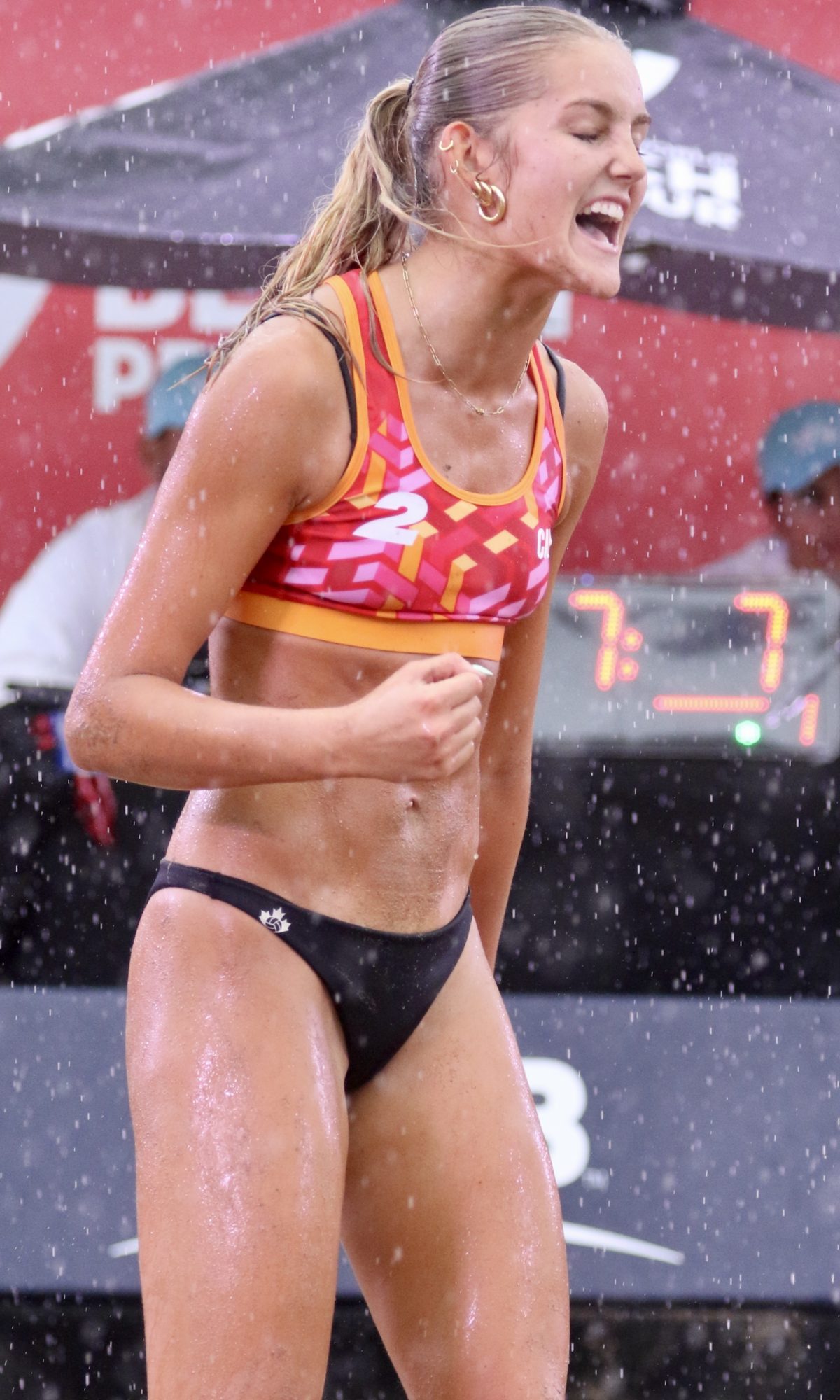
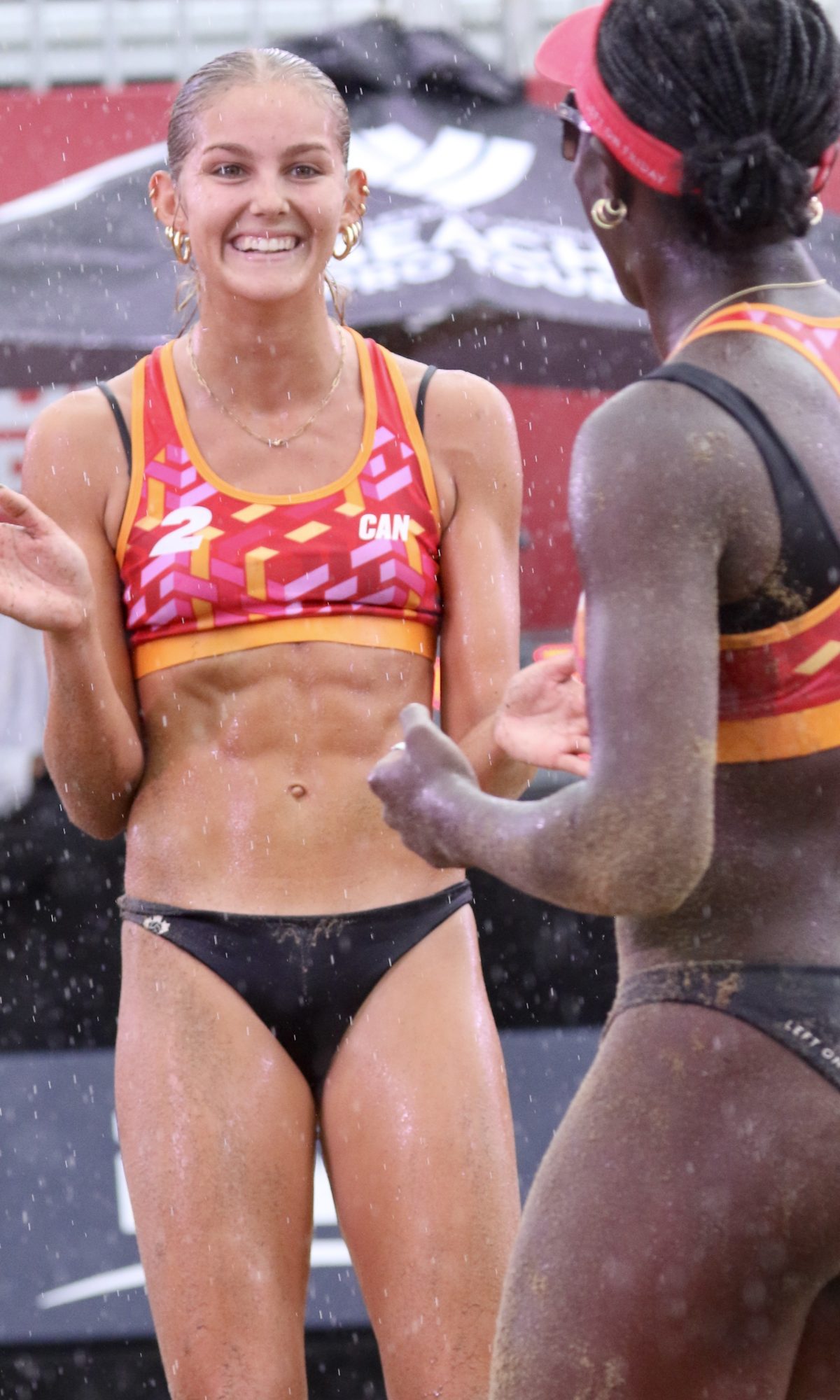
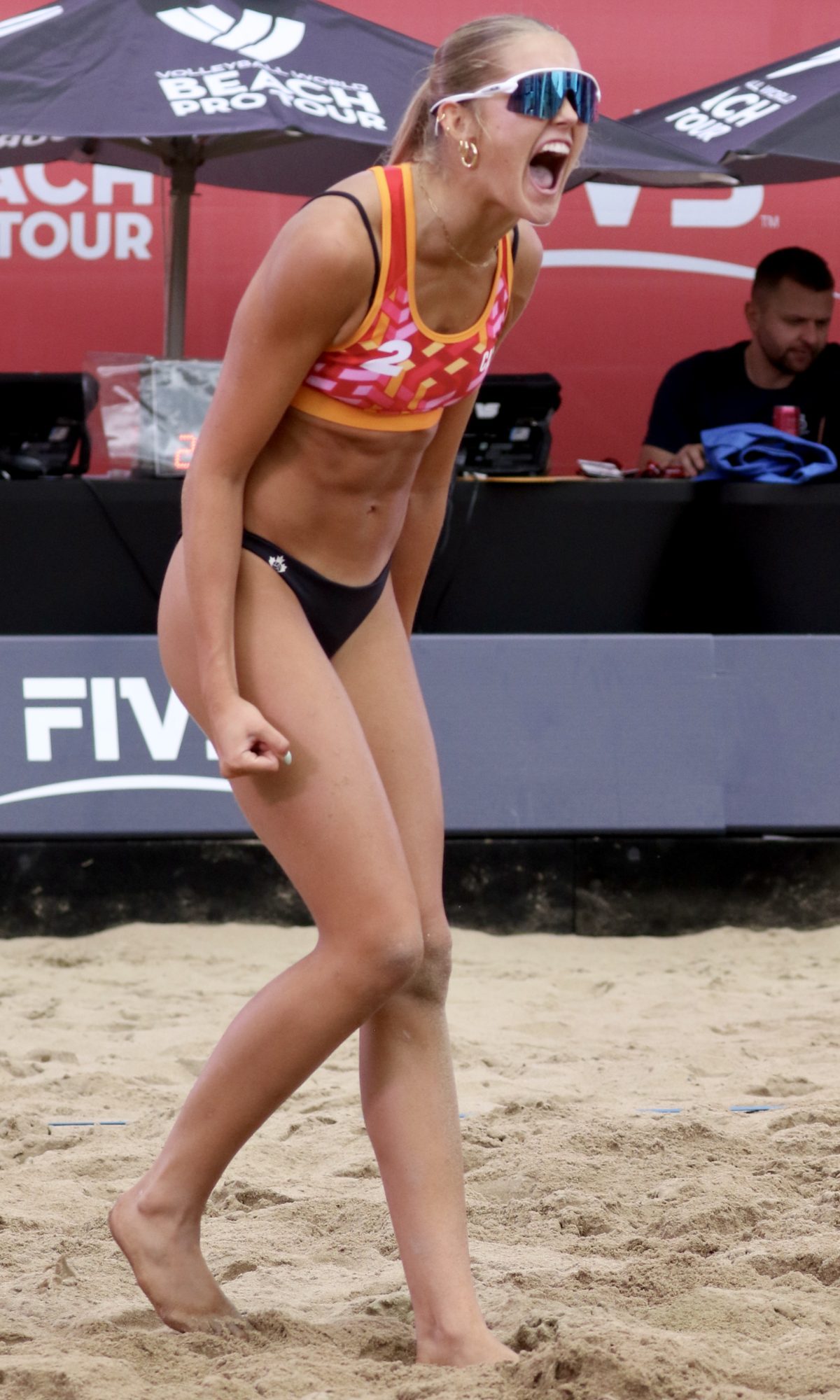
“I play my best when I’m having fun, laughing, when I’m doing weird moves that are scoring, when I’m loud.” – EJ Cudmore (photos by Graham Hays).
The Road Back to Montreal
Mikel now plays indoor volleyball for Fanshawe College in London, Ontario. Cudmore nearly followed a similar path. Finally convinced that she was, in fact, good enough to play indoors collegiately, she intended to go to the University of Waterloo. The volleyball program wanted her. One of the country’s top-ranked universities, Waterloo is also home to Canada’s biggest university-level aviation program, which appealed to an aspiring pilot. It was also her dad’s alma mater. She liked the idea of carrying on the family tradition—he had played football at the school. It was, as such things go, a dream scenario.
She remembers having dinner with her dad one evening in Waterloo, a frequent destination. It was almost an offhand remark, mentioning an American school had reached out about playing beach volleyball. But it wasn’t a big deal, she noted. It wouldn’t change her plans. She doesn’t recall her dad’s exact words, but the message was something along the lines of she would have to be the world’s biggest idiot not to give the United States a try. Dads often have a way with words. Go for a year, two. Try it. Waterloo wasn’t going anywhere.
As her senior year of high school began, so did a whirlwind recruiting process—later than for most of her peers. She played showcase events to raise her profile, an intensely stressful ordeal for someone with still limited competitive experience. She drew interest, but almost to a one, schools told her she would need to take a gap year so late in the recruiting cycle. That wasn’t a problem for her. She could work toward her pilot license. Most also told her they might be limited in how much scholarship money was available. That was a problem. Paying much or all of international tuition simply wasn’t feasible.
Stetson was the exception. Long-time head coach Kristina Hernandez offered her a full ride from the outset. She didn’t pressure Cudmore for a commitment. When the high schooler dithered, putting off any decision for weeks and then months, Hernandez waited.
“She was very certain about me,” Cudmore recalled. “I feel like that’s something that I never really had. Not many people were certain about me, especially when I was playing all these games, and I was just not that good. So they were like, ‘She might work out. She might not.’ No one else was ever like, ‘Yes, her, she’s the one. She’s good.”
Canada has been good recruiting ground for Hernandez, who needs to go down a few more roads and take on a few more projects than the peers in bigger conferences with whom the Hatters routinely go toe to toe. She goes north every summer to attend the Canadian national championships and spread the word through teaching opportunities. Cudmore had been playing seriously for perhaps a year when Hernandez first crossed paths with her.
“Even when we were doing the clinics, she was on the ground the whole time—she kept falling over,” Hernandez recalled with a chuckle. “She was just a hot mess, but she was tall and lanky, like a little gazelle in the sand. It was so raw, but I remember her hitting and connecting on one or two balls, and even as a quick flash, I was like ‘Oh, OK.’
“I’ve been here for 14 years now, so I know the things I like in athletes. I always tell myself if I watch somebody and have to convince myself they’re good enough, that’s probably not a good fit. With EJ, she’s so athletic and so springy in the sand. I just knew this kid can be really good.”
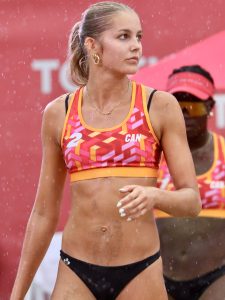
Cudmore during qualifying in Montreal (photo by Graham Hays).
These days, Hernandez enjoys the wistful shakes of the head and congratulations from some of her coaching peers, who lament missing out on as promising a talent as Cudmore proved to be in her debut season at Stetson. As Hernandez notes, you’re bound to miss on enough evaluations that you might as well take some satisfaction in the ones that land.
It’s a far cry, in a very short amount of time, from those gazelle-like early encounters. But collegiate honors, let alone a place on center court in Montreal, seemed, well, unlikely, as recently as last fall. After her gap year, marred by the sort of personal loss that shakes any young life, and a summer spent playing with a variety of partners, Cudmore struggled to settle in at Stetson.
“I wouldn’t say we thought we made a mistake,” Hernandez said, “But I was like, ‘Oh, I don’t know if she is going to challenge herself as much as we expected.’ … I think that even she didn’t really believe that she could play at that level, so she accepted a lot less [than she was capable of].”
She wouldn’t be the first freshman, athlete or otherwise, to need a semester to find their place—and confidence—in a college setting. Hernandez also credits Ontario Volleyball’s Angie Shen, senior manager of coaching culture and beach development, for supporting Cudmore without letting her settle for the false comfort of lowered expectations.
Returning stateside after winter break, she performed so well in preseason that she beat out a returning No. 1 seed. She alternated between the top couple of spots throughout her freshman season. And again, a partnership helped move her forward. Cudmore played much of the season with Julia Radelczuk. The Polish athlete is only a class ahead in eligibility but brings the experience of more than a dozen Beach Pro Tour appearances, including a silver in the 2024 Warsaw Futures.
Although as intense a competitor as anyone on the roster, Radelczuk was patient with a freshman still on the steep ascent of a learning curve. When opponents targeted Cudmore early, Radelczuk hid any frustration at miscues. She handled the strategy and adjustments on the court, freeing Cudmore to lean on her athleticism and concentrate on competing.
Stetson’s standout Spanish duo of Maria Ozaeta and Marta Carro took home ASUN Pair of the Year this past spring, but Cudmore and Radelczuk earned first-team honors alongside their teammates and Cudmore earned Freshman of the Year. Hernandez plays it coy when it comes to whether the two will team up again this season, but that’s also the point. They may not need to for Stetson to be its best. Now, it’s Cudmore who may be ready to take a newcomer under her wing and free Radelczuk to lend her expertise elsewhere.
“EJ is really open and not afraid of us telling her what has to be better,” Hernandez said, “But now equally, she believes in what she’s capable of. She’s such a dynamic athlete. How many athletes do you have, especially on the female side, who are just so super springy, super lanky, super quick in the sand—not big load, just really quick, fast twitch.”
All of which set the stage for the summer that concluded in the unlikeliest of places: center court in an Elite 16.
A Downpour and the Road to Come
It made for a curious sight, even if rowers at work in the waters of the Olympic Basin that runs behind the beach volleyball venue in Montreal were the only ones who saw it. Riding next to each other on the rear seat of a golf cart speeding along the path from the practice courts to the main venue, two women bobbed their heads and dipped their shoulders in seemingly perfectly synced choreography. Except there was no music, just the buzz of the cart’s small motor. It’s like this at most tournaments. Rather than lose themselves in their own respective worlds, Cudmore and Odigie will often don their headphones and listen to the same song at the same time in the minutes before a match, inaudible to everyone else,
“We never stop laughing at our tournaments,” Odigie said. “We are always giggling about one thing or another. We just enjoy each other’s company a lot off the court.”
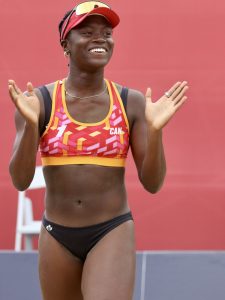
Odigie taking the court in Montreal (photo by Graham Hays).
After playing with a number of partners for Canada throughout 2025, Cudmore found something that stuck with Odigie late in the summer. Although far from a beach volleyball old timer, Odigie followed a slightly more conventional path in the sport. An indoor player, she started playing beach volleyball in 2020, at the 14U level, when an indoor club coach encouraged everyone to play both to aid their development. Initially uncertain about all the complications of sand and sun, Odigie soon enough made beach her priority.
“All the wins and losses attribute to how you play, how your partner plays and how you guys play together,” Odigie said. “It feels like a more personal game than indoor because you can have the best game of your life in indoor but you still lose—or the worst game of your life and you still win. In that way, I feel a little more connected to the sport of beach volleyball.”
When Cudmore and Mikel earned their 18U silver medals at nationals in 2023, Odigie was busy winning gold in the 17U division. A year later, at around the same time Cudmore learned difficult lessons in Brno, Odigie reached the knockout rounds of the 2024 FIVB U19 World Championships in China. She’s now at Stanford, and in the most Stanford way imaginable, majoring in bioengineering while part of the beach volleyball team that played in the national championship match this past spring.
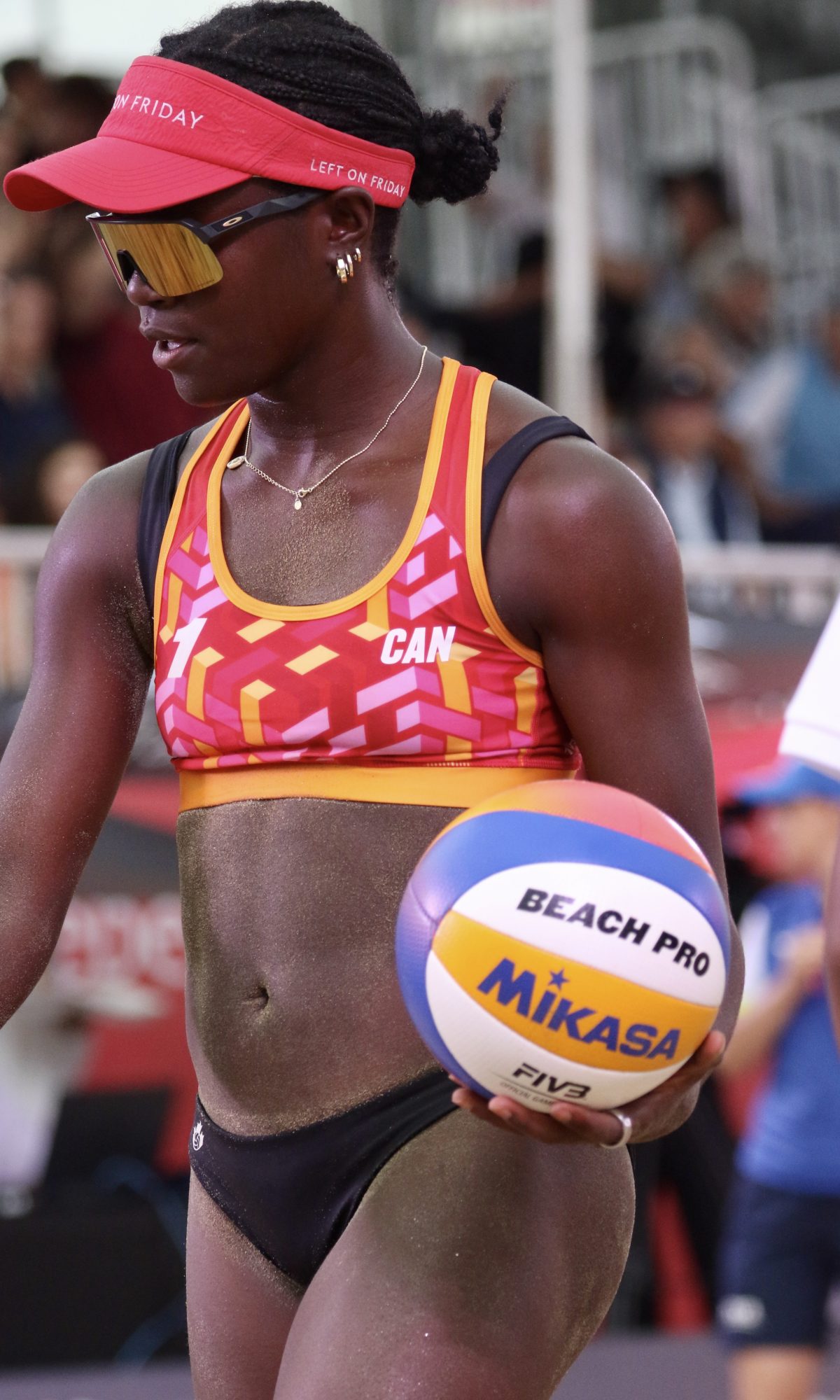
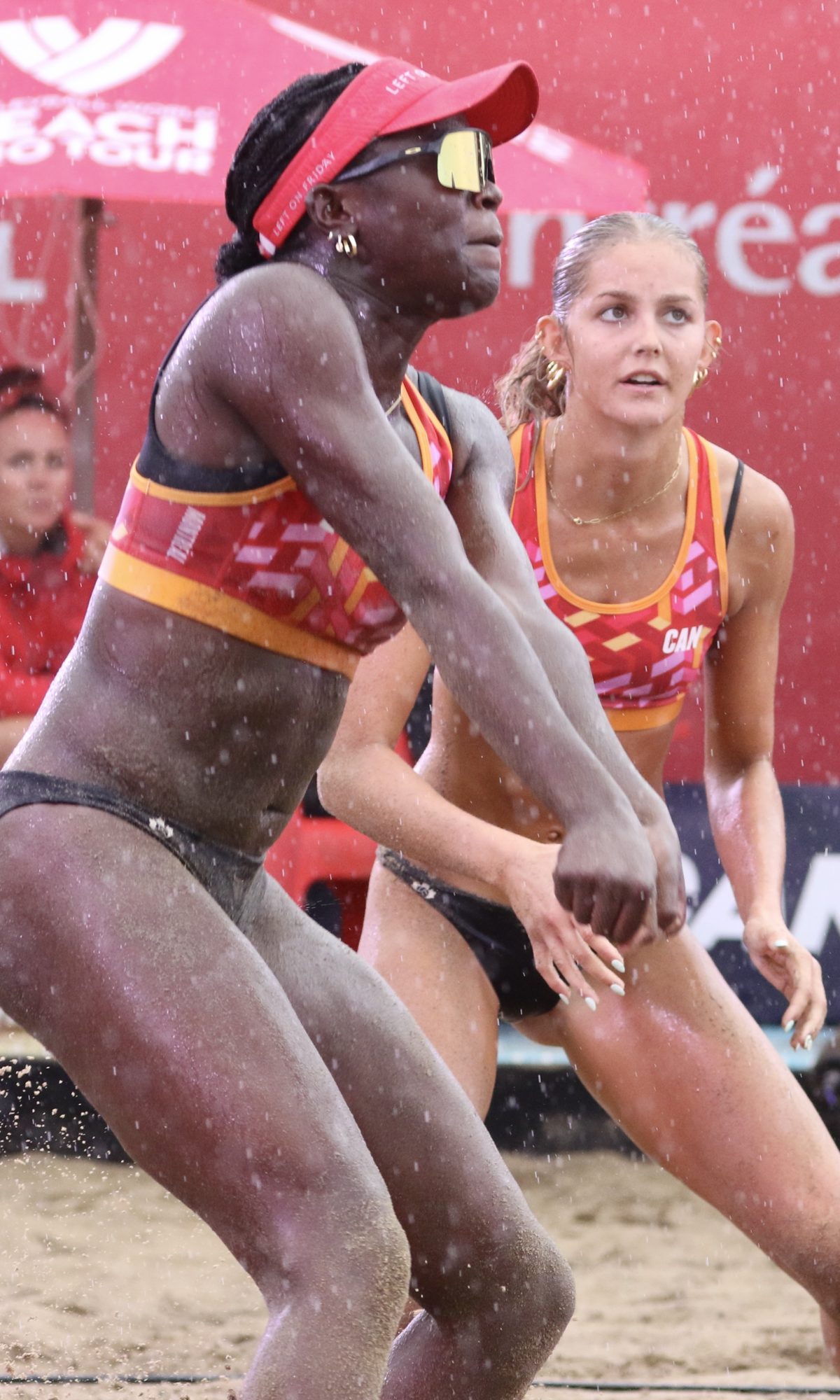
“I think there’s a lot of catching up that we both had to do. We’ve both put in a lot work to be able to compete at higher levels,” Odigie on the team (photos by Graham Hays).
She knew Cudmore before they ever teamed up, had competed against her often enough in Canada. But she didn’t know the gazelle slipping around the sand or the newcomer unsure of where she fit in. She didn’t see an unlikely partner, just someone who could help her get to where she wanted to go in the sport.
“I think what drew me to her as a partner was even within our first couple of practices, when we were still getting to know each other, we just had this really easy communication,” Odigie said. “I feel like we are both really good at asking for what we need—and also giving the other person what they need. She’s a really great communicator. Obviously, there are times in all partnerships when communication isn’t going as well as it could. And I feel like we always have those really good sit-down conversations about what we need to better our partnership going forward.”
This summer, they entered Futures tournaments in Greece and England. They had to work their way through qualifying brackets in both events. In Greece, they persevered through and adapted to wind unlike just about anything they had encountered. In England, after surviving a 15-13 third set in the first of two qualifying rounds, they advanced all the way to the quarterfinals—this time coming within a dropped 15-13 third set of the semifinals.
Odigie had more experience, but for perhaps the first time, Cudmore needed to be an equal partner. By her own telling a “loud” player on court, reacting, emoting and riding the waves of a match, she learned to read those moments when Odigie, by no means stoic all the time, locked in and needed her partner to come with her. Just as Odigie did the same in those moments when Cudmore needed someone to get loud with her.
If understanding the importance and unique bonds of a partnership, that odd mixture of co-worker, travel companion and, sometimes, close friend, helped convince her to love the sport and brought her to Montreal the first time, growing into a player who understood how to give that in return brought her back to Montreal. This time, on the court.
“There are different ways to play and what works for me isn’t going to work for everybody,” Cudmore said. “I can’t be selfish and want to play my way if it’s not going to benefit the team. I’ve learned a lot from Ofure in that aspect, and it has definitely made me a better player.”
They arrived in Montreal the day before qualifying, practiced a couple of hours before the technical meeting for players and then waited. Literally, waited on a bench outside the room to see if they made the draw. From afar, Cudmore’s mom found them a place to stay for the night. Cudmore had to run to the pharmacy that evening for hair gel.
They didn’t win. Up-and-coming Americans and Florida State alumni Alexis Durish and Audrey Koenig were just a little bit sharper in the rain. The Americans looked like a team with four BPT podium finishes and three wins—including a pair of Challenge event earlier this year. The Canadians were left to dry out and wonder what might have been if they had stopped a run a little sooner or found the line a few more times. Never mind that a place opposite Ana Patricia in the next qualifying round was what might have been.
Neither Cudmore nor Odigie was satisfied with defeat. They weren’t just happy to be there. But all the same, they understood that being there was no small accomplishment.
“I’m really proud of how we carried ourselves throughout the whole season and how we fought through really big points and got ourselves out of little ruts that we had on the court,” Odigie said. “I’ll remember those lessons as motivation for when I’m in those moments again—I know I can get out of them. I know that we can communicate during tough times and have each other’s backs when the other person’s not feeling so great.”
How likely is it that Montreal was just Cudmore’s first taste of beach volleyball on the biggest stage? Or that she and Odigie will one day draw the same sort of reaction from Canadian crowds as Humana-Paredes and Wilkerson? Such heights seems far-fetched. Three years ago, to Cudmore, so would playing in the event she was then watching.
That’s the thing about life. It isn’t governed by probability. It’s lived in the improbable margins. It’s made by the unlikely moments.
Cudmore salutes the home crowd in Montreal (photo by Graham Hays).
Maybe you find your calling early. Maybe you train with the best coaches and biggest clubs from your grade school days. Maybe you follow the script that is supposed to deliver a desired outcome.
Or maybe you check a box on a form in high school. You go where that leads you. And find people who make you better at every step of the way. Maybe even all the way to center court. In a downpour. Because likely isn’t the same as certain. And unlikely isn’t the same as impossible.
“This kid is just evolving constantly in front of our eyes—and she’s just a sophomore,” Hernandez said. “I’m so excited for her because she has the right mentality, and she wants to learn and get better. She’s such a joy to coach.
“As young as she is, and it’s outrageously crazy how very, very new to the sport she still is, I’m just so excited for when she gets back the next time. She will do something totally different, and she will be very different.”
Keep Reading …