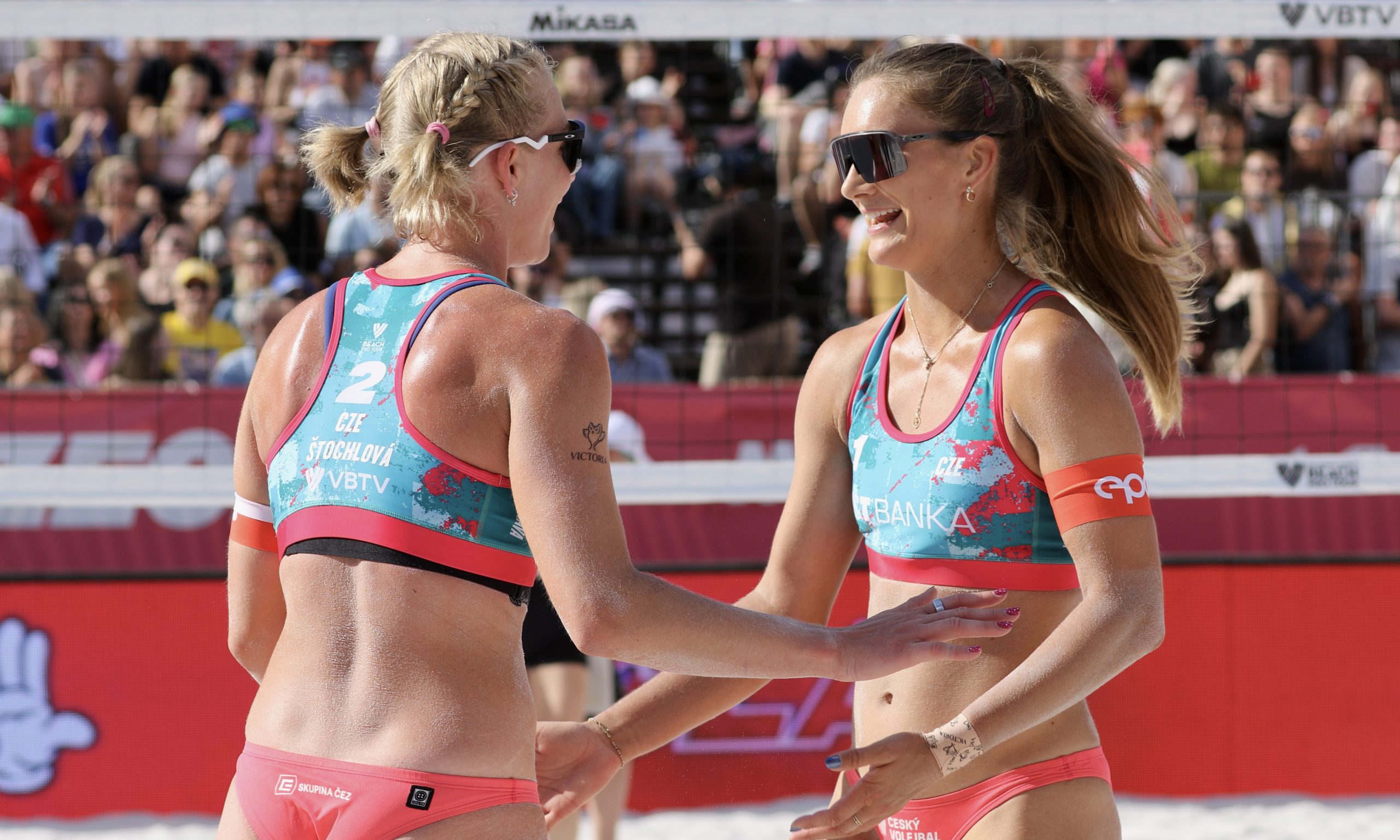
It’s when Markéta Svozilová stops smiling that Marie-Sára Štochlová starts worrying.
Still working her way up the world rankings alongside Štochlová, her partner since the start of 2025, Svozilová is already among beach volleyball’s more distinctive competitors. She’s the one with a smile on her face. Seemingly all the time. First or third set, good or bad point, there’s a reasonable chance “Maki,” as most call the 23-year-old Czech, greets the moment by, as Thoreau put it, silently smiling at her incessant good fortune.
So, it’s those rare moments when the smile fades that Štochlová knows a match is going off the rails. It’s also when you might overhear a vaguely absurdist dialog, the 2024 Olympian urgently imploring Svozilová to get back to smiling. So that they can get back to winning.
Svozilová is one of life’s grinners, genially unassuming and infectiously good-natured. But in truth, there’s also a bit of strategy to her on-court countenance. Those 14-13 third-set deficits are no less stressful for her. Mistakes are no less frustrating, extended rallies under an unrelenting sun no less exhausting. She experiences the same emotions others show. She just doesn’t want anyone on the other side of the net to know.
“I always like playing against people who are super emotional because I feel like when they show emotions, you actually kind of know what’s going on,” Svozilová said. “Sometimes it’s really hard to play against people who are just always the same or show no emotions at all. It’s hard to tell what they feel. So I think it works for me to be the same all the time and keep smiling—and sometimes it’s almost like that makes me play good again. When things go wrong, I think the smile lifts my game.
“Just keep smiling and enjoy that I get to play.”
-
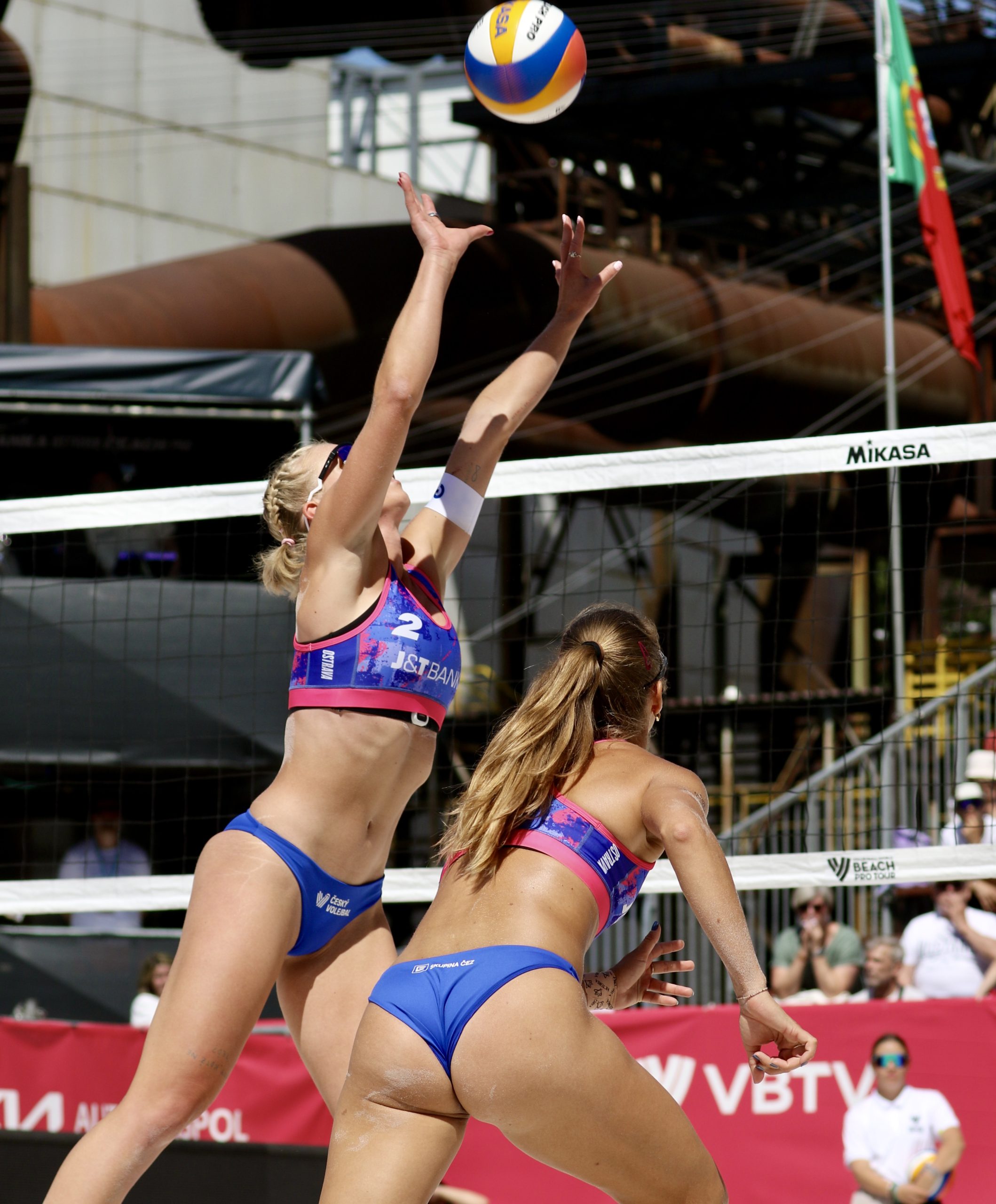
- Marie-Sara Štochlová sets Maki Svozilová in Ostrava (photo by Graham Hays)
-
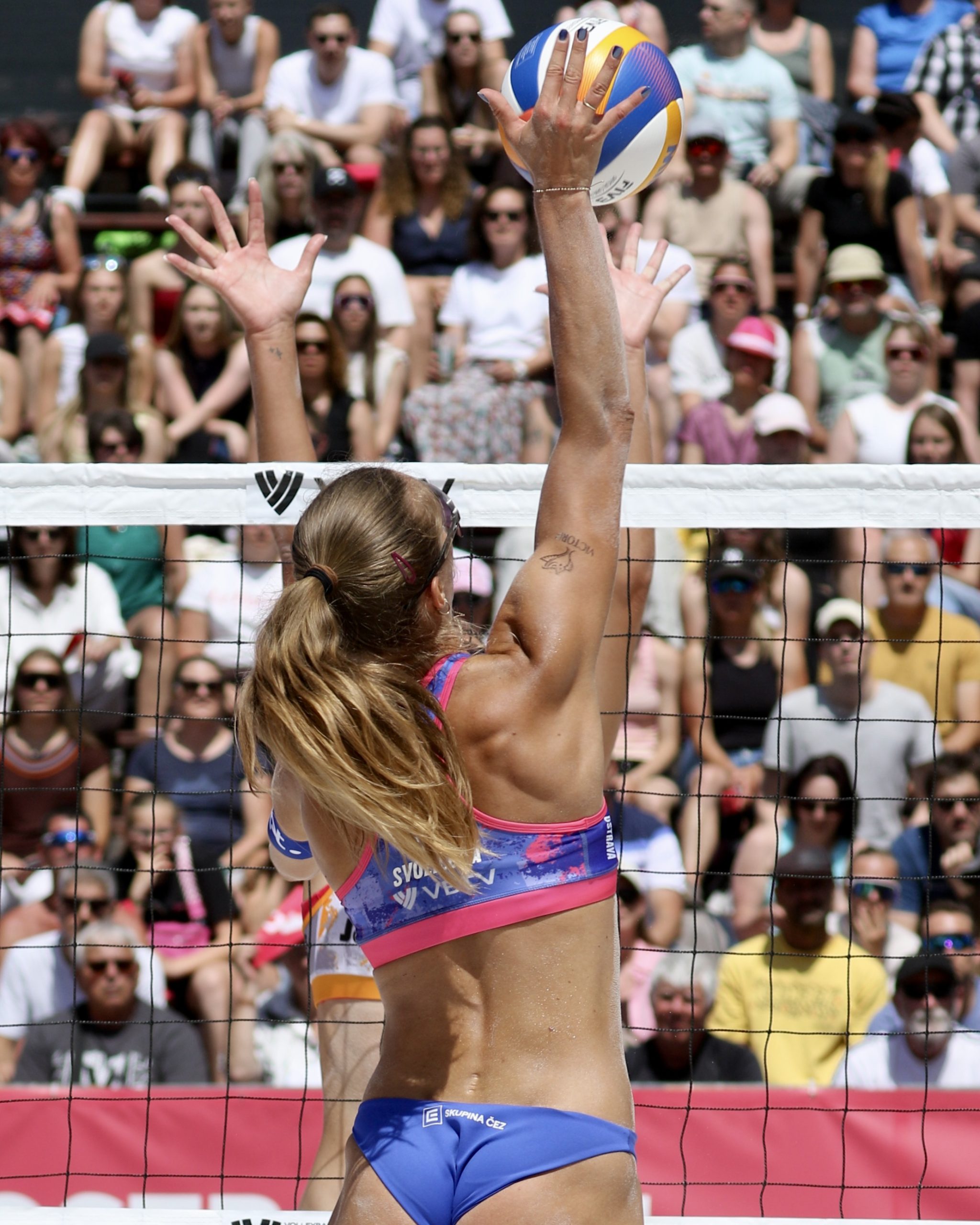
- Maki Svozilová at the net against Spain (photo by Graham Hays)
-

- Maki Svozilová prepares to serve (photo Graham Hays)
A little more than 12 months removed from a decorated NCAA career at Florida Atlantic, where she earned both AVCA and Academic All-America honors, Svozilová is in some ways no different than recent graduates and 20-somethings the world over.
Granted, she has more airline miles and a more encyclopedic knowledge of coffeeshops in Saquarema, Brazil, or Shangluo, China, than most. Not to mention, a patina of sand on seemingly everything she owns. She has a unique job, and, with Štochlová, uniquely bold ambitions: the 2028 Olympics. At least one Czech women’s team has qualified for the past four Olympics, and six of the past seven. Recent gold in the Shangluo Challenge, their first BPT medal together, is further proof Svozilová and Štochlová have the potential to carry the flag forward.
And yet like most her age, whether in law firms, artist studios, research labs or still filling out applications in a challenging job market, she’s writing her next chapter in real time. The first year out of school, the first draft of the rest of her life. From growing a new partnership to exploring pathways beyond volleyball, figuring out where that story goes from here means navigating more than an Olympic qualification process. It means navigating a life unbounded. Daunting, difficult, exhilarating and, if lived boldly, worth smiling about.
“It still seems unreal that I get to do this,” Svozilová said. “When I was young, I was watching all these people, my role models, playing on different continents. And I remember thinking ‘Oh, I would really love to do this one day. But I think it is impossible.’
“And then it happened. This was my dream, and I think that’s why it makes it so special. I don’t want to stop doing this because it just brings me so much joy.”
Diving in the Deep End
It’s probably for the best that Svozilová looks back at the transition as living a dream. Because it has often afforded scant time for sleep. As her final spring at FAU arrived, she had one foot in the old world and one in the new world. Sometimes almost literally. Consider her calendar from spring 2025.
On March 16 that year, she wrapped up a weekend tournament in Pompano Beach, Florida. She and collegiate partner Ashleigh Adams lost their match against fourth-ranked USC before winning a three-setter against third-ranked and eventual national champion TCU. Three days later, playing alongside Štochlová, for the first time on the Beach Pro Tour, she was dodging Valentina Gottardi spikes during a three-setter against Italy at the Challenge event in Mexico’s Yucatan. Seeded No. 22, they finished ninth.
She and Štochlová stayed in Mexico for the following week’s Elite 16 event in Quintana Roo, but they weren’t exactly heartbroken when they lost in qualifying. That setback allowed them to make their flight to Prague in time for a weekend domestic event that determined which Czech team would get a wild-card entry into the Ostrava main draw later that spring. They earned the wild card, jet lag be damned, but there wasn’t any time for Svozilová to head home and see her family or friends. On Monday, she and Štochlová had to visit the Chinese Embassy to arrange their visas for an upcoming Challenge event in Xiamen, China.
Then she was on a plane and back across the Atlantic to FAU—just in time for a trip north to the panhandle. On April 4, three continents, three events and not quite three weeks later, she and Adams opened a tournament at Florida State with three-set wins against South Carolina and No. 10 LSU.
Thanks in part to her own stubborn excellence, she even missed FAU’s commencement. Her peers walked in Boca Raton on May 1. A day later, she closed her collegiate career alongside her teammates in the NCAA Championship in Gulf Shores, Alabama.
By the end of the following week, after wrestling as many of her belongings as she could into a couple of decidedly overweight checked bags for the flight home to the Czech Republic, she was back in the airport again, visa in hand, for a flight to China.
“I came home and I was destroyed,” Svozilová said with, of course, a smile of returning from Xiamen with a fifth-place finish. “But it was fun times. Crazy. But fun times.”

Štochlová, left, and Svozilova won the Shangluo Challenge for their first BPT medal together (photo by Graham Hays).
Even calling what she returned to home is a bit of a stretch. The Brno native had decided to move to Prague, for training purposes, following her time in Florida. But she never quite got around to finding an apartment last summer. She was never around long enough, lending physical reality to the sense that she was very much betwixt and between chapters in life.
Going abroad in the first place was as much serendipity as carefully crafted plan. If FAU hadn’t offered her a full scholarship, she probably couldn’t have made college in the States work. If she hadn’t liked the idea of playing for the late Capri Grotowski, the beloved head coach who passed away from cancer in 2022, and her husband and current FAU head coach Steve Grotowski, she probably wouldn’t have taken the chance. As it was, she figured she would take it year by year. She could always leave. Four years later, she could scarcely process that it was time to go. She had friends and a volleyball family, memories and a degree. She even got used to living in a land where you needed a car to get pretty much anywhere, or at least the electric scooter she used to go grocery shopping.
The whirlwind of continents, competitions and partners last spring and summer was almost helpful. There wasn’t time to ponder the bigger picture. She threw herself into volleyball, living in the sport for a bit. Figuring out the rest could wait.
The Start of Something
The new partnership was four years in the making. In the months before she left for her freshman year at FAU, with both of them in the market for new partners, Štochlová proposed an alternative to going to the United States. They could team up. Svozilová stuck with FAU. When Czech legend Markéta Sluková stepped away, Štochlová instead teamed up with Barbara Hermannová, ultimately making it to Paris and the 2024 Olympics.
Sometimes everyone wins.
By 2025, however, Hermannová, too, had stepped away from the sand. Svozilová had by then played a score of Futures with Kylie Neuschaeferová, the duo taking gold in Brno in their final BPT tournament together. But as Svozilová eyed taking on the Tour full time, she could hardly turn down a second offer to play with someone who by that time had already played nearly in 50 BPT events, the Olympics and the World Championships.
Still, outside of a handful of practices in Florida squeezed in around FAU practices, they had to figure out how to play together while playing against other teams in matches that counted.
“In the beginning, with everything being so crazy, I was just excited and I think I was feeding off the energy Marie-Sára brought,” Svozilová said. “We just had the goal of playing the tournaments we needed to play to qualify for the Europeans, and then the World Championships, too. I didn’t have time to think much about how we work together. It’s all blurry, I don’t even remember how I did it. Now, I have more time to think about everything and how we’re working. But a year ago, I was just playing.”
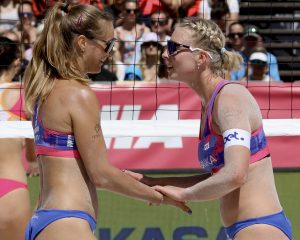
Svozilová, 23, and Štochlová, 27, are eying LA 2028 (photo by Graham Hays).
There wasn’t time for nuance or technical details, especially after a mid-summer physical setback that included Svozilová missing the European Championships. The objective was to adapt and thrive, or at least react and survive. Typically among the best players in age-level events and college volleyball, Svozilová wasn’t used to being targeted. She was used to helping her partner avoid being overwhelmed. Now, she was the inexperienced one who opponents went after with serves. To shore up their side out play, she had to get better at communicating what she needed in the most stressful competitive moments. And when that went well enough that opponents started serving Štochlová more often, the Czech team had to do all the same work in reverse, Svozilová learning to bring out her partner’s best.
They had time to figure out who they were as partners on their global odyssey, traveling from Germany to a pair of events in Brazil, a return trip to Mexico and South Africa before the World Championships in Australia. Time to develop rhythms and routines, like venturing beyond their lodging in search of the coffeeshops that lend a work trip local flavor. But a lot of the volleyball work, paradoxically, couldn’t really begin in earnest until they could approach an offseason and preseason together in 2026.
“Now, we figuring out our roles more because we know each other better,” Svozilová said. “We started exploring what the other person actually needs and trying to work on these little details. We’re learning more and more, so we’re ready for the next period, with [Olympic] qualification.”
The Czech team had the crowd on their side in Ostrava (photo Graham Hays)
Finding New Paths
By late last year, particularly after Svozilová and Štochlová saw their World Championships run come to an end in the knockout rounds, life finally slowed down.
That had its benefits. Svozilová made it to the United States to see her longtime FAU partner Courtney Moon get married, then returned to Boca Raton in early December for the annual Capri’s Legacy Beach Bash tournament that honors FAU’s late coach. Compared to the rushed departure amid the mayhem of May, going back allowed Svozilová, in her own mind, more satisfactory closure. And a chance to bring home the remaining conference trophies that she simply hadn’t been able to jam into her overstuffed spring luggage.
But there was also time to think. Which can be a tricky thing for a certain type of mind.
“I like thinking a lot,” Svozilová explained with laugh. “I’m an overthinking person probably.”
At FAU, Svozilová was not only one of the most accomplished athletes in program history but the first CSC Academic All-American in FAU beach volleyball history. One of only five beach volleyball athletes nationwide so honored in 2025, she left Boca with a 3.97 GPA and a bachelor’s degree in psychology.
Although not solely responsible for her academic interest, she worked with a sports psychologist during a difficult recovery from back surgery her sophomore year. It remains an important part of her training even now, the mental work to keep enjoying the game no less important than the physical work necessary to excel in it.
“Sometimes there are these moments, like when it’s 14-13 in the third set and you are not able to side out and finish the game,” Svozilová explained. “I think it’s really important to talk about this with someone else as well and discover what is going on in your head, and see ‘Why am I not able to do something?’ So that the next time I can at least try some new techniques. It’s really interesting to experiment with your mind.”
Beyond applying those lessons to her own situation at FAU, she was curious about the general principles behind how and why they worked—like someone who doesn’t stop with learning how to change a tire after suffering a flat but seeks to understand how the drivetrain, suspension, wheels and engine fit together. And what a better design might look like. Earlier thoughts of studying chemistry faded away and psychology took the lead.
So, perhaps it’s no surprise her single-track life after graduation didn’t last long. She needed something more to challenge the parts of her mind not occupied with volleyball. One degree in hand, she’s back in school in Prague and working toward another psychology degree with an emphasis on special education. The subject matter fascinates her, and in a country facing a shortage of child psychologists, it is a path of societal consequence.
Recently, she had an opportunity to work with autistic children, including many who are non-verbal. After a year of thinking about the on- and off-court communication necessary for a new volleyball team to reach its full potential during this Olympic cycle, something as fundamental as opening lines of communication with the kids to help navigate food refusal or eating challenges was at once a new and also familiar learning experience.
“I really liked trying to engage with these children,” Svozilová said. “I think the process of finding out what works with them is just super, interesting. It all came together now, and I like what I’m doing outside of volleyball, too.”

Svozilová and Štochlová after falling to Spain in Ostrava (photo Graham Hays)
Life in Progress
Having finally secured an apartment of her own in Prague, she’s slowly developing a local’s feel for the capital. She doesn’t need a car or even a scooter. She has a routine, or as much of one as volleyball’s itinerant lifestyle allows. Coffeeshops and bakeries? You can be sure she’s finding her favorites.
And after going months, even most of a year, without seeing family and friends during her time across the Atlantic, she’s now a couple of hours from Brno. She still has a group of lifelong friends there, many of them women who grew up playing volleyball with her—until they stopped and she didn’t.
“I have conversations with them, and sometimes I feel like I’m the person who is like ‘OK, I don’t actually have a real job,” Svozilová said. “But I’m also learning that beach volleyball, it’s also a job. And there are a lot of things you have to do. It’s not just playing volleyball.”
At some point we all go from preparing for life to living it, from imagining the freedom of charting our own course to the responsibility of control. From dreaming of traveling the world to sleeping in the middle seat in coach on another overnight flight. Perhaps the important part is making the living count, whether it comes with weekends, summer vacations and a commute or the adrenaline rush of a third set in the Alps.
“They think it’s really cool that I get to travel so much and have this different life,” Svozilová said. “But at the same time, in my head, I was like ‘Oh, you guys are so cool that you have this fixed job and you can do these things and it’s so normal.’ I think we’re all just encouraging each other, even though we’re doing different things. I think it was really helpful in this way to understand that It’s normal that everybody has different paths.”
Perhaps what matters is finding the one meant for you. The one that makes you smile.
Keep Reading …