MONTREAL, Canada – There’s a word I learned this summer, on a podcast with John Mayer and Billy Allen.
It’s called mudita.
It’s a Sanskrit word denoting a “pure, unselfish delight and pleasure that comes from watching other people experience happiness, success, or good fortune, without any feelings of envy or jealousy.”
And that, in word, is what commentating has become for me – a week-long experience of mudita.
For the past three years, I have traveled with the athletes on the Beach Pro Tour as a commentator for VBTV. For most of them, I have known them many years more, either playing with, against, traveling alongside, or, in the rare and hilarious case, a whimsical combination of all three. We share meals and shuttles, airplanes and Ubers. We spend more time in hotel restaurants and lobbies than you should ever care to. I see them at their most vulnerable and am entrusted with telling their stories.
It is inevitable, then, that I have come to know them far beyond the simple occupation they perform as beach volleyball players and who they are as humans, and they have done the same for me. Now, when we see each other, the conversation has become far less about volleyball than it is about family and how are the kids and do we like Tallahassee and wow you’re having another one that’s so cool and what are your thoughts on spirituality and how would you navigate this life scenario or that and dude your garden looks awesome and have you played any golf recently and oh that book looks interesting how is it.
We are, in other words, well beyond the question and answer you see on the microphone.
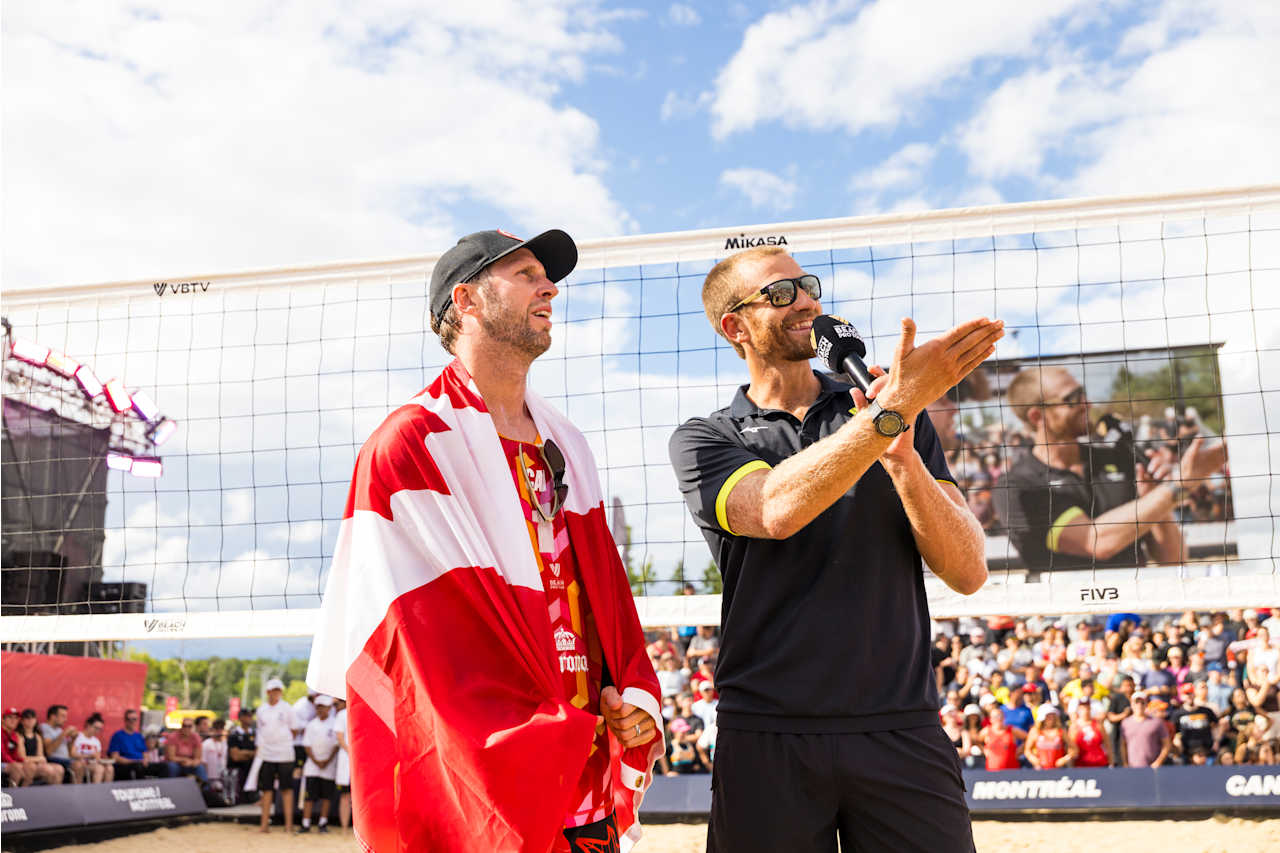
So when I stood next to Sam Schachter on Sunday afternoon and watched him come, briefly, to a loss of words as he drank in a moment in Montreal, surveying a towering wall of 4,000 flag-waving, adoring, screaming Canadians, many of whom were in tears themselves after watching their 36-year-old win his first medal in a decade, I was filled with an empathetic joy for my good friend.
This was no different than when I was able to put Kristen Cruz and Taryn Brasher in the same sentence as Misty May-Treanor and Kerri Walsh Jennings after a gold medal in Gstaad.
Or when, an hour earlier, Alex Brouwer fought with, then relented to, tears of his own as he spoke of how special it was for his wife and three kids to be there, in person, after trekking across Europe, to witness his first win in Gstaad after 14 years trying.
Or when Marcio Sicoli, who is some lovely combo of mentor and wonderful friend and fun uncle, wrapped me in a tight, almost explosive hug after his team, Brandie Wilkerson and Melissa Humana-Paredes, won their first gold medal of the year in Ostrava.
Or when Martins Plavins ribbed me on a lovely, sundrenched afternoon in Rio, as he explained his Jedi mind trick to winning his first gold medal with Kristians Fokerots, his partner 20 years his junior.
The list could go on.
And that list could prompt one to wonder: But what about those who do not win?
In sports, someone must lose.
What do you feel for them?
As any consummate optimist or storyteller would know, a setback is merely the staging grounds for a comeback.
And comebacks are triumphant.
Adversity is merely the fertile soil upon which the ultimate victory is grown.
So yes, I feel for those who, as Teddy Roosevelt once wrote of those men and women in the arena, fall short. Whose “faces are marred in dust and sweat and blood, who strives valiantly; who errs, who comes short again and again, because there is no effort without error and shortcoming.”
I feel for them, for I have been them.
There is no empathetic joy, no mudita to feel, without the empathetic pains of loss and disappointment.
But without the possibility of loss and disappointment, of heartbreak and setback, of erring again and again, there is no possibility of triumph, either.
Sports would not be worth watching if there were no dejection on the other side of the victorious jubilation – for there would be no jubilation to feel at all. And if there were no challenge present, no possibility of the risk going wrong, there would be no Mudita to feel. It would not be a victory worthy of the adoration of those 4,000 screaming Canadians. It would not be a moment to create a loss of words. It would not bring Brouwer, an accomplished man of 36 years, to tears.
It would simply… be.
And that would not be worthy.
Challenge makes life worthy.
Sports, by extension, make life worthy.
They create moments we love and cherish, provide the narratives to the stories we will tell far after the moment is gone.
They are fountains of mudita.