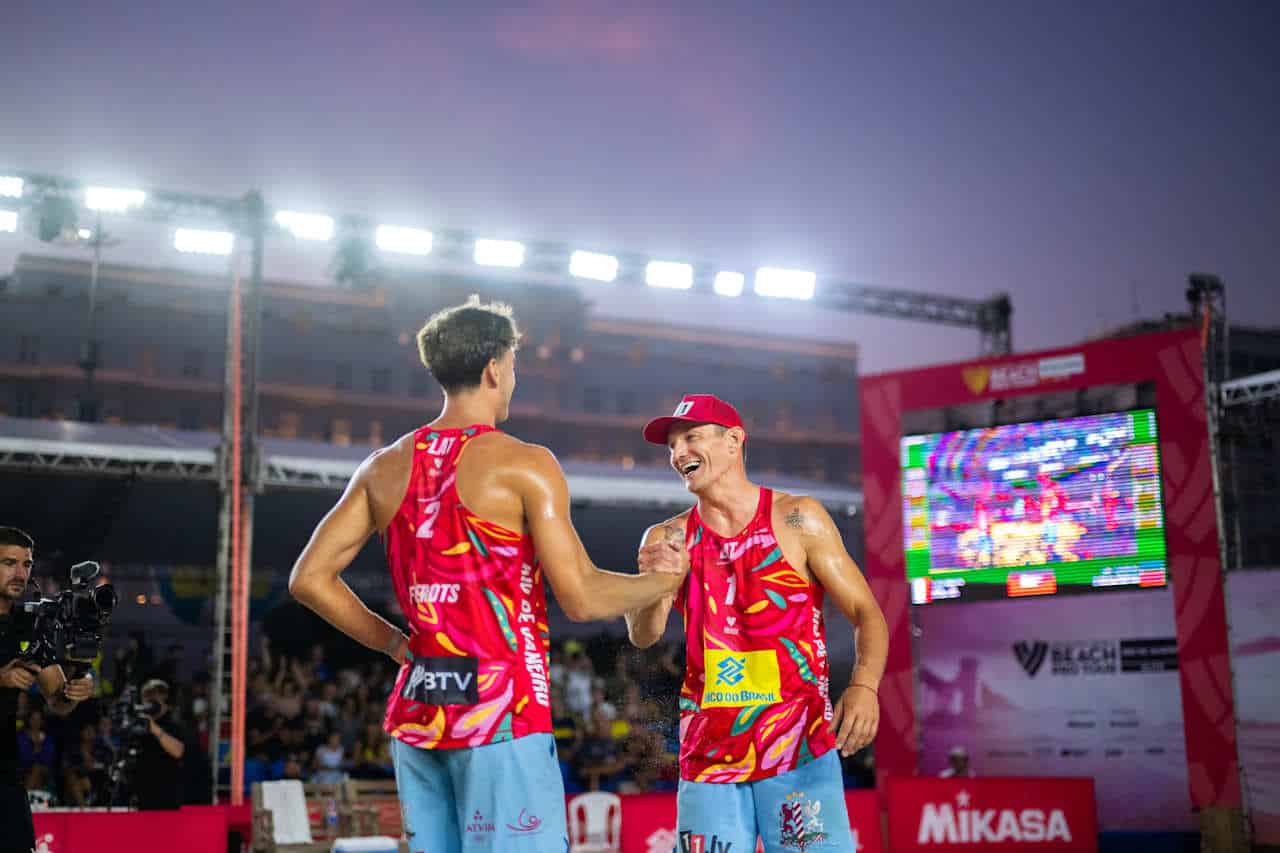
RIO DE JANEIRO, Brazil – In the four hours between his semifinal and gold medal match on Sunday at the Rio Elite, Martins Plavins had a most peculiar bit of advice for his young partner, 21-year-old Kristians Fokerots.
“Be ready to lose,” the 41-year-old veteran said.
He’s quick-witted, Plavins, with a deadpan sense of humor that requires a pause, an inspection of the facial expression, to tell whether he’s serious or just pulling your leg. Even then, after a most careful of glances, it is impossible to tell if he’s telling the truth or not. He’s the quiet class clown, a man who commands the respect of his peers on the Beach Pro Tour in one moment while chopping them down with high lines and cut shots the next, who will joke with the volunteers handing him the ball on match point – and then shift into a medal-winning machine in a blink.
The beauty of any joke, what makes comedy tick, is the kernel of truth that lies in its core.
This, however, was no joke, nor was it merely a kernel of truth.
It was the sage wisdom of a man who won his first gold medal when his partner was still in diapers.
“When everyone tells you that you must win, it’s really hard to win,” said Plavins, who has been to three Olympics and has now won eight gold medals. “But I told him that what works is when I say ‘I’m OK if I lose, and we just try to show our good game’ and today it worked, because for me it was no stress. We played really calm and it worked out really well.”
That perhaps backwards, counterintuitive piece of advice worked to the tune of a gold medal in Rio, their first as a team in an Elite event. It capped a run in which they lost just a single set, bookended by a final won by a margin of 21-17, 21-11 over an excellent French team in Remi Daubas and Calvin Aye.
Martins Plavins, Rory McIlroy — and Marcus Aurelius
Plavins is far from the first athlete to use the worst-case-scenario visualization prior to a massive breakthrough.
Rory McIlroy, the Irish golfer, did this exact practice on the tee box at the Masters, the setting that was once his most formidable foe that he has since turned into consecutive green jackets.
“I’ll think about if I’m on a tee box, where’s the worst place I could hit it off the first tee?” McIlroy told The Athletic. “And then I put myself there, and I’m like, well what would you do? You get up there, and figure out if you have a shot or a swing. There’s no scenario so bad that I can’t figure it out. Some people would call that negative in some ways, but to me, it can free me up.”
Not coincidentally, free was the word most regularly used by VBTV commentator Maria Clara Salgado on the broadcast during the finals. Everything about the match seemed to be coming easy for Plavins and Fokerots, playing as loose and free as they would in a practice match with no consequences – perhaps because any consequences had already been mentally rehearsed and dealt with in the hotel prior to stepping foot on the sand.
This type of mental preparation dates as far back as the Stoics. In his book, Meditations, Marcus Aurelius wrote to himself: “When you wake up in the morning, tell yourself: the people I deal with today will be meddling, ungrateful, arrogant, dishonest, jealous and surly.”
Imagine Plavins, then, telling himself he’ll likely pass a few off the mark, that he’ll hit his signature high line wide here and there, that there’s the possibility his young partner will show his youth, that he would, at worst, return to Riga with a silver medal around his neck.
When framed like that, the worst that could happen isn’t so bad at all.
And when acknowledged and embraced beforehand, it reduced the possibility of it ever happening, just as it did for McIlroy in 2025 and 2026 at Augusta National.
“It feels amazing,” Fokerots said. “We have bronze medals, silver medals, it was always one thing missing in the semifinals or finals. Now, finally, we have won all the games.”
That one thing missing?
Preparing for worst thing possible.