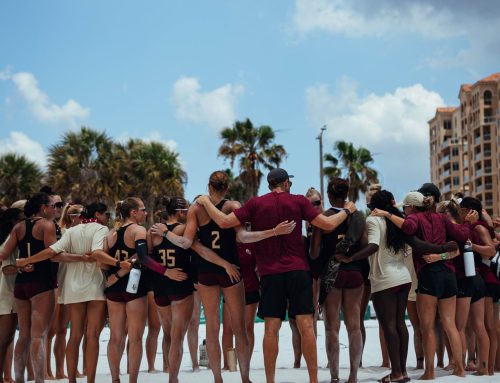
TALLAHASSEE, Florida – Midway through the fall of 2025, Brooke Niles and Nick Lucena – my new colleagues as the second assistant at Florida State University – were on a call with the family of a recruit. I was off commentating somewhere, and though I had spearheaded the effort to put FSU in the final stages of this recruit’s process, I was, in retrospect, relieved I hadn’t been on the call.
The conversation covered the usuals – the strengths of our program and what we offer, why the recruit would be a good fit for us and us for them, everything you’d expect – until the father asked a question I would have been wholly unprepared for:
“What is your coaching philosophy?”
I would have had no idea.
***
At the time of that call, I had been at Florida State for a few weeks. I’d been a coach for a little longer than that, but not by much, having run my first practice with Tri Bourne and Chaim Schalk at a training camp in Hawai’i only 10 months prior. Even that job was an unexpected one, having begun as a joke between two friends, until Tri exhausted all other potential coaching candidates for him and his new partner, and he circled back to me.
Was I actually interested?
Could two good friends and partners in the media world make for a healthy player-coach combo?
Suddenly, my entry level coaching job was to helm a team amid the final and critical stages of an Olympic race.
I was nowhere near ready, though I’m also a believer that full immersion, ready or not, is the most expedient manner in which to learn something new.
My coaching education had begun.
My life by then had taken so many dives into the realm of new that I’d crafted a process to learn as quickly as possible. When I was expediting my writing career, I took the advice of my former editor at the Carroll County Times, Bob Blubaugh, and every other professor I had at the University of Maryland: “If you want to be a good writer, you need to read good writing.”
So I picked up every book and magazine and newspaper I could that printed excellent sportswriting, reading not just to read, but reading with a purpose. I studied word choice, phrasing, structure, pacing, when to integrate quotes and when to tell the story yourself. I stole from every writer I could. But when you’re early in the process, what inevitably happens is that you do bad impressions of the writers your admire. You read Wright Thompson, and you attempt to craft a story as Wright Thompson would. It’s worse, obviously, as nobody can do Wright like Wright. But within each of those bad impressions, you’ve internalized an element of what makes Wright so damn good.
And then you do this with Mitch Albom, and Gary Smith, and SL Price, and Tom Verducci, and Sally Jenkins, and Brendan Quinn, and Brian Hamilton, and on and on and on the list goes, until your bad impressions of everybody else have suddenly morphed into an amalgamation of a style that is uniquely your own.
One day, you realize, you’ve developed a writing voice.
I repeated this process when I began playing beach volleyball, borrowing and stealing from every elite player I could, studying their film, toying with the approach and blocking style of Piotr Kantor, the dartiness of Tim Bomgren, the on-two intrepidness of Miles Partain, the pull digging of Bill Kolinske, the craftiness of Rafu Rodriguez – and on and on and on it goes, until your borrowing from everyone else has suddenly coagulated into something that looks like your own unique style of playing.
So it has gone with my coaching career.

Competition With a Purpose
When you learn as I do, walking a new path is a bit like trying on someone else’s clothes. When it would be my job, for example, to design a practice to solve a certain problem we were having, I’d lean on someone else’s idea or philosophy, because I didn’t trust my own. So I’d dive back into the Coach Your Brains Out podcast, or flip back through one of Rob Gray’s books — he is coming on the podcast on Wednesday! — on ecological dynamics, or revisit a thesis someone wrote on Bruce Lee, or read up on Jon Scheyer or Coach K or Bill Belichick or Nick Saban or any of the coaching leviathans who have come before me.
How would they have solved this problem?
I’d try on their style – their clothes, to continue the metaphor – and design a practice I thought befit whatever that style or philosophy might be and observe how it went. As it can go when you’re wearing someone else’s clothes, often this wouldn’t fit quite right – but some of it I thoroughly enjoyed, some of it seemed effective, some of it seemed to resonate. So I’d keep that piece of clothing that seemed to fit just right.
That’s how these past nine months at Florida State have gone, me fully immersing myself in every piece of coaching material I can find, be it podcasts or books or magazine pieces or seminars, trying on everyone else’s style, doing bad impressions, seeing what sticks, discarding what didn’t – recycling might be the better term, as there’s a high chance I’ll revisit what hasn’t immediately worked – and continuing the process.
John Mayer, someone I consider a mentor in the coaching realm, once did this as a new coach, doing his best bad impression of Marv Dunphy, his former coach at Pepperdine and one of the all-time greats in the sport of volleyball. A humble man, Mayer, who is in my mind one of the best talent developers in the sport of beach volleyball, says he still isn’t sure he’s found his own voice, but if he once attempted to be John Dunphy, he’s now got the first few letters of his last name back, so it’s more like John Mayphy. I don’t know how true that is, but it’s spoken in the manner of the lifetime learner that he is.
He’s been at the helm of LMU for a decade now, and had been coaching for more than a decade before that. If he says that he hasn’t yet found his own coaching voice, I cannot be arrogant enough to think I’ve found mine.
But I’ve found a piece of clothing that seems to fit, a rough draft of a coaching philosophy:
Competition With a Purpose.

Will Chu Photo
What if we were the best in the world at this?
How did I get there?
Someone else’s idea, of course. It was an appearance by John Kessel, a longtime coach for USA Volleyball, on the Coach Your Brains Out podcast who steered me in this direction. He’s been on the show a number of times, so I cannot pinpoint the exact episode, or even when I initially heard it, but a philosophy he espouses stuck to me like a remora that day. Every drill he designs at practice, he runs through the prism of: “What if we were the best in the world at this?”
That’s stayed with me.
That prism is why I have such a distaste for free balls in practice — unless the purpose of the free ball is to create an in-system attack in a drill designed for the defense to effectively defend in-system attacking — and attacking on open nets, with no defense in sight.
What if we were the best in the world at that?
If we were the best in the world at passing free balls and attacking without a defense… I don’t think we’d be all that good at beach volleyball. Not at the level we aspire to be, anyway.
It’s why I have a reluctance to do anything that could be perceived as scripted. It’s why, when we’re focusing on passing, and a player is struggling with, say, a line to line serve, it is no longer my belief that serving them line to line a million times, when they know it’s coming, will make them better. I once believed that, using that philosophy to guide me as a basketball player and golfer. The simplicity, and the math, adds up: If you pass a bunch of line to line serves, even when you know it’s coming, you’ll get better at passing line to line serves.
I no longer buy into that.
It isn’t representative of the game of beach volleyball.
It’s easy to do something when you know it’s coming.
In reality, that never actually happens.
The ball is only ever on your platform for less than half a second. The vast majority of the work is done before: reading the contact of the server, making the necessary moves and adjustments, putting yourself in a position to make an accurate pass. The skill of passing, then, isn’t technical so much as it is visual.
So, you may be asking, you just roll the balls out and let them play?
Not quite. This is where the second bit of my (very) rough and first draft of a coaching philosophy comes into play: Competition with a purpose.
One of my favorite creative challenges as a coach is designing games and drills, manipulating the rules and the environment and dimensions of the court so that the skill we would want to iron out happens to occur naturally, in an unscripted, realistic manner.
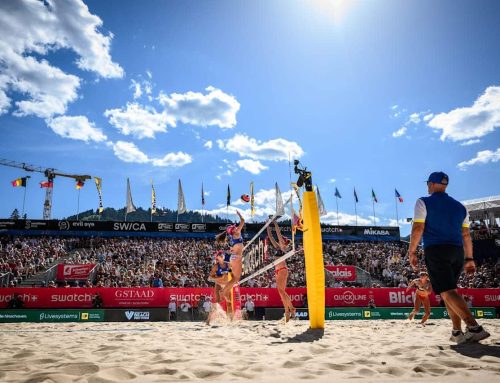
To revisit the line to line passing example again, a favorite of mine is narrowing the dimension of the court to, say, 40 percent of its typical width, and doing some sort of game from there. This makes it all but inevitable that the passer will be served down their line, while keeping open the possibility of a seam serve. There’s still reading involved, still visual aspects, but what we’re attempting to accomplish – line to line passing – is accomplished, but now with multiple, representative benefits.
The real challenge is extending this philosophy to reach across the full spectrum of skills, from blocking to serving to passing and setting, and so on and so forth. That’s where much of the fun, and the frustration, lies. Because everything must pass the test. Everything must answer to the question: What if we were the best in the world at this?
And if the answer is a shrug, I don’t find it to be good enough.
And it’s back to the drawing board I go.
***
I don’t know how long it took me to develop my own writing voice, my own playing style, my own anything. I don’t believe my writing voice is finished developing, either, a constant process of growth and learning and layering-on. I’m just nine months into my career as a full-time coach.
I haven’t yet found my voice, and won’t for quite some time.
But, I believe I’ve found a rough first draft, a foundation upon which to build, a question that must always be answered:
What if we were the best in the world at this?

Will Chu Photo