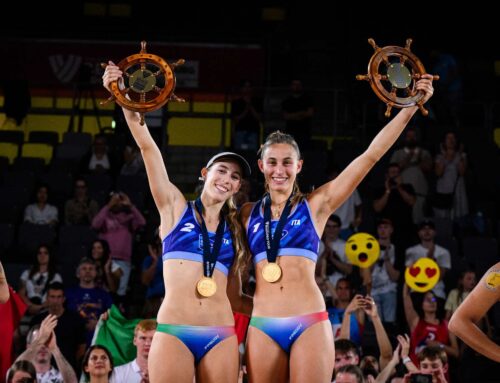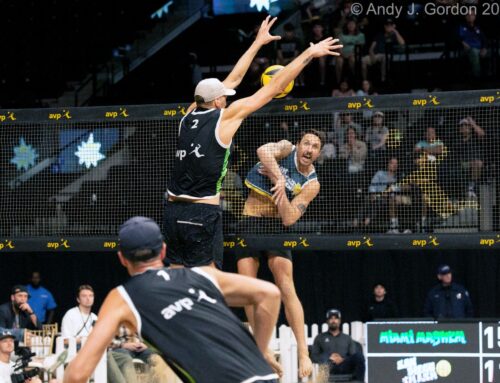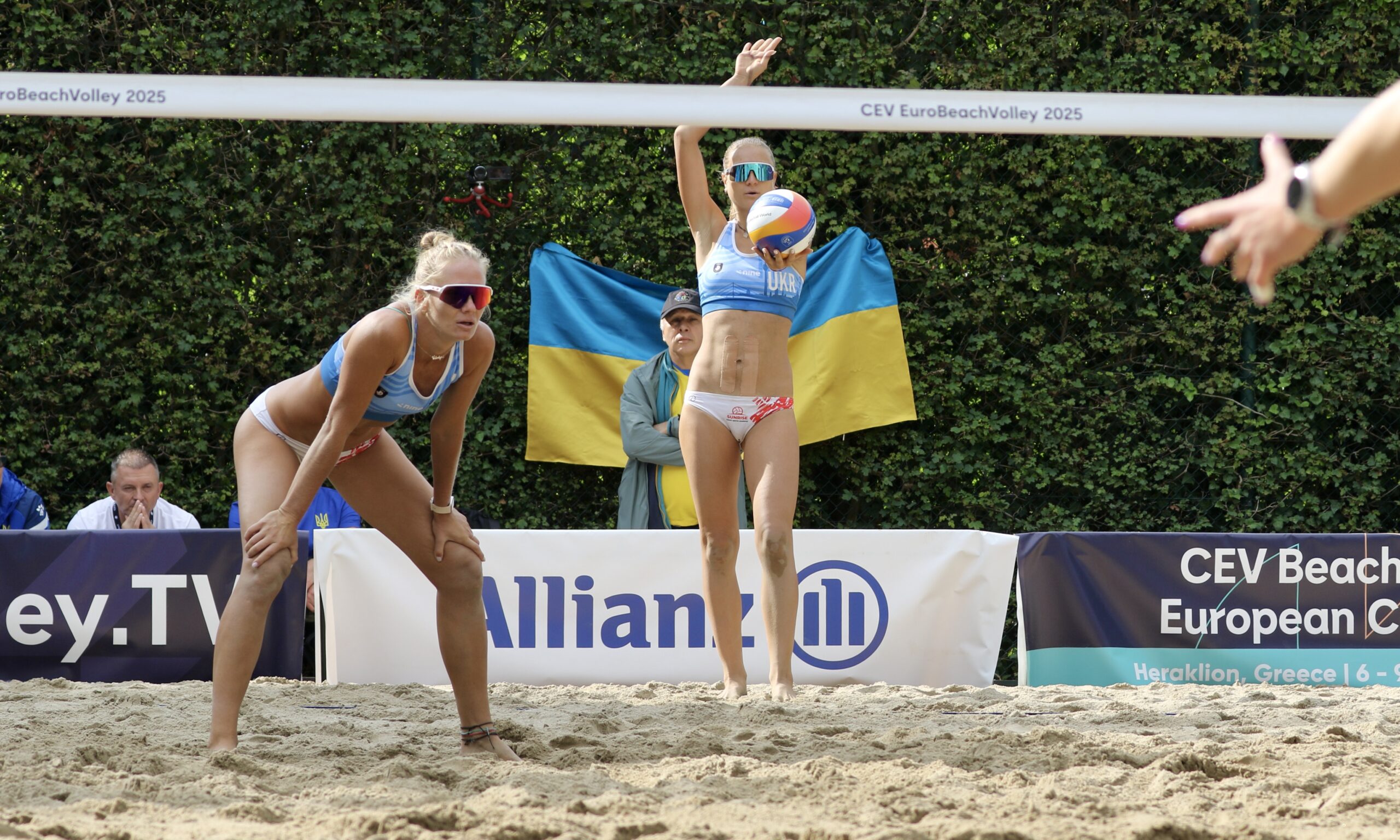
It isn’t that Anhelina Khmil doesn’t appreciate the bronze medal she won alongside partner Valentyna Davidova in the recent Beach Pro Tour event in Baden, Austria. After twice reaching the podium in Futures tournaments, it was the Ukrainian pair’s first medals together in a more prestigious Challenge event. Khmil was downright giddy about winning the bronze — even before anyone slipped the medal over her head and handed her a bottle of champagne.
It’s just that in scarcely more than 100 days between winning an NCAA national championship and beginning her senior year at TCU, she played 10 events in almost as many countries. Baden was the last stop.
A suitcase can accumulate a lot of life.
So, as the second week of classes began, there the Baden bronze sat, still in her luggage.
“School started, and I was unpacking my stuff, cleaning my room, and it’s just still in there,” Khmil admitted with a laugh. “But I’ll keep it in a safe place.”
The third podium for a Ukrainian women’s team at the Challenge or Elite 16 level since the beginning of 2022, and Russia’s full-scale invasion of their country, Baden was another significant chapter in a remarkable Ukrainian beach volleyball summer.
- In July, Khmil and Davidova were half of the Ukrainian entry, alongside Maryna Hladun and Tetiana Lazarenko, that won silver in the CEV Nations Cup.
- Soon thereafter, and not long after winning a Challenge event in Poland, Hladun and Lazarenko were crowned European champions in Dusseldorf.
- A week after Khmil and Davidova’s podium in Baden, Yeva Serdiuk and Daria Romaniuk added a title in the U22 European Championships on the same court.
- Serdiuk and Romaniuk and fellow Ukrainians Inna and Iryna Makhno also won summer Futures events — a pair of titles in the case of the Makhnos. (Khmil and Davidova took Futures silver after an all-Ukrainian final against Serdiuk and Romaniuk in Bulgaria, before turning the tables in a Euros Round of 24 rematch.)
- In Hamburg, Serdiuk and Romaniuk reached their first Elite-level main draw.
Maryna Hladun, top, and Tetiana Lazarenko, bottom, celebrate a European championship in Dusseldorf/Graham Hays photo
From Texas to China to crisscrossing Europe and back, Khmil literally circled the globe to play her part in the summer success. As a measure of how far she’s willing to go to reach the full heights of her potential, not to mention make a run at booking another long-haul flight to the World Championships in Australia, well, let’s just say she has the receipts.
Those miles also offered a connection with the destination that remains hardest to reach: home. Khmil was there this summer, too, if only ever briefly. Reaching her hometown, or any Ukrainian city, isn’t as easy as flying from Dusseldorf to Vienna—or sometimes even Texas to China. Very little about being Ukrainian is easy anymore.
Even as she builds her future in TCU classrooms and on volleyball courts from Fort Worth to the four corners of the Earth, it’s hard to plan very far ahead when your country is at war. It’s difficult to revel in successes large and small when the news is a steady stream of heartache and your phone buzzes with the air raid alerts your family endures at home.
“It really impacted the way she was enjoying the game,” TCU head coach Hector Gutierrez said of the toll of three-plus years of war. “It is hard to enjoy something that you love when your family is in that situation in your home country. I think, in general, that all the Ukrainian girls found that joy for the sport and kind of an outlet to really enjoy something where they worked so hard to reach their dreams. The biggest thing that stuck with me in the summer was how much she was enjoying every day and all the tournaments, even with all the traveling that it takes for them. That was pretty cool to see.”
That’s why Ukraine’s summer resonates beyond medals, even if Khmil will eventually find a more permanent home for hers. In the best way she knows how, she represented her country. With resolute stubborn will, skill and, when the moment allowed, even delight, she made the most of each day as it came. At home, people she cares about wake up every morning, if they slept at all, and try to do the same. Across Ukraine, people try to do the same. She hopes the world that so often welcomes her with open arms doesn’t forget them.
“We try to enjoy it for ourselves, but we always think about our country and our people,” Khmil said of a moment like standing on the podium in Baden. “The medal lets the world know about Ukraine and brings something positive—even just a little bit.
“We enjoy it, but the biggest thing is we play for our country and we play for our people. We want to carry our flag to all these countries and be on these stages to communicate to the world through our sport about what’s happening in our country.”
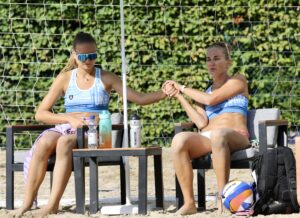
Khmil and Davidova during a timeout in the Euros, where they reached the Round of 16/Graham Hays photo
Summer on the Go
It isn’t difficult to find Khmil’s court in a crowded venue. Just close your eyes and listen for the staccato cadence that precedes points.
“Давай, давай, давай”
“Davay, davay, davay”
Accompanied by a few quick claps, it carries the same energy as “vamos” in Spanish or “let’s go” in English. As both instruction and motivation as she and Davidova bounced from airport to airport and city to city, it might as well have been the motto of Khmil’s summer.
TCU defeated Loyola Marymount for the NCAA title on May 4 in Gulf Shores, Alabama. A little more than a week later, after a pit stop at TCU, Khmil was already in the sand for a Challenge event in Xiamen, China—nearly 8,000 miles from Fort Worth. By the time she got to Baden, she had played additional events in the Czech Republic, Bulgaria, Türkiye, Latvia, Poland, Portugal, her native Ukraine and Germany.
Touching down in Xiamen, she hadn’t played a competitive match with Davidova in essentially eight months, since winning bronze in last fall’s Ukrainian Championships.
Most of her volleyball life, she’s played alongside partners about her age, whether earning Big 12 Pair of the Year honors with Ana Vergara at TCU last season or winning a European age-level title with Lazarenko in 2022. At 38, on the other hand, Davidova is nearly a decade older than even first-year TCU assistant coach Sarah (Sponcil) Marmelstein, let alone the 22-year-old Khmil. Now in her second year as the team’s junior partner, Khmil was still weeks shy of her fourth birthday when Davidova played an event in Poland in 2007.
In Baden, when Davidova and Khmil dispatched Americans Deahna Kraft and Molly Phillips to finally break through a stubborn quarterfinal ceiling, even Serdiuk and Romaniuk emerged from the side-court crowd for the post-match celebration. A week earlier, Davidova and Khmil had knocked them out of the Euros, but they were clearly ecstatic for their countrywomen—in particular, for a veteran who may be a rival but is also a role model and mentor for one of Europe’s more promising new generations.
“I trust her 100 percent,” Khmil said. “It’s an honor to play with such an experienced player and to see how she’s working her ass off—she’s working really, really hard on and off the court. It’s such a great example, and I’m just trying to learn from her as much as I can. It’s just so precious to see. I hope I’m going to be playing that good when I will be her age.”
The blocker had to dig a little deeper to make sure Davidova didn’t miss out on her first podium at the higher level. The Ukrainians ran into the red-hot Louisa Lippmann and Linda Bock in the semifinals. The Germans held opponents to 16 or fewer points in nine of 12 sets in Austria. Khmil and Davidova couldn’t stop that rolling boulder, losing 21-14, 21-12.
It was hot in Baden, temperatures nearing 90 degrees through much of the tournament and hottest of all on a shadeless center court on the final day of the women’s draw. It had been a long summer by any measure, let alone with the added toll on Ukrainian teams left effectively itinerant by the logistical complications of going home between events. The scale of the semifinal setback, too, could have been tough to shake off in a matter of hours, especially for a young player. But there wasn’t much drama in the bronze-medal match, just an inspired and clinical 21-18, 21-16 victory against Finnish opponents. And then a chance to hydrate with champagne.
Watching from afar, such moments stand out to Gutierrez. Even a few years ago, Khmil, a perfectionist, could get in her own head. She dwelled on mistakes. She worried about letting down her partner. Her body language, so often a dictionary of positive energy, faltered. This summer, in Baden most of all, she just moved on to the next point, the next match. Davay.
“Even during the [semifinal], everybody could see—and I could see—that my game wasn’t going my way, the way I wanted,” Khmil said. “The game was not even close, unfortunately. But we knew that the tournament is not done for us yet, and this is our big chance to get our first medal in a Challenge event. Knowing all the work we’ve done, training so much with my partner, I just wanted to give it all. It doesn’t matter if it was for gold or for bronze. I just wanted to enjoy it and get what we came for.”
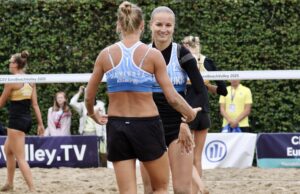
Khmil and Davidova are ranked No. 31 in the most recent FIVB World Rankings/Graham Hays photo
Living in the Moment
One week after standing on the podium in Baden, Khmil sat in a lecture hall on the first day of classes at TCU. In the blink of an eye, give or take some long flights, she was back in Fort Worth. Still, that’s nothing compared to how quickly the past few years have passed.
Coming to the United States in the first place was more of a last-minute decision than a grand plan. The first year was a challenge for reasons familiar to international students, from living in a second language to balancing school with training to Texas culture—and reasons unique to her, the war then in its first year. Time sped up as she immersed herself in her new world. She adapted to a less confrontational coaching style than she had known at home. She learned to trust a collaborative environment where she really could open up if she chose. And she gave back. Some people pass through a place with barely a ripple. Others change it, maybe even leave it better than they found it.
“She is a beautiful human, so funny, so easy to live life with, always open to any plan, an incredible teammate and friend,” said Spain’s Daniela Alvarez, her former TCU roommate. “She is always there for people she cares about. And she is one of the strongest people I have ever met.”
Khmil was already a special talent when she arrived as a freshman—the summer prior, she and Lazarenko won the European U20 Championship and took bronze in the U22 European Championship (their only loss in either tournament at the hands of Alvarez and Tania Moreno). In Texas, at what might as well be a beach volleyball PhD program, she’s grown into something more under the tutelage of Gutierrez and former associate head coach Majo Orellana. She’s honed the physical skills that allowed her to go toe to toe with Tina Graudina in a thrilling Euro Round of 16 encounter in Dusseldorf and the mental edge to bounce back from the semifinal stumble in Baden.
“Her physicality got better,” Gutierrez said. “She’s super talented for a blocker, all her skills like passing setting, serving. We’ve worked more on her physicality. She’s gotten strong. She’s a grown-up woman right now, and when she came here it was a little bit different.”

Khmil at the net against Latvia in Dusseldorf/Graham Hays photo
At least as much as the tools to conquer the Big 12 and that will be needed to compete with the Ana Patricias, Brandie Wilkerson and Valentina Gottardis of the world, she also found community as part of a group of women with a shared goal. And in amassing the degree, friendships, connections and memories that come with college, TCU provided the building blocks of a future. Still, when she talks about trying to put everything else aside this year and enjoy the moment—a common throwaway line for seniors—it hits differently. As she puts it, war makes everything else complicated.
“I don’t like to think ahead,” Khmil said. “I don’t think it’s a good idea because as soon as I start thinking ahead and planning all that’s going to happen in six months or a year, it’s never going to be that way. It’s always something different. So I usually just wait and see. You cannot predict, especially right now.”
She follows the news from home. She tracks the alerts on her phone, the ones that tell her whether her hometown—her family—is targeted in the seemingly nightly barrages of drones and missiles. Davidova still lives in Ukraine with her family. All summer, whenever her phone buzzed with alerts, she called home to ensure her two children took shelter. The nomadic lifestyle can wear on every pro. But not like that. Khmil could see the toll it took. She suggested even she can’t fully grasp how that would feel, to be a mother in those moments. And yet, she worries, too, the stress no less real as a daughter and sister.
She returned home this past week for the Ukrainian Championships in Kyiv, taking bronze after embarking on the multi-day travel she detailed on social media ahead of last year’s event. She and Davidova also intend to play the Challenge event in Mexico, the last event from which points transfer to World Championships qualification. Back at TCU, the not-so-small matter of defending Big 12 and NCAA titles also awaits in the spring. Beyond that? It’s complicated.
“I don’t think people realize what Lina, and probably all her Ukrainian teammates, are going through,” Alvarez said. “The way that Lina shows up and is there for our friends, with everything she is living right now, it is unbelievable. I admire her so much, and I look up to her in so many different ways. Media is not really covering everything that is happening, and when Lina tells me, I am always shocked. …
“She is the best, and I am really proud of her and the woman she is. I always want her to succeed in everything she does. She has the biggest heart, and the courage to do everything she is achieving is really impressive. I can only hope that the situation back home gets better and she gets to live a regular life as soon as possible, because she deserves everything good to come her way.”
Alvarez is more aware than most. It troubles Khmil when the news that interrupts her sleep and dominates her thoughts seems invisible to others. When even well-meaning people she encounters aren’t aware of the everyday realities of kids beginning their school year in underground classrooms after nights in subway shelters, or even that the war continues apace, she wonders if she can do more with her platform to inform and raise awareness.
Playing a volleyball match doesn’t fix everything. Or anything. But it is also more than just a volleyball moment to watch Serdiuk pound her fist into the sand to celebrate a first ever senior Euros win or Hladun and Lazarenko moved to tears by their Euros title. Or Khmil and Davidova share a moment and a medal earned across so many miles. The Ukrainian teams spent the summer living, competing, growing—and winning beyond all expectations.
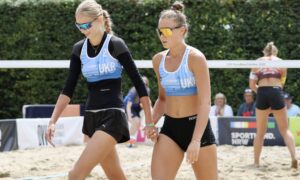
Daria Romaniuk, left, and Yeva Serdiuk, right, won this summer’s U22 European Championship and this month’s Ukrainian Championships/Graham Hays photo
“I don’t care who is on the other side of the net, I’m just going to do my best and we’ll see what happens,” Khmil said. “I think that’s the mindset of every Ukrainian player, especially after this summer—it builds momentum and elevates our mood, our motivation, everything for the future. I hope to see Ukrainian teams on more world stages, holding a medal, representing our country and holding our flag.”
The future and hope. She spoke the words in such quick succession that they jump off the page.
They are harder to come by than any medal. And so much more treasured.