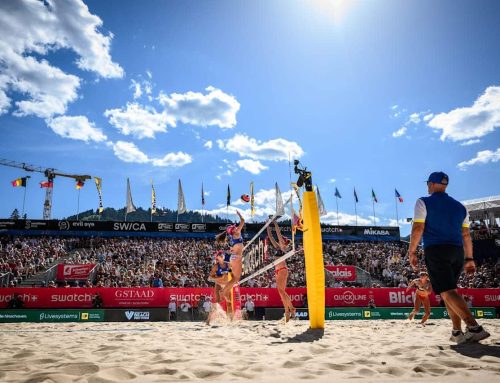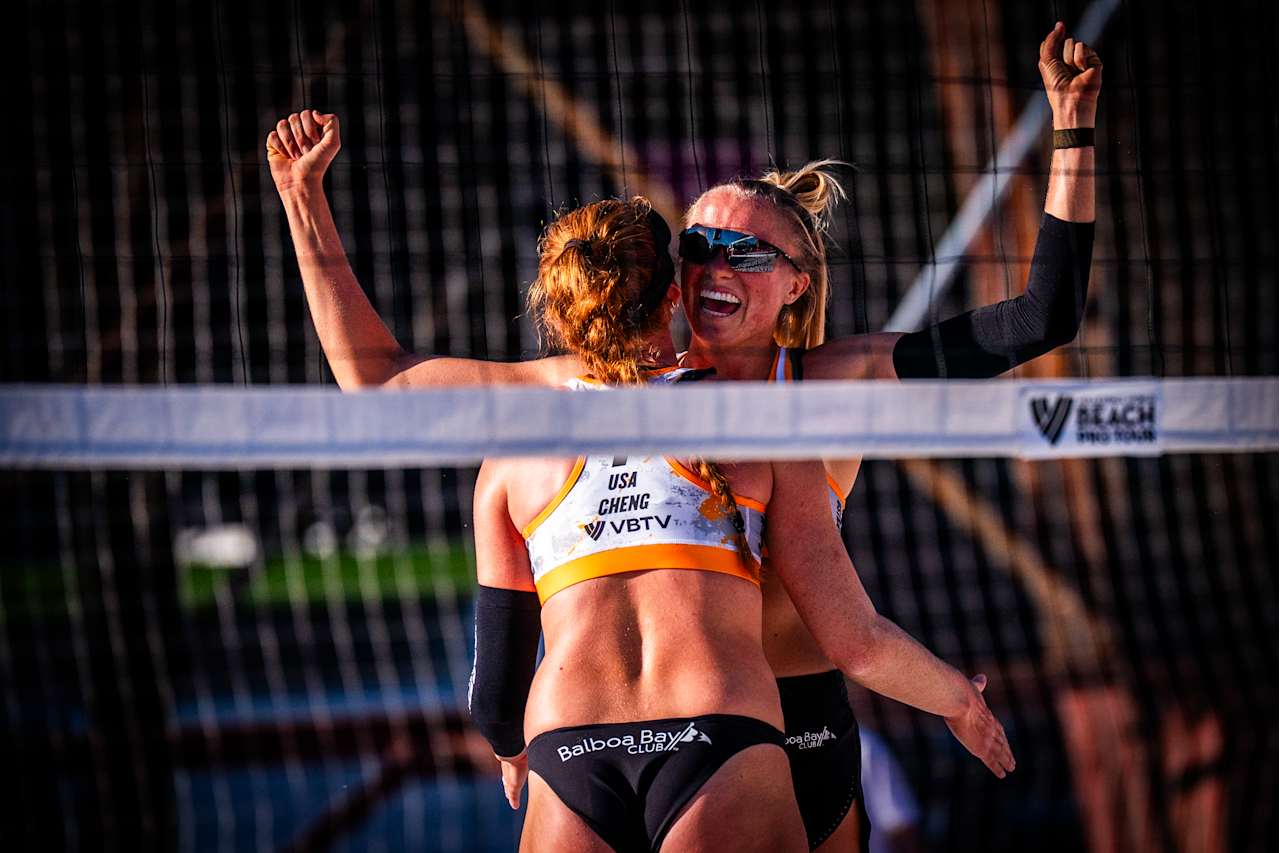
OSTRAVA, Czechia – Something strange keeps happening to Kelly Cheng and Megan Kraft.
On the one hand, they are winning beach volleyball matches in 2026 at the exact same rate (79%) as Carol Salgado and Rebecca Cavalcanti, the No. 1 team in the world — and 10 percent higher than Cheng won with Sara Hughes in 2023, the year they became World Champions.
Through four tournaments on the Beach Pro Tour – Joao Pessoa, Saqaurema, Brasilia, Ostrava – they haven’t lost a single pool play match.
They’ve notched wins over Ostrava silver medalists Katja Stam and Raisa Schoon, world No. 2 Victoria Lopes and Thamela Coradello, and world No. 1 Carol and Rebecca.
They’ve played three AVP tournaments – two AVP League qualifiers and AVP Huntington Beach – and lost a combined two matches, both of which came to the team who would win it (Betsi Flint and Kylie Deberg, and Thamela and Victoria).
Viewed through that lens, they are, at worst, the second-best team in the United States and a top five team in the world.
They are also, somewhat unbelievably, a team who has suffered three straight first-round exits on the Beach Pro Tour, settled for three straight ninths, and is on the cusp of slipping into Elite qualifiers.
In the USA Volleyball hierarchy, they are currently behind in entry points to Kristen Cruz and Taryn Brasher, Julia Donlin and Lexy Denaburg, Savvy Cory and Devon Newberry, and Piper Ferch and Teegan Van Gunst, and are tied with Sara Hughes and Ally Batenhorst.
They are two spots out from the Gstaad qualifier.
How can both of these things be true?
What’s been happening to Cheng and Kraft this season has been nothing shy of baffling.
The team who wins pool play has been a drastically different version of the team who has been losing in the first round of playoffs.
Consider. In matches that Cheng and Kraft win:
- Their sideout percentage as a team is 73 percent, eight percentage points higher than the collective average of the top 10 teams in the world
- Their transition rate is 53 percent, seven percentage points higher than the average of the top 10 teams in the world
- Cheng is out-blocking her opponents 53-20
- They are passing in system 83% of the serves they receive, while their opponents are in-system just 74% of the time
- They are hitting 38 fewer errors than their opponents
Now, contrast those numbers in the four matches on the Beach Pro Tour in which they have lost:
- Their 73% sideout rate drops to 57%
- Transition slips from 53% to 44%
- Cheng is being outblocked 17 to 7
- They are passing in-system 81% of the time, which isn’t a huge dip, but their opponents are passing in-system 82% — an eight percent increase from their wins
- They are hitting 15 more errors than their opponents
That’s what is happening.
The bigger question is why it is happening.
Aside from a tight loss to Ana Patricia and Duda (19-21, 20-22) in the Brasilia Elite semifinals, it isn’t a matter of difficulty of opponent. They lost to eighth-seeded Nina Brunner and Tanja Huberli in Saquarema, seventh-seeded Stam and Schoon in Brasilia (a team they had already beaten earlier in the year), and seventh-seeded Leona Kernen and Joana Mader in Ostrava.
In each of those tournaments, Cheng and Kraft had already beaten a more difficult team – Stam and Schoon in Saquarema, Thamela and Victoria in Brasilia, Rebecca and Carol in Ostrava.
Strength of opponent, then, can be ruled out.
It would be lazy, too, to lean on pressure as the main factor, and the fact that they could be eliminated from the tournament, whereas in pool play, such pressure doesn’t exist; you can lose twice and be fine (Kernen and Mader, for example, lost twice in Ostrava and made the semifinals). Cheng has qualified for two Olympic Games and won a World Championship. Kraft made four semifinals in 2025 alone.
They’ve both dealt with, and handled, pressure in far more high-stakes scenarios than regular season Elites.
Team chemistry is another some might point to in a budding duo. Perhaps they just haven’t yet figured out how to play with one another.
This, too, makes little sense.
Through four tournaments with Molly Shaw a year ago, Cheng’s record was 12-9 – but she had two fourths, a 13th, and a fifth to show for it.
Through those same four tournaments with Terese Cannon in 2025, Kraft’s record was 12-8 – but she had a silver medal and a trio of fifths on the ledger.
So what in the world, then, is happening?
Here I’ll give the same explanation I gave during Sweden’s perceived “rut” a year ago after the Hamburg Elite, where David Ahman and Jonatan Hellvig missed the podium for a fourth straight tournament and Elmer Andersson and Jacob Holting-Nilsson, then the hottest team in the world, also missed the podium: Absolutely nothing.
Call it bad luck.
Call it bad timing to throw in a rough match.
Call it a fluky coincidence.
I’ll call it all three, to be honest.
To be playing as well as Kraft and Cheng are this season and boast just a single medal while tacking on three straight ninths rests somewhere between improbable and bizarre. I don’t find those results to be sustainable, in the same way that I’d say a team playing mostly unremarkable volleyball but somehow winning medals wouldn’t be sustainable.
Eventually, should they continue playing as well as they are, the dam will break.
Eventually, the door on which they continue knocking will open.
Eventually, the medals will begin being hung around their necks and trophies and trinkets will find their places in their California homes.
That’s what I’d bet on, anyway, no different than when I doubled down on Remi Bassereau (now Daubas) and Calvin Aye after a 13th in Ostrava in 2025. Then, I wrote that they’d win an Elite medal by year’s end. Three months later, they won a silver in Joao Pessoa.
Perhaps, for Cheng and Kraft, the dam will burst in Gstaad.
I, for one, wouldn’t be surprised to hear them ringing cowbells all the way home.