This is an excerpt from the passing chapter in Travis Mewhirter and Gabby Reece’s new book, Volleyball for Dummies. You can order your copy on Amazon.
Chaim Schalk and Alex Brouwer are two of the best passers of their generation. A pair of Olympians on the beach, Schalk has also competed in six World Championships, while Brouwer has even won one, in 2013, and also boasts an Olympic bronze medal in 2016. Both are superior offensive players, thanks, in large part, because they are almost always in system, passing to their ideal target.
And both, when asked, offered the same advice when it comes to being an elite passer: “It starts with the feet.”
Wait.
Isn’t passing supposed to be all about angles, and our platforms?
Why would our feet dictate where our forearms will send the ball?
Because our feet and positioning largely determine how we can angle our platform, and our ability to be still upon contact. A hallmark of elite passers is being still – or “quiet” as many call it – upon contact. If we put ourselves in a position to be still, unmoving, when the ball contacts our platform, it is going to produce a consistent pass. If we are still in motion, or swinging our arms while passing the ball, thereby changing our angles, it is going to produce a wildly inconsistent product, and our setters will be unhappy.
We don’t want unhappy setters.
“The most important thing,” Brouwer said, “is to move our feet so we can be still upon contact.”
Indeed.
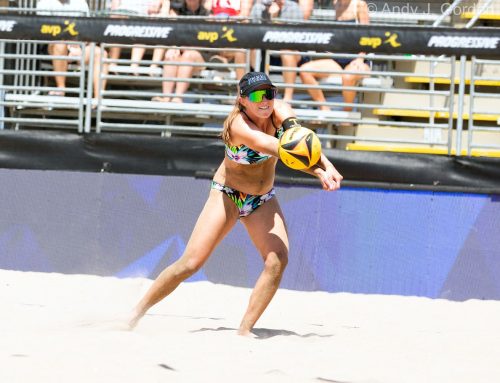
The goal of our feet is to put ourselves in a position where the ball will be in front of us. It is much easier to aim our platform at a target when everything is in front of us rather than the ball being overhead or behind us.
For Schalk, this begins with a prep step, similar to what you might see in tennis when players are receiving a serve. Others look at this like a boxer, small and light on their feet. It’s a small hop that will keep you light and quick on your feet. From there, as the ball is traveling towards us from the server, we want to stay behind the ball. If we see the ball coming for our chest or over our shoulder, we can either backpedal, keeping the ball in front of us and on our mid-line, or we can open up, dropping our right or left leg back to the end line and allowing us to pass to the outside of our body.
If we do pass the ball outside of our body, we’ll have to angle our shoulders to aim our platform at our passing target, which adds a layer of complexity to the pass. Whenever possible, try to pass on the body’s midline.

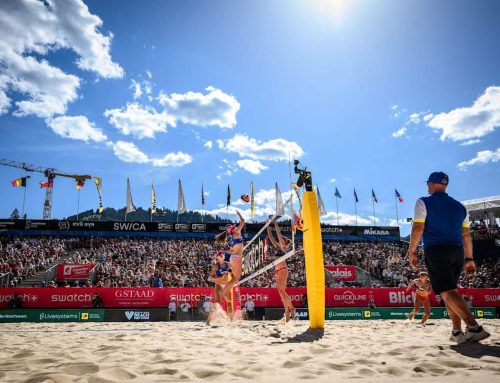
Chaim Schalk passes the ball during the Finals of the Hermosa Beach Open on September 7, 2025 in Hermosa Beach, CA. (Photo by Will Chu)
Footwork for passing in beach volleyball
There are two basic footwork fundamentals to use when passing. The first is just a step. If the ball is slightly outside of your current passing window, either to the right or the left, a simple step is all you need. Keep one foot planted, as if you’re pivoting in basketball, and step with the other foot to get your platform in the right position to pass the ball, while of course angling our shoulders to our target.
This is sometimes called a “stick step” as we are stepping – and sticking, so we’re balanced and solid as the ball contacts our platform.
But say the server has upped the ante. They’ve served well outside of our bodyline and we need more than a step to get there. Here we can make a shuffle to our target. A shuffle step, rather than taking multiple individual steps, is a far more efficient way to get to our position, as it required less movements and it’ll get you there faster. A shuffle will also keep space between your legs so they can stay roughly shoulder width apart and we maintain that nice, steady balance we need to pass well.
A key to the shuffle step, or any movement when passing, is to stay level as best we can. We want to keep our eyeline as close to level as we can throughout the pass. Undulating up and down will keep us off balance and make it more difficult to pass consistent.
A cue to help you remember to get your feet there first, and then worry about the platform, is this: Beat the ball or the ball beats you.
Beat the ball to its path, and you’ll be able to form a solid, balanced, even platform.
Allow the ball to beat you there, and you’ll either get cooked for an ace or the result will be an out of system pass and an unhappy setter.
Remember: We don’t want unhappy setters.
Get your feet there. Beat the ball and it’ll rarely beat you.