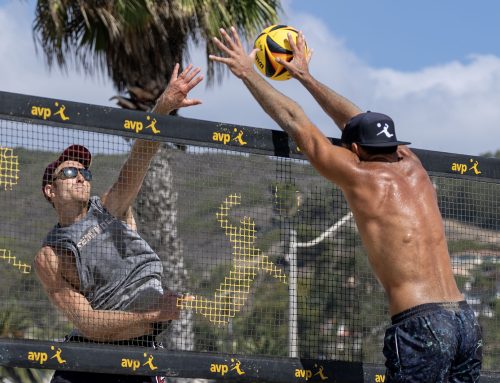
This is an excerpt from the hitting chapter in Travis Mewhirter and Gabby Reece’s new book, Volleyball for Dummies. You can order your copy on Amazon.
There is no singular path to becoming an excellent hitter in volleyball, be it indoor or beach. If you are looking for a rule, a formula, to become elite, or even passable, you will not find it here, or anywhere else, for that matter.
An example: T.J. DeFalco is 6-foot-4 – he is listed as 6’6 but you can file that in the category of generously overlisted athletes – with a long, languid arm that cracks like a whip. From a pure height perspective, he is vastly undersized, several inches below your average outside hitter at an Olympic Games. What he lacks in height he atones for in an arm swing that can be described as a sort of beautiful violence, extending back, back, back – and then, blinkandyoumissedit, suddenly it’s lashed forward and the ball is whistling by your ear and tagging the floor and it’s a point for the United States and defenses are left wondering what in the world has just happened?
He is smart, mixing speeds and tempos and angles. He hits it where you’re not, plain and simple.
Wilfredo Leon is a Cuban who won a silver medal at the 2010 World Championships, defected to Poland, then won a silver medal at the 2024 Paris Olympic Games. He is 6-foot-7 and a towering presence. His arm swing is fast, yes, but nothing like DeFalco’s. It is what is often described, in volleyball circles, as heavy. The ball simply explodes off his hand, often detonating on the poor soul in the way. He cares not where defenders stand; he often aims right for them. Where DeFalco relies on deception and varieties of speeds and locations, Leon leans on an astonishing power he knows is all but indefensible if he is not blocked.
These two players play the same position and are considered mostly equals despite the vastly different manners in which they go about accomplishing the same goal, which is to hit the ball and score a point as a result of doing so.
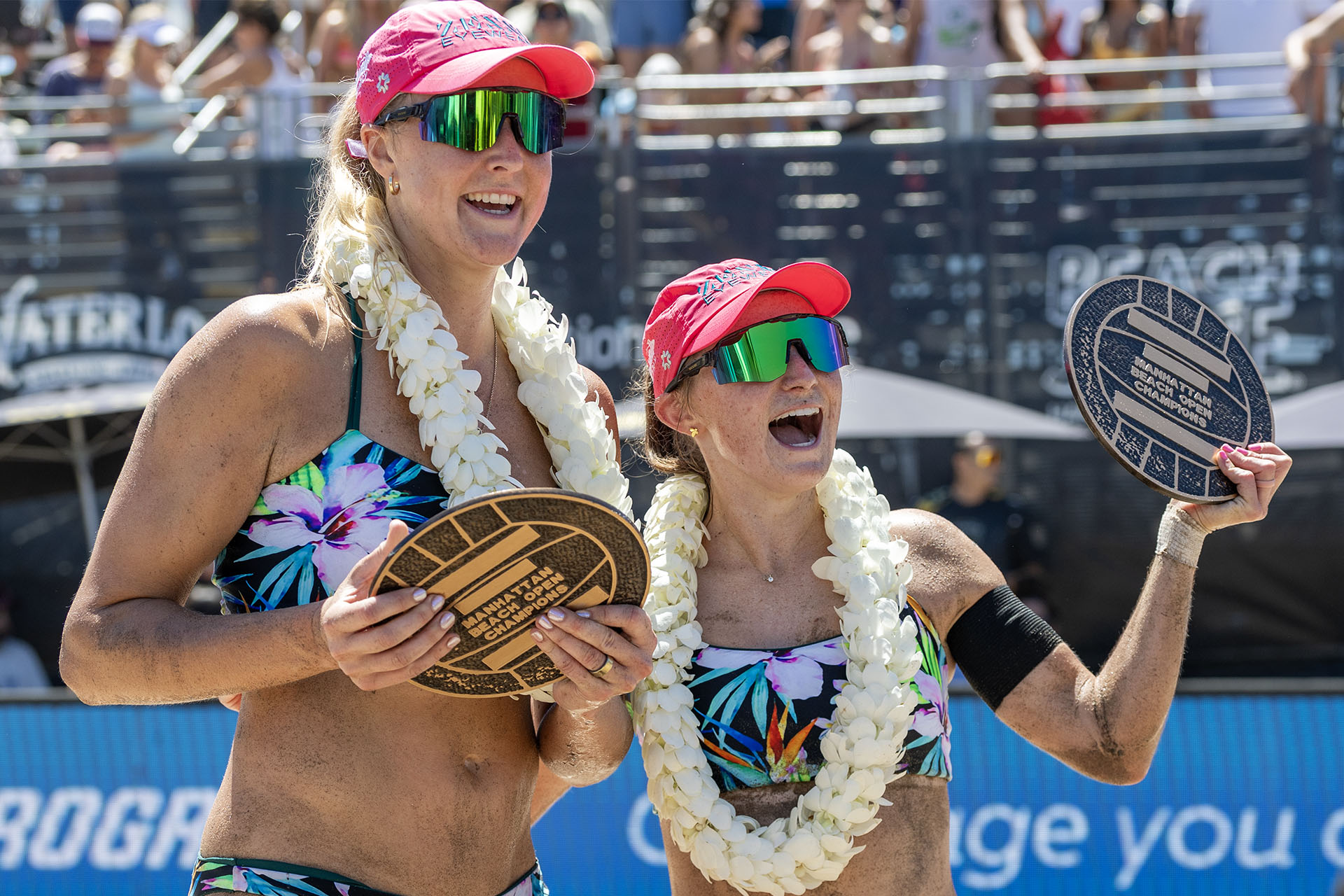
Taryn Brasher & Kristen Cruz – Photo by Rick Atwood
If you’re here for beach volleyball, allow us to provide two more contrasting success stories. Kristen Cruz is a 5-foot-6 sparkplug of a human being. When she graduated from Louisiana State University in 2021, she did so as the winningest player in the history of NCAA beach volleyball. She and her partner, Taryn Brasher – then Taryn Kloth – went straight to the Association of Volleyball Professionals (AVP) – the United States’ domestic professional tour – won their first event, in Atlanta, and did the same internationally, in Australia.
Brasher stands 6-foot-4.
Who would you rather attempt to defend: Brasher or Nuss? The 6-foot-4 bruiser or the 5-foot-6 woman who couldn’t knock over a kitten?
The answer has not been found.
As of this edition, written largely in 2025 — and it holds true now in October of 2026 — Nuss and Brasher are the No. 1 ranked team in the world. They are the sport’s most unsolvable riddle: Serve Nuss – and therefore defend her on the third contact – and you will be driven batty by a player who seems to see and know everything you’re doing before you’re doing it. She hits it where you’re not, and you wonder, with vexation and anger and frustration and much, much respect, how in the world she always seems to know where you’re not. She’s a sniper, a craftswoman. Her shots hit every line, find every gap. She is crisp in her shot placement because she must be.
So you’ve tried the sniper, and even though she cannot beat you with power, you have gotten nowhere.
It is now time to serve Brasher.
Brasher’s passing may not be as steady as Cruz’s, though such is an unfair standard: Nobody’s passing is as steady as Cruz’s. But, you hope, you’ll get some passes that are known as out of system, meaning the set is coming from locations either outside of the court or towards the back of the court or too high or too low or too tight to the net for it to be a comfortable set for Nuss to make. So even if Brasher is playing with an exquisite setter – she is – these sets are more difficult to hit, as they are more difficult to track.
This, too, matters little. Brasher is in system – the term we use for a mostly perfect pass, roughly three feet off the net, in the center of the court – on the majority of her passes. For a player her size, she has remarkable control of the ball. Like the Wilfredo Leon example above, Brasher does not worry so much about avoiding the defender or the blocker; in fact, she often seeks the hands of smaller blockers and intentionally chips it right off them. She will see defenders standing across from her and blast it in front of them. Where Cruz avoids, Brasher seeks. Where Cruz chooses peaceful shots, Brasher often chooses power.
Same result, different means.
This is all a long way of saying that, whether you are a 5-foot-6 female who wouldn’t stand out in gym class hitting lines or a 6-foot-7 male with a 40-inch vertical who could hit a ball so hard onto the floor it’ll bounce and hit the ceiling – this happens with alarming frequency with players such as Leon – there is a place for you in volleyball, be it indoor or beach.
Even better news: Whether you are 5-foot-6 or 6-foot-7, you will find success using the same principles of attacking, no matter the surface on which you’re playing.