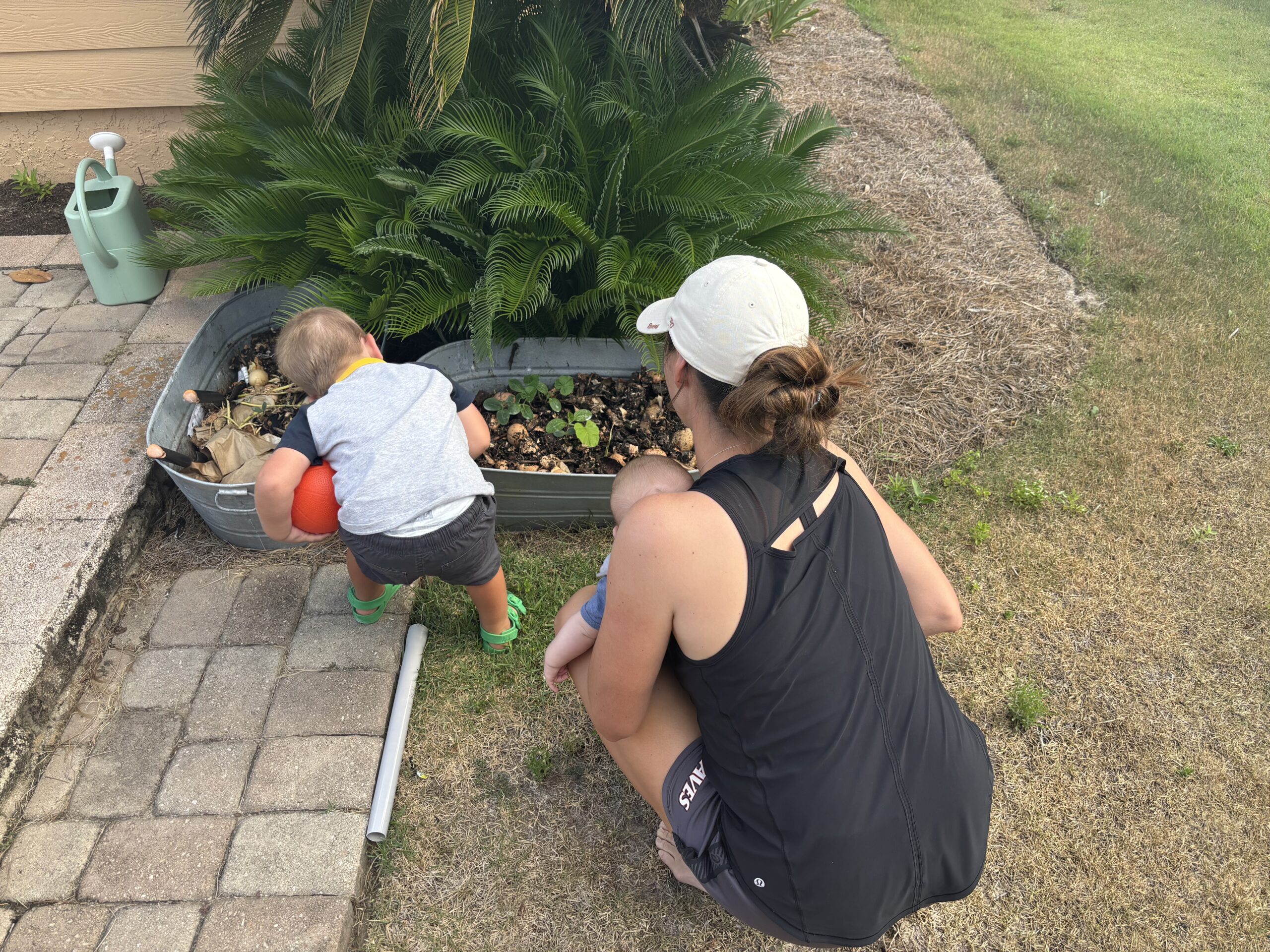
TALLAHASSEE, Florida – We ate our trash earlier this year.
My wife, Delaney, hates it when I say that — but it’s true!
In a mostly literal way. We did eat something that was, at one point, trash, and became, months later, a potato and a squash.
Such is the beauty and wonder of composting. It’s magic of the most natural sort, turning food scraps and organic waste – paper, paper towels, used coffee grounds and filters, old Trader Joe’s paper bags, all the wrapping in Amazon boxes, and more – into rich soil for our little garden.
And, yes, sometimes surprising food.
We came down one morning and, to our great surprise, there were sprouts growing out of our compost bin, right next to the compostable trash and egg shells. Turns out, it was a squash.
It became a living example of that timeless quote from Jurassic Park: “Life finds a way.”
And it did.
Right into our kitchen.

Our compost bin — and a squash sprout! Or something
Not everything that accidentally grew out of our compost would become food. Most of the transplants that we moved to the garden didn’t amount to anything other than a fun experiment. But the concept was just so dang fun: Our trash literally turned into sustenance, with essentially zero effort. We just separate our compost into one place, recycling into another, and trash into another.
Then, with the occasional stirring and turning, we let nature take over.
And, boy, does it take over.
Eating the few things that grew and thrived out of our compost was fun, and it is a delightful little story to tell. But the most amazing part, to me, is that our trash just sort of…
Disappears.
The word is biodegradable, and what we put in the compost does, indeed, degrade. But where does it go? What happens? There’s a sciency explanation for it, but again I’ll use the word magic, because that’s what it feels like: magic.
The trash just vanishes into the Tallahassee air.
Our two compost bins, whose initial use was to hold drinks for our wedding, have taken mountains of waste over the last 15 months we’ve lived in Tallahassee and allowed them to decompose into soil or be used as food for insects and rodents to the point that we’ve never once emptied it.
In 15 months!
It makes me wonder what would happen if more folks began composting. In the U.S., we throw away roughly 80 billion pounds of food each year – one-third of our total food supply. The Food and Agriculture Organization estimates this waste “contributes to 8 percent of greenhouse gases emitted, more than all U.S. animal agriculture and nearly as much as total U.S. agriculture.”
Kinda wild.
That is one of the reasons why we began composting. Shortly after we married in 2020, we made an unofficial commitment to living as naturally as we could. Our goal is to get enough land to one day make a little homestead, and every year, we try to do a few things that get us closer to that goal, be it composting or cooking almost everything or hunting for wild game or growing a few things we can eat or getting our kids outside as much as we can. More than anything we’ve done, the composting has blown my mind the most.
It’s made us wonder, too: What else can we do with our trash?
I needn’t search far to find an answer.
Just last night, three eves before Christmas, Delaney wanted to show me a project in the garage. It was homemade wrapping paper for our kids, with trees and snowflakes painted on using a cookie stencil to follow. What’d she use for the paper? All of the Amazon packaging we’d stored up from her family, with us for the holidays, shipping their packages here.
“You know,” she said, “how I like using trash.”
Indeed I do.