This is an excerpt from the serving chapter in Travis Mewhirter and Gabby Reece’s new book, Volleyball for Dummies. You can order your copy on Amazon.
Evandro Goncalves, and the power of a jump serve
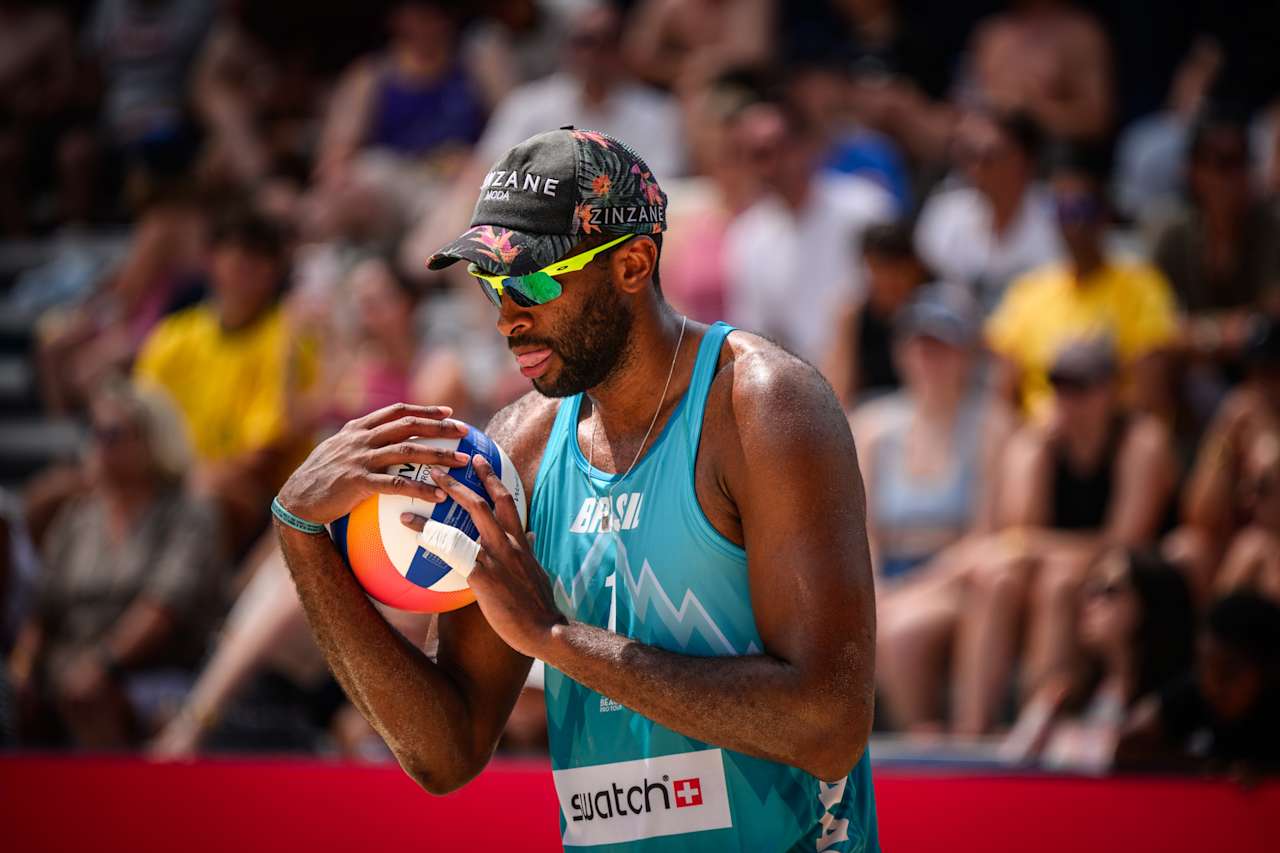
There isn’t a single individual who evokes more fear when at the service line in beach volleyball than Evandro Goncalves. From 2017 through 2025, the 6-foot-11 Brazilian was voted the Best Server in the world eight times, a record. Still only 35 at the time of this writing, he will go down as the greatest server in the history of beach volleyball, a title that will be as close to impossible to usurp as any in sports.
He did not accomplish this with the relatively safe float serve. Evandro hitting a float serve is as rare as snow in his hometown of Rio de Janeiro. He has climbed to the top of the serving Mount Rushmore using the most-feared weapon in both beach and indoor volleyball: The jump serve.
A jump serve may be the most intimidating skill in the game, even more intimidating, perhaps, than a hitter who can spike with the power of Thor. Because there is simply no avoiding Evandro, or any other elite jump server. You know, when the rotation turns their direction, the ref will hand them the ball, it will be their serve, and you will have to find a way to pass it. There is nothing you can do about it, whereas there are certain strategies and techniques that can help you avoid or mitigate hitters.
With a jump server, it’s coming – simple as that.
But if a recent study on serving conclude that movement is the most reliable source of out-of-system passes, what makes a jump serve so dangerous?
In a word, power.
A jump serve, where a hitter is essentially setting themselves from the end line and hitting it as they would a set while they are on offense, is the highest-velocity serve a player can hit. Statistically speaking, when a player can bring enough power and pace with their jump serve, it has the highest probability of producing an ace, which is the quickest manner to score a point.
As an example: During a tournament in Recife, Brazil, in 2024, Evandro hit 37 aces en route to a gold medal with his partner, Arthur Lanci – more than the next three best servers combined. This doesn’t take into account out of system passes produced, either, where Evandro’s serve led to excellent opportunities to score defensively.
At the 2025 World Championships in Adelaide, Australia, Evandro again led the field in aces, despite finishing fifth and playing two less matches than the four teams who advanced into the semifinals.
If you can hit a jump serve with enough pace and power, there is no more threatening tool.
But it does not come without its risks.
Just ask John Speraw.
Live by the (jump serve) sword, die by the (jump serve) sword
With the score tied 17-17 in the third set of the 2018 National Championship, one that pitted UCLA vs. top-seeded Long Beach State and a glut of future Olympians, a 6-foot-4 Bruin junior from Holbrook, New York named Dylan Missry had the ball in his hands.
Already, it was serving that had been the theme for UCLA, which won the second set primarily due to just that: serving.
In particular, jump serving.
To be even more precise: Dylan Missry’s jump serve.
This was no surprise to those who had followed the Bruins and their head coach, John Speraw, who also doubled as the head coach of the United States men’s National Team. Risky serving is what he had preached in Westwood since he was hired back to his alma mater in 2012, and what he had espoused to the American men since he was promoted to head coach in 2013.
It had led the Bruins to the championship, after all. And it had led the American men to a 2014 FIVB World League Gold Medal, a 2015 FIVB World Cup victory, and a 2016 Olympic bronze medal.
Serving was the sword he had chosen to live by.
It was the same sword they had accepted to occasionally die by.
At the moment, he and his Bruins were living quite nicely.
Because there was Missry, bombing one jump serve after the next, igniting a 6-0 run that put the Bruins up a comfortable 22-17, all but sealing the set.
“Boy,” said Paul Sunderland on the commentary, “did he do his job.”
The question being asked of the Bruins: Could they sustain it?
Half an hour later, the score tied 20-20, the Bruins were five points away from being crowned National Champions.
They missed a serve into the net.
At 21-21, they missed another serve into the net.
At 22-22, they missed a serve long.
“It should be in, it must be in,” Sunderland said. “This is way too many free points in this situation, UCLA donating to Long Beach State.”
At 23-23, with Missry, the most dangerous server in the country on that night, at the line, UCLA gifted another point to Long Beach via a missed serve into the net.
Three points later, Long Beach sealed up the fourth with an ace of their own, a hooking jump serve from Josh Tuaniga.
Twenty minutes later, Long Beach won their first National Championship in 27 years.
Such is the dichotomous nature of the jump serve: It can propel you to greatness, onto the very doorsteps of a National Championship – and it can be your most inconsistent weapon, donating, as Sunderland said, four straight points in the most critical juncture of a season.