ADELAIDE, Australia – There was always going to be a wrench.
Sweden, for the second time in as many years, is that wrench.
A year ago, David Ahman and Jonatan Hellvig, the No. 1 ranked team in the world, with four straight victories and five finals made in 2024, inexplicably lost twice in pool play at the Paris Olympic Games. Granted, their pool was the Pool of Death at the time — as it was here in Adelaide — but still: They had been on a 17-match winning streak. To lose two in a row was unthinkable.
Of course, you know how the story played out from there: They resumed their unbeatable form, knocking off Cuba’s Jorge Alayo and Noslen Diaz, Brazil’s Evandro and Arthur, Qatar’s Cherif Younousse and Ahmed Tijan, and, for gold, Germany’s Clemens Wickler and Nils Ehlers.
Pool play was a blip.
A warm-up.
Now here we are again, in the biggest event of the calendar year, the 2025 Beach Volleyball World Championships, and Sweden has stumbled in pool play. As they did in Paris, they lost twice here in Adelaide, first to Brazil’s Andre and Renato, then to Brazil’s George and Saymon. The losses dropped them to the three seed out of the Pool of Death, and while they have not been the juggernaut they were heading into Paris, they’re still Sweden, still 30-11 coming into the World Champs with a gold medal in Ostrava and seven top-five finishes. Now, rather than Cuba, it is Poland’s Bartosz Losiak and Michal Bryl on the other end of the land mine of a draw, setting up the No. 5 seed vs. the No. 3 in the first round of playoffs.
They’ve played each other twice this year, once in a controversial semifinal in Ostrava, and again in Hamburg, where Bryl and Losiak won their first match against Ahman and Hellvig. And they’ve played each other in World Championships before — only in 2023, it was the semifinals, an 11-21, 22-20, 16-18 heartstopper that sent Sweden into the finals and Poland to bronze, where they won.
It all begs the question: Can Sweden do as they did in Paris and bounce back from a pair of pool play losses to win?
There is precedent for a two-loss team to win the World Championships. Just two years ago, the Czech Republic’s Ondrej Perusic and David Schweiner lost matches to Cuba and Evandro and Arthur before rallying to win the next five, taking out the one (Anders Mol and Christian Sorum) and two (Sweden) in the process.
But in the 14 previous World Championships leading into Adelaide, that is the only time a World Champion has lost multiple matches. Only four of the 14 World Champs have finished with a loss on the ledger, including, even Marcio and Fabio, when the 2005 edition of the tournament, in Berlin, was held in a double-elimination format and they lost, of all matches, their first.
Nine wins later, they were World Champs.
Sweden will not have to win nine, but they will have to find a way to win five in a row, something they have done just once all year.
Sweden’s struggles, meanwhile, made for Brazilian success. George and Saymon topped the Pool of Death, no small achievement, while their countrymen and my faithful Dark Horse, Andre and Renato, took the second spot. In what has been a down year for the Brazilian men, pool play has been a smashing success, as Evandro and Arthur finished 3-0 and tops in their pool as well.
Catch all the World Champs action on VBTV for 10 percent off using SANDCAST10
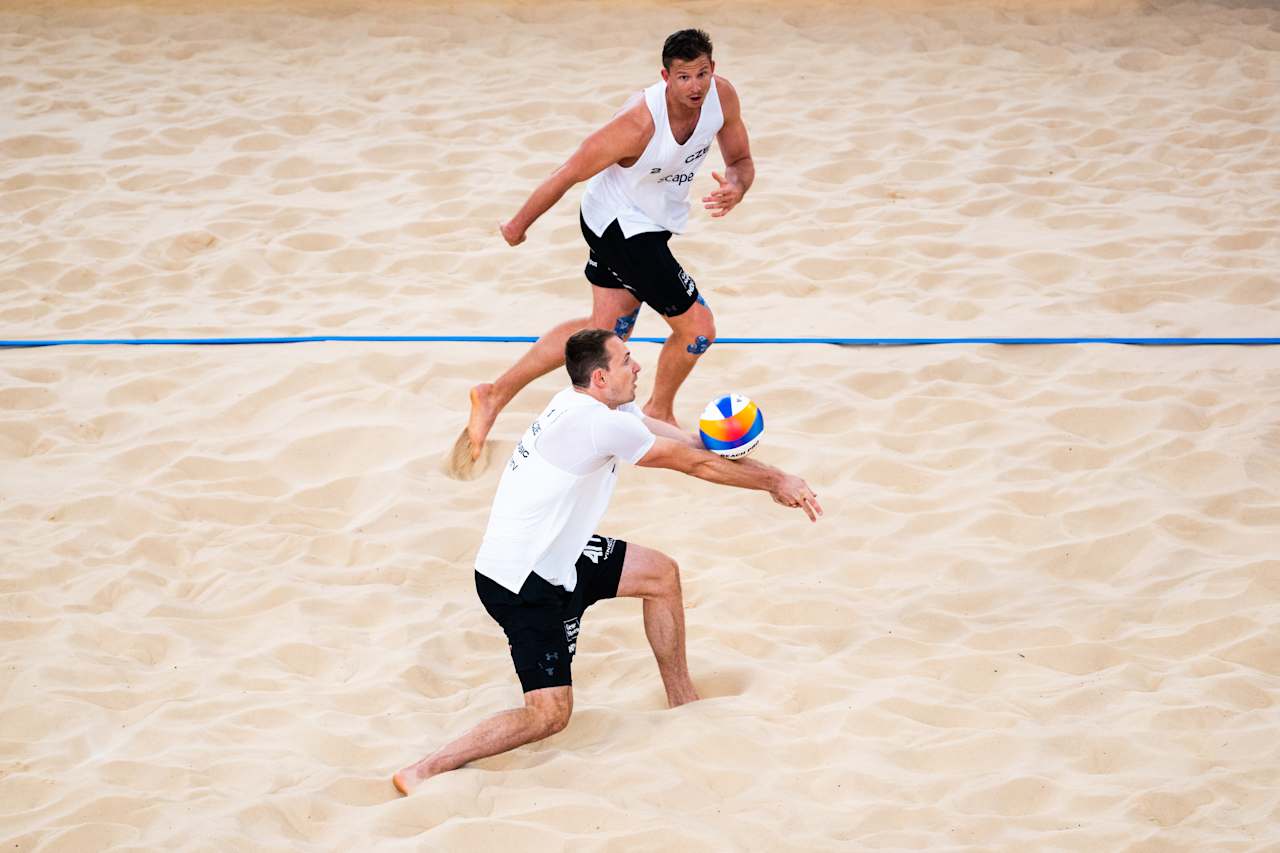
Ondrej Perusic and David Schweiner are 3-0/Volleyball World photo
Ondrej Perusic, David Schweiner off to smooth title defense
Speaking of those 2023 World Champions, Ondrej Perusic and David Schweiner, they had a much better start to these World Champs than they did in the year they won it. Perusic and Schweiner went 3-0, dropping only a single set, to Andy Benesh and Miles Partain, in an eventual 15-9 third-set victory.
As a team, they are siding out an absurd 80 percent, a whopping 34 percent better than their opponents. Schweiner is nearly doubling up their opponents’ blocks while they have hit 30 percent fewer errors.
It doesn’t get cleaner than that.
USA men all break pool despite Civil War
It was a shaky start for the USA men at these World Championships. Chaim Schalk and James Shaw were upset on the opening day by the 40th-seeded Australians, Jack Pearse and D’Artagnan Potts. One day later, Andy Benesh and Miles Partain were swept by Latvia’s Martins Plavins and Kristians Fokerots.
The one piece of consistency was Chase Budinger and Miles Evans, who used a six-point run to sweep Ruben Penninga and Matthew Immers of the Netherlands, which they parlayed into another sweep over Pearse and Potts and guaranteed themselves a berth into the round of 32.
In the final two days of pool, however, Schalk and Shaw swept Immers and Penninga and topped Budinger and Evans, making it a one-two finish for USA Volleyball in Pool I. Meanwhile, Benesh and Partain became the only team to claim a set off Perusic and Schweiner and expectedly smashed Togo by a combined 22 points, giving them a friendly point differential.
It only gets more difficult from here, but for now, the USA has all three of its lives left.
Evans and Budinger have a favorable draw, against Portugal’s Joao Pedrosa and Hugo Campos, an up-and-down duo who needed a comeback to beat Benin — and then nearly beat Cuba the next day. Schalk and Shaw will play Argentina’s Nico Capogrosso and Tomas Capogrosso — more on them below — who are coming off a convincing sweep over Germany’s Nils Ehlers and Clemens Wickler to win pool. And Benesh and Partain have the toughest draw of the lot, earning a bout against Cuba, whom they’re 2-1 against but will doubtless come in as heavy underdogs.
Argentina’s Capogrosso Brothers finish pool play unscathed
Maybe it’s not a surprise to you that Nicolas Capogrosso and Tomas Capogrosso claimed the top spot of Pool K, seeing as they were the highest-seeded team in the pool.
Still, right or wrong, I look at a win over Germany’s Nils Ehlers and Clemens Wickler as an upset, especially given the recent trajectory of Argentina. Coming into Adelaide, they had taken three consecutive 13th-place finishes, and hadn’t logged a notable win since the Montreal Elite in August.
But they are playing well, showing flashes of the team who made the finals in Quintana Roo to open the season.
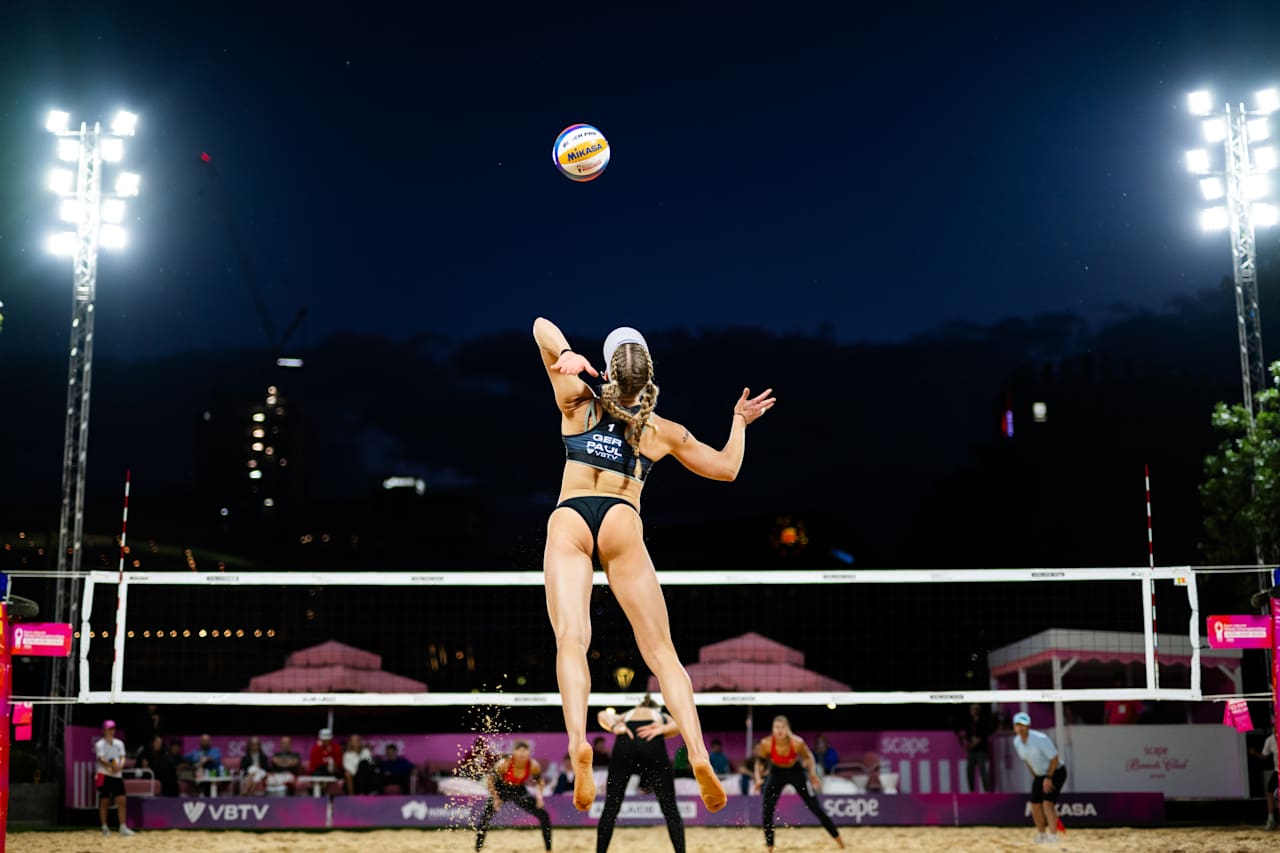
Melanie Paul hits a jump serve at the World Championships/Volleyball World photo
German women on a tour de force in Beach Volleyball World Championships
In the leadup to these World Championships, all the attention from my end was on the USA-Brazil rivalry. Six of the top seven teams in the tournament are from either the USA or Brazil, both of whom have expectedly held up their ends of the bargain through pool play, and whom I’ll get to shortly.
But going a little under the radar were the German women, who sent the maximum four teams to Adelaide and will be sending all four straight into the round of 32.
It was easily anticipated that the two German pairs in Pool H – Linda Bock and Louisa Lippmann, Cinja Tillmann and Svenja Muller – would go 1-2 in their pool, although Bock and Lippmann winning it no doubt turned a few heads. And it is not a huge surprise that Sandra Ittlinger and Anna Grune took second in Pool D, behind only Terese Cannon and Megan Kraft.
But how about the sensational rookie performances being put on by Melanie Paul and Lea Kunst?
The No. 36 seed who needed a wild card to get into the event have been phenomenal, albeit in an admittedly weak pool, knocking off a strong Chinese team in Xinyi Xia and Xu Yan, winning a youthful battle against Switzerland’s Annique Niederhauser and Leona Kernen, and dominating a third set against Taliqua Clancy and Jana Milutinovic, all in three sets.
The German federation is quickly becoming one of the deepest in the world.
As for the deepest, however, USA and Brazil would no doubt like a word.
USA, Brazil coast through pool play
It has almost been easy to forget that Kristen Nuss and Taryn Brasher are even here in Adelaide, so quick have their matches been. Only twice has a team scored more than 15 points in a set, the same number as Duda and Ana Patricia, and one more than allowed by Brazil’s Carol and Rebecca, who have been positively dominant.
All but one pool that featured a team from the USA or Brazil was won by either the USA or Brazil, while Pool G had Kelly Cheng and Molly Shaw finish second, which doesn’t really matter anyway. They’ll begin in the round of 32 whether they won or lost a match, so their loss to Spain’s Dani Alvarez and Tania Moreno, while a nice win for Dani and Tania, was mostly inconsequential.
While we’re on the topic of inconsequential: I can write this while Julia Donlin and Lexy Denaburg are playing Italy’s Valentina Gottardi and Reka Orsi Toth in the final round of pool.
Why?
Because it didn’t matter to Donlin and Denaburg.
They won twice and were guaranteed to be either first or second in pool, which means, regardless of result, they were going to begin playoffs in the round of 32. They wound up losing, 21-16, 21-12, but at the end of the day, it didn’t matter one bit. The loss pits Donlin and Denaburg against undefeated Anouk Verge-Depre and Zoe Verge-Depre, while the win vaulted Gottardi and Orsi Toth to the one seed and… a matchup against Germany’s Cinja Tillmann and Svenja Muller, a team three seeds ahead of the Verge-Depres who are coming off a gold medal in Cape Town.
The meaninglessness of pool play has reached new heights
The number of completely meaningless matches in this tournament, the biggest of the year, is mind-boggling.
Twice on Monday, a day that should be a day full of meaning and consequence, I commentated two matches that didn’t matter a lick, because win or lose, the two teams on court would begin the playoffs in the same position. There were no consequences to losing, no benefit to winning, and therefore no reason, other than pride and entertainment, for the players to try and fans to tune in, respectively. Those who prefer pool play will say that winning pool will give you a better seed — this, as shown above with Italy vs. Germany and Poland vs. Sweden, is not true in the least — but we also have a seeding process for these tournaments.
It’s called the Beach Pro Tour.
There is a season of four-dozen-plus tournaments that will properly seed the field so we can get straight into the playoff rounds without the waste of time that is pool play.
The format is criminally absurd, a waste of time in more than half of the pools, and that’s before we even get into the ridiculous, calculator-inducing tiebreaking format that leaves fans, staffers, and even players and coaches wondering who is moving on to where and why.
The 2005 World Championships in Berlin featured a double elimination that is as easy to understand as tomorrow’s sunrise, with meaning and consequences on every match.
It’s time we go back.