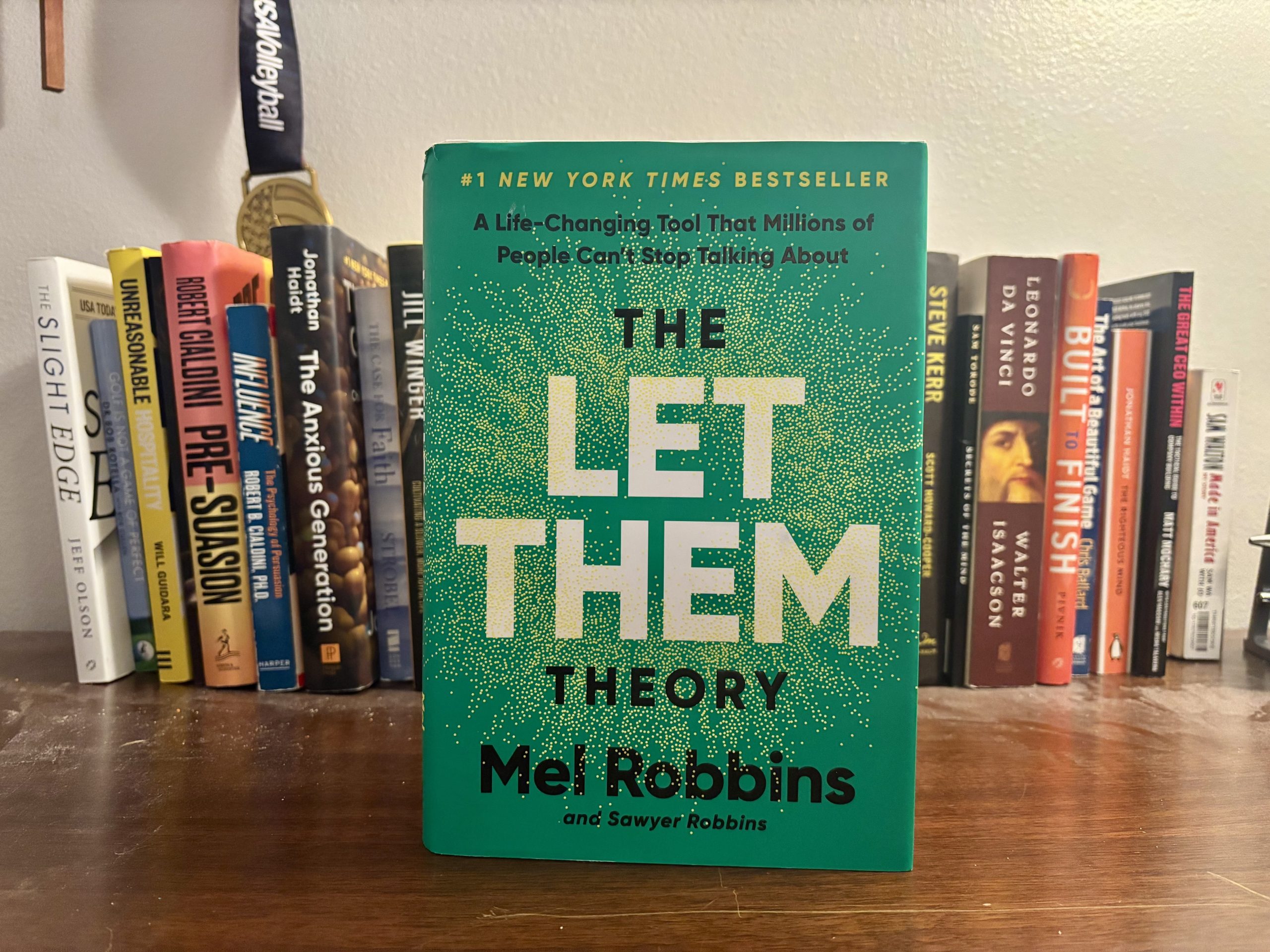
I saw Mel Robbins’ Let Them Theory everywhere I went.
Saw it in airplanes and at the airport, bookstores and on campus at Florida State, in restaurants and lobbies of hotels. I saw it on the bus as we were traveling to LSU in 2025, when one of our associate athletic directors was paging through it.
The Let Them Theory was lifechanging, she said. She’d recommend it to everyone she knew, and wished she had read it earlier. I respect her a great deal, and within minutes, The Let Them Theory was on my Goodreads to-read list.
In 2026, I finally got around to it.
It was…OK.
Maybe less than OK.
It’s possible, probable, even, that I simply read the book at the wrong time. The timing of when we read books is almost as important as the content of the book itself. It is adjacent to Mark Manson’s The Subtle Art of Not Giving A F***, which is one of the most impactful books I’ve ever read. I also read that when I was in my mid-20s — exactly when I needed a book like The Subtle Art.
I picked up The Let Them Theory nearly 10 years later, when I’d already absorbed and applied many of the lessons in the book – because they were mostly a more delicate, polite phrasing of what Manson wrote in The Subtle Art.
But, like any book, good or otherwise, I still took quite a bit away from The Let Them Theory. More than I initially thought, to be honest. As I flipped through the pages and transcribed the notes you’ll find below, there were still many powerful takeaways that made it, in retrospect, a worthwhile read.
If you want to order the Let Them Theory on Amazon, here’s the link.
My most powerful takeaways from The Let Them Theory
On the power of action
Page 4: The 5 second rule taught me that action is the answer. Thinking about your problems will never solve them. Waiting around to feel like doing something means you’ll never do it.
Page 10: Through action, I have achieved some extraordinary things, and so can you.
On self-confidence
Page 9: Did you know that high-fiving yourself in the mirror is one of the fastest ways to rewire your mindset for self-confidence?
On controlling only what you can control
Page 18-19: The truth is, other people hold no real power over you unless you give it to them. Here’s why this works: When you stop trying to control things that aren’t yours to control, you stop wasting your energy. You reclaim your time, your peace of mind, and your focus. You realize that your happiness is tied to your actions, not someone else’s behavior, opinions, or mood.
Page 56: I said let them to myself instead. The effect was immediate. I softened. Did it speed up the cashier? Nope. It did something better. It protected me from this habit of letting little things become big stressors in my day-to-day life. The 10 extra minutes that this line was going to take wouldn’t negatively impact the rest of my day, but allowing myself to get agitated and annoyed about something I couldn’t control absolutely would. Why get stressed out about things beyond your control or that don’t really matter? How does something so small have such a large impact on you?
When you let the world around you impact your emotional state and peace of mind, you become a prisoner to these external forces. You’re letting trivial nonsense dictate your mood, drain your motivation and steal your focus. There’s this famous quote about life from Greek philosopher Epictetus: ‘It’s not what happens to you, but how you react to it that matters.’
Page 62: How cool is it that you don’t have to live your life feeling like everything happening around you has to stress you out? How amazing is it that other people’s behavior doesn’t have to be a huge problem in your life?
Page 65: When you let other people stress you out, you surrender your power to things that either don’t matter or are beyond your control. And it often spirals into other areas of your life for hours, weeks, and even years. If you want to achieve your goals, be more present, feel more confident, and be happier, you must stop allowing other people to stress you out. In life, there will be things you can control, and things you can’t. There will be situations that are fair, and situations that are not. You get to decide what stresses you out and for how long.
Page 80: What if you gave yourself permission to live your life, and you gave other people permission to think about whatever they want about it? What if you pour your time and energy into your hobbies, your habits, your happiness?
On focusing your energy
Page 62: No more rage texts, or snapping at your loved ones, or wasting hours crafting an email at work. The fact is, not every email warrants a response and not every conversation needs your participation – and you do not always have to have the last word. And as the famous saying goes: ‘Your silence can’t be misquoted.’ You’ll start to see that a lot of what used to set you off isn’t worth your time and energy, and the less you react to the things around you, the more in control you feel.
Page 74: And if it doesn’t matter enough for you to get involved, then stop complaining about it. It just stresses you out. And as you are learning, that’s dumb. Talk is cheap. If it really bothers you, dedicate some time and energy to changing it.
On assuming people will think negatively about you
Page 86: Instead of fearing other people’s opinions, you are just going to allow them to think what they want. In fact, I recommend that you assume people will think negative thoughts about you. Because people do have negative thoughts about you. This is normal.