In the wake of my most recent — and surprising — professional beach volleyball tournament, a seventh at the Laguna Beach Open, a fan on Instagram said that I have some crazy tics, that my pre-serve routine was giving him anxiety.
This was amusing to me. Because what gave him anxiety does the exact opposite for me: My three-step pre-serve receive routine — line shake, sand toss on the forearms, hat adjustment — is a complete and total antidote to any anxiety and nerves I feel when competing.
It’s a tranquilizer, a focusing agent, dare I say a superpower.
Some history.
I’m a golfer.
Golf was my best sport growing up, and anybody who has ever watched a golf tournament will know: We’re a neurotic, routine-crazed bunch. If you’ve ever watched Bryan Harman waggle, and waggle, and waggle some more, or Max Homa stare over a putt, or Keegan Bradley twitch and twirl and step, or Jason Dufner shuffle his feet and walk in and out of address — you’ll know golfers can be quite odd in their mini dances prior to every shot.
But it isn’t just golf.
Basketball players often have elaborate, unique free throw routines — I will never forget Jason Kidd blowing a kiss — swimmers have their own distinct routines both before and on top of the blocks — Michael Phelps’ arm slaps, anyone? — tennis players will bounce and bounce and bounce some more prior to serving, and their opponents will do similar dances prior to receiving said serves.
Routines are an invariable part of sports.
Mine, prior to receiving serve in beach volleyball, is no different than any of the above athletes: It is distinctly mine, and do an outside viewer might seem quite strange.
The first step of the routine is one I actually stole from Katie Spieler: The line shake.
In 2019, Katie and my wife, Delaney, upset Jace Pardon and Karissa Cook in the second round of the AVP Manhattan Beach Open. It was a huge win then, as Pardon and Cook were just a few months off winning an AVP in Austin, Texas. One thing I noticed is that, between every point, Katie would go to the end line, pick it up, and shake off the sand — even if there were no sand to shake off. She did this so routinely that she was heckled a bit for being OCD.
Afterwards, I asked her why she did this, and she said that having a physical practice to separate one point from the next was helpful for her. I liked it, and took note. I don’t know when I began to incorporate it into my routine, but I’ve been doing it for as long as I can really remember.
But having something physical to separate points is only the baseline benefit to me.
Just as critical is this: It takes time.
I’m an undersized blocker. For the majority of my career, I was the target in serve receive, while also serving and running up to block. The physical demands of that are considerable. Any legal way I could get a few extra seconds between points, I would. When you establish something as part of your routine, referees generally let you have it, so long as you don’t get carried away. Even then, at worst, you’ll get a yellow card, which come with zero punishment. This is why so many teams will hug in between points, no matter the result: It slows things down and gives them a few seconds to breathe and gather themselves.
So I find the end line, I breathe, I shake out the sand.
I recenter myself.
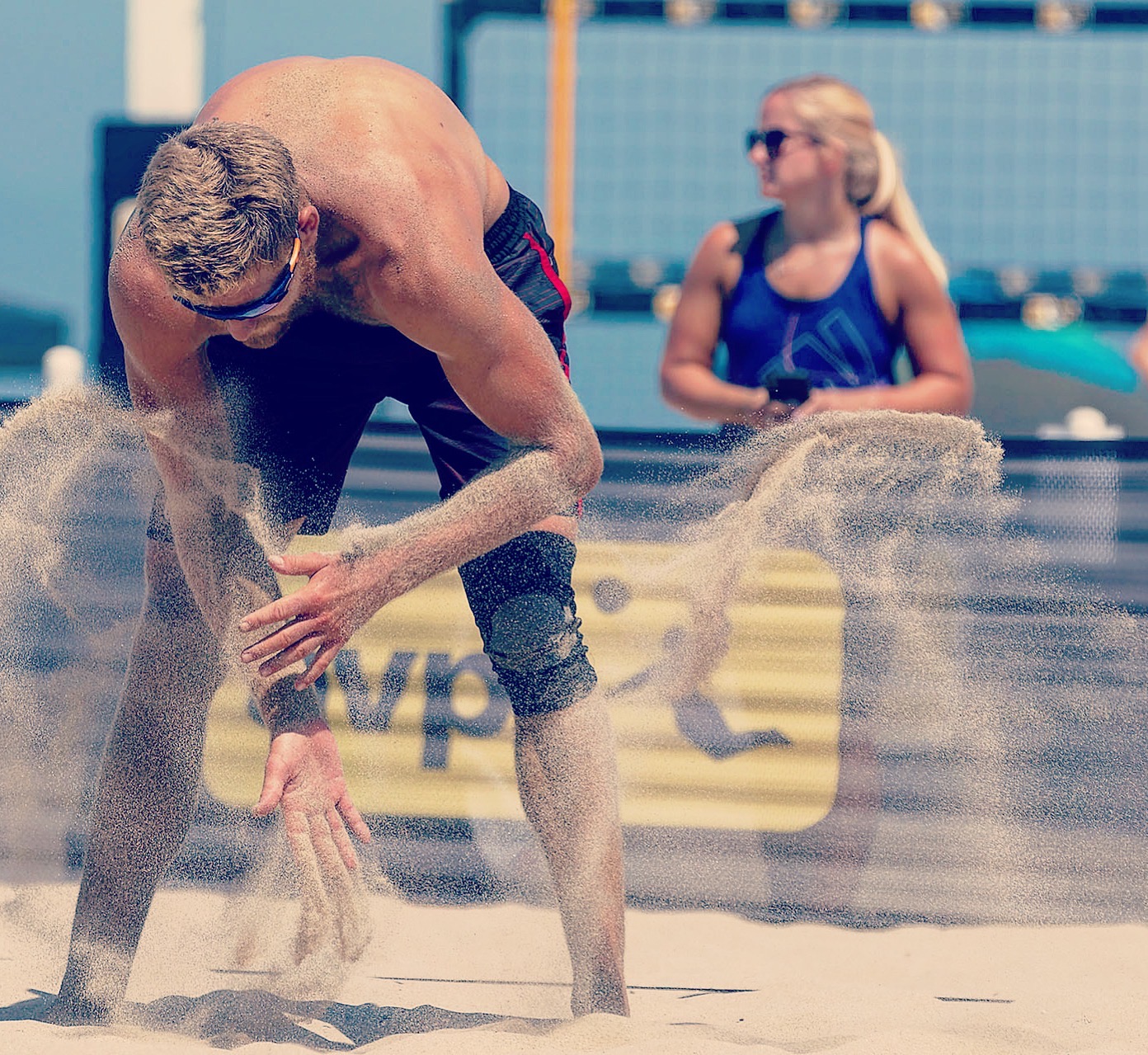
Travis Mewhirter rubs sand on his forearms/Ed Chan, VBshots.com
Then comes No. 2: I toss sand on my arms.
This is actually just a practical solution to a legitimate problem: I sweat. A lot.
The number of times I would pass a ball, only to have it slip through my partner’s hands, is too high to recall. Somewhere along the lines, someone suggested I toss sand on my arms so less sweat would slick up the ball. Once I started doing it, I never stopped.
Again, though, it also takes some time, and throughout the sand tossing process, I’m breathing, slowing my heart rate down, and refocusing my mind on the point to come, not on the point that just was.
Alas, to No. 3: I adjust my hat.
Again, mostly a practical solution to something that happens throughout a point: Between running and jumping and twisting and diving and setting and hitting and blocking, my hat and sunglasses invariably move throughout a rally. So I just move them back to a comfortable position, sometimes I’ll take off my glasses and give them a wipe, and I am then ready to receive serve.
Are all of these things necessary? No, but they work for me.
And what works for me might not — probably won’t, to be honest — work for you. That’s why every NBA player has a different free throw routine and every golfer will waggle and shuffle in a different manner and every tennis player will bounce and hop in their own way and every swimmer will do their own thing on the blocks.
Is a routine necessary? Maybe not necessary, but in most cases, I find them to be exceptionally useful. In sports, there are nearly infinite number of variables that are outside of our control. What we do in between and prior to every point is in our control.
And when we control what we can, that’s the antidote to anxiety — not the source of it.