HERMOSA BEACH, California – In 2022, I was finally getting good at beach volleyball.
It was the first year I walked onto the court, any court, and knew I could beat whoever was on the other side.
This was different from years past, when I’d match up against, say, Billy Allen and Ryan Doherty, or Casey Patterson and Chase Budinger, or Tri Bourne and Trevor Crabb, and my only real goal, to be honest, was to keep it competitive and not embarrass myself.
Finally, in 2022, I knew I could win, and there are a few bullet points on my admittedly small resume that proved as such.
And then, for the most part, I stopped playing.
It’s been sort of a running joke since then that I “retired” – a term I use loosely – when, four years after making my first main draw, I was alas in a position to turn the corner and be a legitimate presence on both the AVP and Beach Pro Tour. Had I continued the trajectory I was on, I have no doubt I’d have reached a level of being in and out of Elite main draws, and regularly contending for Challenge medals and in AVP quarterfinals and beyond.
The question I’ve been asked on occasion since is why.
Why stop when all the work I’d put in since I first picked up a ball in 2014 was beginning to bear its fruits?
The answer is simple: I no longer wanted to.
A once smoldering competitive furnace had gone out.
No longer did I wake up with a ravenous appetite for practice and improvement. Somewhere between 2022 and 2023, practices became a chore. I grudgingly went through my lifts. Film, which I once devoured as readily as I did steak and potatoes and something I credit as much to my expedited learning curve as physically practicing, was put on the backburner.
And that, in a paragraph, is the difference between good and great, great and world class, world class and Olympic medalist.
To be truly great is to be unreasonably obsessive with your craft.
It’s to be misunderstood.
It’s to put in work when most don’t, because you don’t see it as work. You see it as play, as something you choose to do in your free time as much as others might read a book on the beach or hit the bars at night or laze on the couch. Hitting hundreds of high lines by yourself at sunset to find just the right snap on the ball is a thrill.
You do it because doing the work is the very oxygen you breathe.
For eight years, I was unreasonably obsessive with squeezing every drop of potential I had out of my athletic abilities on a beach volleyball court. This is no different to how unreasonably obsessive I have been, for as long as I can remember, with being a writer.
What was hard for most – waking up early, practicing even when I was sore, studying film, lifting, picking the brains of the best players in the world – was easy for me. Generally speaking, that’s a reliable path to being great at whatever it is you’re chasing: Pursue a craft that is easy for you but difficult for others.
Almost overnight, that changed.
Can’t really tell you why.
What I can tell you is that it made all the difference.
I knew it as soon as it happened, because I’d felt it before.
My best sport growing up was golf.
I picked it up in the summer of my eighth-grade year and was so obsessive that I made varsity as a freshman a few months later. Six days a week during the summer months, I’d get dropped off at the course in the morning and stay until it was dark. We didn’t lose a single match in my final three years, winning our county, conference and district championship all four. In the span of five years, I went from a novice picking up a club for the first time to a scratch golfer, captain and MVP of an historically great high school team with the longest winning streak in Maryland high school history (one extended, I feel obliged to point out, by my younger brother).
The difference between a scratch golfer and a professional is at once infinitesimally small and monumentally vast. It is a cliché in sports to describe matters as a game of inches, but cliches are cliches because they are invariably true.
To close the gap on those metaphorical inches on a golf course requires hour upon lonely hour at the range and putting green – putting, putting, putting, chipping, chipping, chipping, wedge after wedge. Once you’re a scratch golfer, a thousand extra hours might earn you, on average, a stroke or two per 18 holes. In a story I once read on the transcendent golfer Michelle Wie, she told a reporter, who was watching her practice, that she wasn’t hitting putts that afternoon to see the improvement the next day.
She’d see the putts fall five years from then.
That is an enormous investment with no guarantee.
For me, that investment became monotonous and dull.
The desire to close the gap, to improve, improve, improve, had gone out.
Beach volleyball is no different.
People will often ask what the difference is between, say, Taylor Crabb and Andy Benesh, and a lower main draw or upper qualifier team. To make a main draw on the AVP or Beach Pro Tour is no small feat. One must be talented, elite to the point that they have proven themselves superior to the level below them, which is a considerable level of quality. Those teams will often come close to the top-ranked pairs, regularly getting to 21-19, occasionally even stealing a set.
They almost never win, and they literally never win a tournament.
The difference comes down to obsession, nuance, a finetuning of details overlooked.
To talk with Benesh about blocking is to talk hand shape, positioning, timing – small, infinitesimal aspects few consider but over which the greats obsess. To talk with Crabb is to listen to a 6-foot runt in a world of giants who plays six, sometimes seven days a week. He’ll play fours and sixes, against professionals and 70-year-old foul-mouthed men, with his coach or his fiancé, always finding something he can add to his game, no matter the setting.
Those small obsessions, the tiny improvements, are richly rewarding for the true greats.
It is play for them, not the dull monotony of the average player.
And to make those tiny improvements, the fractions that separate 21-19 from 19-21, requires an extraordinary amount of work that might not pan out for a year, two years, three years, maybe more, as Wie explained. That requires an extraordinary amount of faith, belief, and perseverance, to the point where you might be considered delusional by others, and often yourself.
It is why so few get to the top level.
It is why I know I never would.
I knew better than to kid myself.
I knew my competitive furnace had been reduced to a small ember, and I’d have been wasting my time pretending I could compete at the highest level, against the obsessives who were putting in the work I no longer wanted to do and therefore, soon, no longer would.
With an infant at home, time – and the expense of flying to tournaments – suddenly became more precious than it ever had. My obsessive nature had changed its sights – onto my nascent career in coaching, parenting, being a better husband, a man of faith, and storytelling.
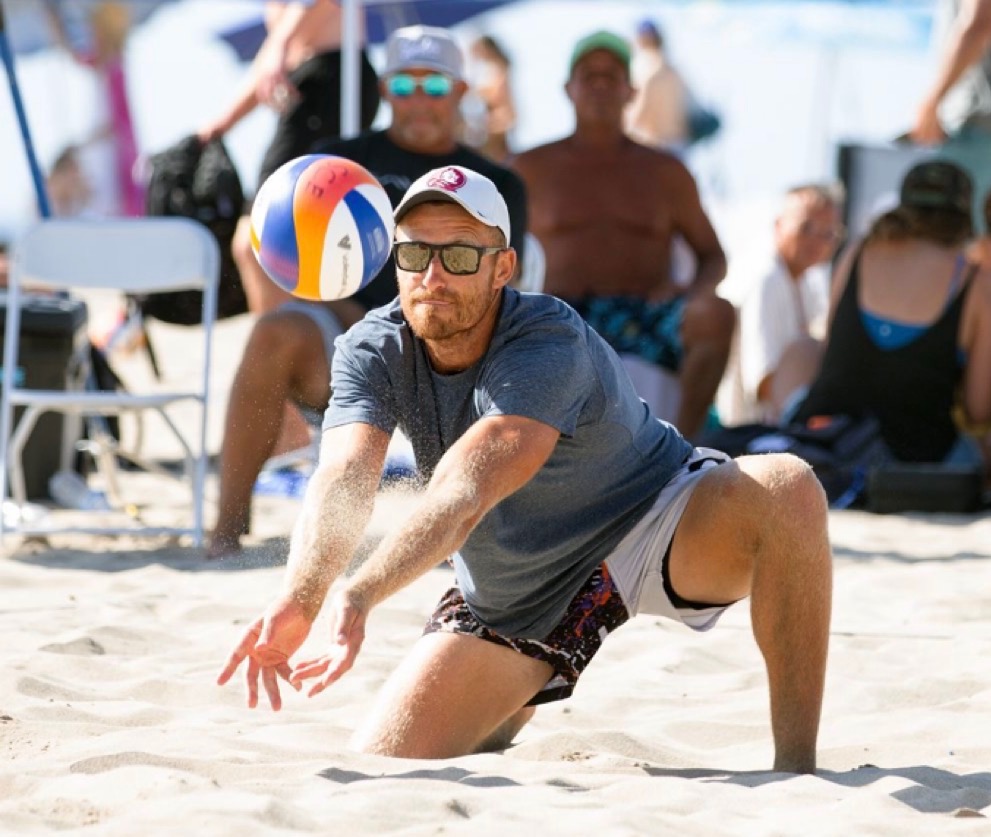
This year’s Hermosa Open, during a win that moved us onto Saturday/Andy J. Gordon photo
I still do enjoy scratching my competitive itch, once a year or so, mostly at the Hermosa Open. It felt nice to scratch it again this weekend with Cody Caldwell, a wonderful friend who helped us to a respectable 13th place finish which, aside from my fifth in Hermosa two years ago with Andy Benesh, is my best in a 32-team main draw, even when I was playing professionally full-time (Another topic for another day: How teaching, in my case via coaching and commentating, is the most effective way to learn).
A handful of fans in attendance asked if I wanted to make a comeback, seeing as I am still young in beach volleyball terms and am mostly playing at the same level, in some ways even better, than I was when I stopped playing full time.
I smiled, as it was certainly lovely to think so for a moment or two. But the answer was an easy no.
There are other gaps between good and great I’d like to close, other obsessions I have, other tasks that are now easy for me and difficult for others.
And that makes all the difference.